






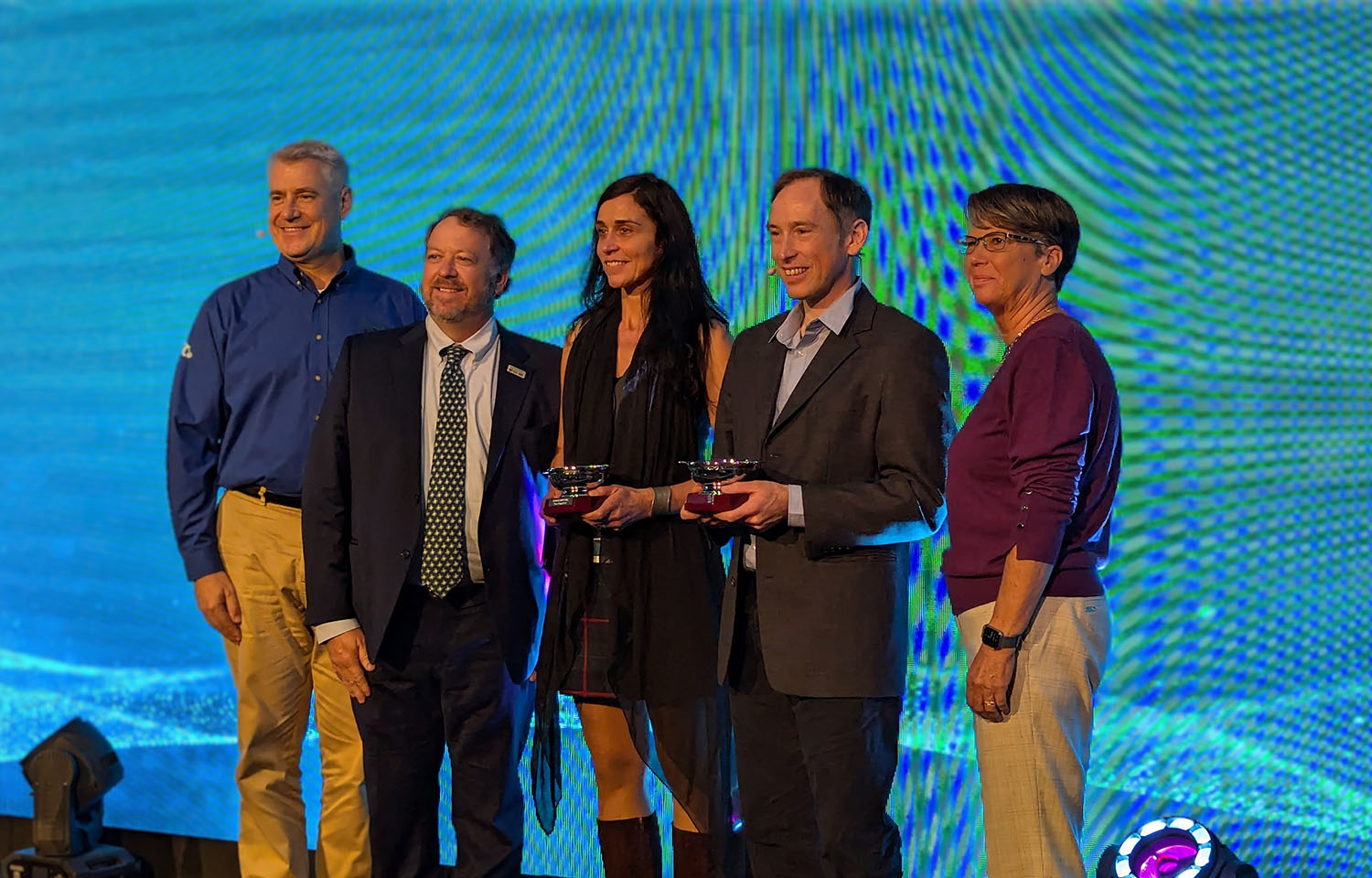
GenusWave’s targeted acoustic startle technology and Tiny Fish’s new method of utilizing salmon smolt that were previously euthanized and discarded have won the Global Seafood Alliance’s 2024 Responsible Seafood Innovation Awards.
The 12th edition of the awards featured a fisheries and an aquaculture category, with GenusWave winning the fisheries category and Tiny Fish winning the aquaculture category. Both winners were announced during the Responsible Seafood Summit in St. Andrews, Scotland.
GenusWave’s targeted acoustic startle technology (TAST) utilizes targeted sound to deter aquatic predators from interfering with either net pens or purse seine fishing operations. Using a narrow band of sound frequency that is attuned to the predator the fishing operation or aquaculture operation wants to deter – whether that is seals or orcas – the TAST has been proven to keep predatory mammals away.
Thomas Götz of GenusWave said the technology taps into the autonomous reflexes of the creatures, which forces them to unconsciously avoid the area the TAST is located. With repeated use, the TAST has an increasing effect so seals and orcas become increasingly likely to avoid the area.
Studies on seals inside pools showed that over time, the seal would be reluctant to even return to the water in the pool.
“What we see is the opposite of habituation. The seal is not getting used to the sound,” Götz said.
The same was true in the wild. Repeated use of the TAST kept both seals and orcas away.
Because seals and orcas hear sounds at different frequencies, the device can be tailored to target an individual species. Götz said that most fish also don’t hear in the same frequency ranges as the mammals, and are unaffected by the noise.
In a purse seine fishery, the TAST can be optimized for species like orcas, and according to Götz the company saw a 92 percent reduction in predation events after application.
The second winner, Tiny Fish, has found alternative revenue streams for salmon farming companies and a use for small smolt that were previously euthanized and discarded.
Teresa Garzon, one of the founders of Tiny Fish, said she has a decade in the seafood industry and recognized that millions of fish each year are discarded because they don’t reach target sizes fast enough.
“Smaller fish get out of production, only because they don’t reach a suitable size to be in the process and be transferred to the sea,” she said. “Our mission is to find responsible uses for these fish that are not currently used, and our innovation is to create the supply chains to make this happen.”
One of the initial challenges for the new company was the method of disposal of the tiny fish. Each one was typically killed with anesthetics – which was humane but also meant that the fish were no longer usable for any food application and were typically used in biogas or compost.
“We thought in Tiny Fish, we could do something better than this,” Garzon said.
Tiny Fish switched to using an Ace Aquatec stunning system to euthanize the fish, which removed the chemical issue. Then, the company began finding alternative uses for the small salmon – which included canning it, freeze drying it, selling it to zoos and using it in restaurants.
“We want to explore this a little bit more, we really want this to be a unique product that is on the plate,” Garzon said.
The company has also partnered with pet food manufacturers in Scotland to create a pet treat for dogs and cats.
Garzon said the company is still in its very early stages, and needs to continue building up its supply chain and market. Salmon farming companies are already ready to work with Tiny Fish, and now it’s a matter of growing past the first customers.
“It’s still very early days, but we already have some products on the market,” she said.
