






JBT Marel recently announced it has sold a salmon gutting machine to Bakkafrost, marking the processing equipment manufacturer’s first foray into the segment.
The two companies announced the sales agreement during Seafood Processing Global, which took place from 6 to 8 May in Barcelona, Spain. The agreement is JBT Marel’s first entry into salmon gutting and is the result of prototype collaboration which included on-site development and testing at Bakkafrost’s facilities.
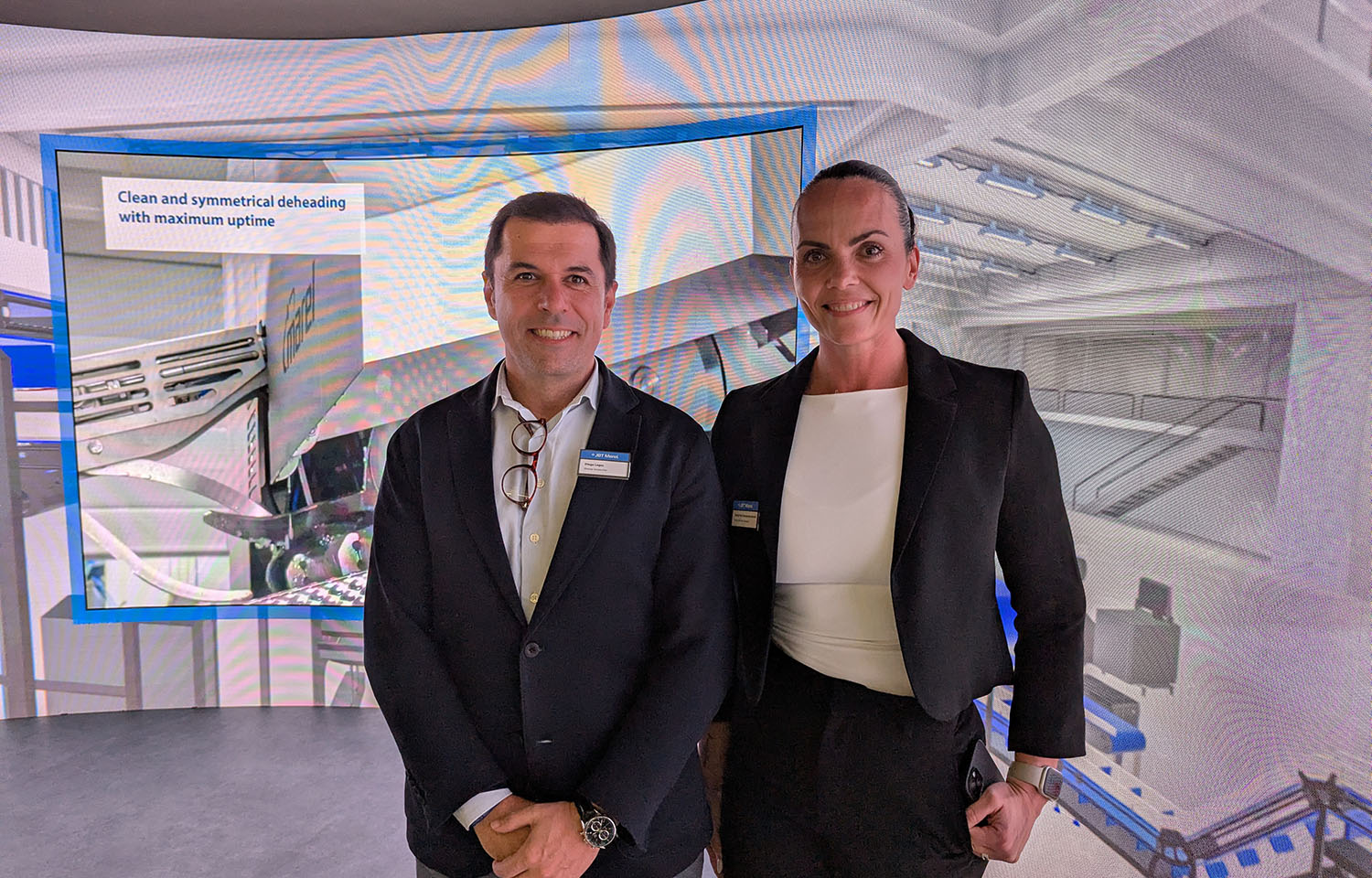
JBT Marel Director of Service for Fish Diego Lages told SeafoodSource during Seafood Processing Global that the new salmon gutting machine, dubbed the EVi, was the result of extensive research and development.
“In our industry, developing a project like gutting is not something that happens overnight, and this has been in the works for the last three years,” Lages said.
Lages said JBT Marel has been a market leader in secondary processing for seafood for years, and its decision to move into primary processing is a result of an initiative identifying the gaps in its value processing chain.
“Gutting was one of them,” Lages said. “In primary, we did a lot of projects, but our stuff was basically grading lines – we did a lot of packing graders for salmon, and some quality control systems, but nothing related to the gutting, or stunning and bleeding.”
In contrast, the company already has a wide array of solutions for almost every other type of secondary processing, he said.
“If we talk about secondary, we have filleting, we have pin boning, we have robotics, we have portioning, we have basically the entire line,” Lages said.
In February 2024, the company entered into a strategic partnership with MMC First Process, a move intended to help the two companies fill gaps in seafood processing solutions. Lages said that partnership was in part oriented around further penetrating the primary processing market and salmon processing.
“The journey has been fantastic, really really good. We’ve got a lot of attention from the market; we’ve closed very important projects together,” Lages said. “The missing link, or the missing piece in the core of primary processing, was gutting. So that was when we decided to fill that gap.”
Lages said the customer response to its other recent additions to the salmon processing lineup have been extremely positive. The company launched a new salmon-filleting machine dubbed the 2750 in 2023, and since its introduction, demand has been strong.
“We have had to speed up manufacturing in order to cope with demand,” Lages said. “According to our business plan, we had to produce more units than expected because the product is penetrating very very nicely in the market.”
Lages said the join-up between JBT and Marel has also gone extremely well just a few months into the new larger company, as the two had strengths in different areas that compliment each other.
“The Marel name was much more known; it was a [stronger] presence in the seafood sector, than JBT. Now JBT Marel is even stronger, and JBT came to compliment some of the gaps that we have in our product portfolio,” Lages said.
As the company expands its existing product offerings, it is also expanding the services it provides for those products. JBT Marel Service Business Manager Sonja Rut Adalsteinsdottir told SeafoodSource the company is taking steps to streamline its supply chains to help its customers keep their processing lines running.
“The most important thing for our customers is, of course, our resolution time – having the spare parts located at the right places, the availability and lead time of spare parts, the quality of the service in general,” Adalsteinsdottir said.
She said JBT Marel is placing a greater emphasis on all aspects of the service side of its business, which includes opening new global distribution centers in the U.S. and in the Netherlands to decrease response times and lead times.
The facility in the Netherlands was the largest organic investment Marel had ever made, and consists of a fully-automated warehouse that allows the company to access and distribute spare parts as quickly as possible.
Adalsteinsdottir said that making sure lead times are short has been more complicated than ever post-Covid due to complications in the supply chain, but the company’s strong team has helped it navigate those challenges.
“Having a strong team is kind of saving us, for sure it is a challenge, but having good people is key,” she said.
Another aspect of JBT Marel’s push to improve its service is increasing the level of involvement the company has with its customers using data.
“I’m more and more convinced that data is our superpower,” Lages said.
Lages said JBT Marel continuously emphasizes how key that data will be for operating a successful facility.
“Think about it, would drive your car without a dashboard? So why are you running your factory without a dashboard?” Lages said.
Adalsteinsdottir said that additional data is also helping the company provide service solutions by monitoring the machines it sells and proactively react before problems arise to shift away from reactive responses to breakage to preventative ones.
“If we see something is about to break, we can step in and make a plan before hand,” she said. “This is extremely exciting, and this is also what our customers are asking for, we’re getting demand from them.”
