


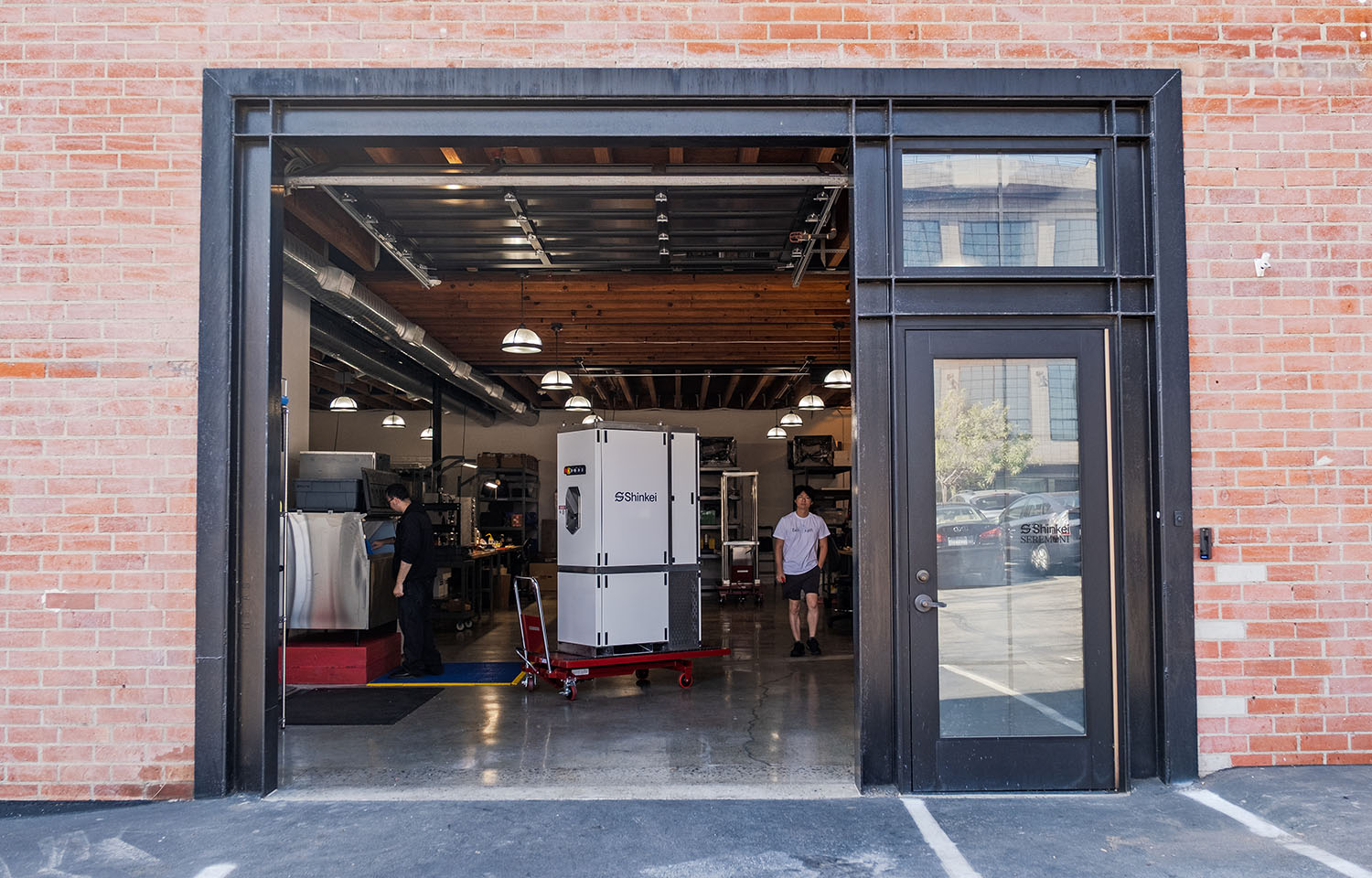
Shinkei Systems announced it has more than doubled the size of its corporate footprint in El Segundo, California, U.S.A., after strong uptake of its robotic seafood-processing systems.
Shinkei Systems has created processing machinery that automates the “ikejime” process of slaughter – a method historically used by Japanese sushi chefs to improve the quality of a fish. The company’s machines have been in development since the company’s founding in 2021 and have expanded into multiple species.
The firm uses a unique business model, which involves partnering with fishermen in a pseudo-profit share that sees Shinkei build them tooling for its processing methods and then pays fishermen a premium for their product. In return, Shinkei Systems can sell the product it receives at a higher premium due to its high quality, and it markets the fish under its Seremoni brand, labeling the fish as “Seremoni grade”
Shinkei Systems CEO and Co-Founder Saif Khawaja told SeafoodSource that since it launched commercially, demand has exceeded expectations, which necessitated the company’s expansion into its new space.
“I’m very excited to share the news; it sounds quite trivial, but it’s two-and-a-half times the size. We thought we were going to be in the old factory for at least two years,” Khawaja said. “We ended up being there for barely nine months.”
The location is on El Segundo’s Standard Works campus, which Khawaja said has given the company access to top engineering talent and has contributed to the environment that allowed Shinkei Systems to expand so quickly.
“Being in El Segundo, the proximity to hardware talent – for example, my co-founder being from SpaceX and El Segundo being where SpaceX was founded – I think that’s been able to really be a large driving lever for us to be able to move with this pretty complex set of automation problems very quickly into things that are achieving surgical accuracy at industrial speeds,” Khawaja said.
Shinkei’s processing system uses machine learning and AI technologies to automate fish harvesting to a high degree – a challenge which Khawaja said has taken many hours of work and intense engineering to solve.
“We’re ultimately solving fairly difficult controls problems, which are hard to solve,” Khawaja said. “Getting and acquiring data sets and building out our own models for the unique morphology has taken quite a lot of time, and we have our own models that we’ve built.”
Khawaja said the complexity of the machine also required a lot of mechanical engineering to get right, combined with the need for its own models and the difficulties of holding a fish still quickly.
“How to hold a fish really quickly and make sure it's still, at the tens-of-thousands of pounds level of volume, is not an easy problem you can solve with machine learning,” Khawaja said.
Shinkei Systems is capable of building a new machine in as fast as two weeks, and with the new facility expansion, the company will be able to have three machines in parallel production at once.
In addition to its factory expansion, the company has also developed two additional species its machinery is capable of processing – blackgill rockfish and vermillion rockfish – which adds to the existing capabilities of black cod and black sea bass.
Despite the unique nature of Shinkei Systems’ business model and the complexity of the problems it has had to solve, getting uptake from fishermen has been easier than expected, Khawaja said.
“I think the conversation with fishermen has been a lot more straightforward than I think we expected,” Khawaja said. “Ultimately, they’re getting a pay premium to do this one extra action.”
As it continues to expand its customer base and its manufacturing capacity, the end goal is making the product as ubiquitous as possible and allowing for a high-quality seafood product with a longer shelf life at an affordable price.
“We’re trying to democratize a previously inaccessible product for the average consumer,” Khawaja said. “What we really didn’t expect was how fast this democratization is happening. Because of the automation, we’re priced below what anyone can feasibly get by doing this by hand.”
Shinkei initially got uptake from high-end foodservice venues and Michelin-starred restaurants due to the high quality of its products, but the ability to scale the supply of those products has allowed it to expand into other markets.
Expanding access doesn’t mean Shinkei Systems and the Seremoni brand are turning away from high-end establishments. The company has engaged in restaurant partnerships, and recently, three-Michelin-star restaurant Alinea hosted a pop-up in Los Angeles that featured Seremoni’s black cod on its menu.
“We have brought a number of new partnerships that are all household names in the industry,” Khawaja said.
Khawaja said the hope is that, as Shinkei Systems continues to gain scale, that Michelin-star product will become a consistent presence on store shelves, and the new expansion is part of making that happen.
“Our hope is that you can walk into any mass market retailer, and in the same way there would be a grass-fed beef or pasture-raised chicken aisle, there would be a Seremoni-grade fish aisle, as well,” Khawaja said. “That would be the dream.”
