




Seremoni Fish has made three new strategic hires as the company works to expand adoption of its innovative business model that aims to improve seafood quality.
Seremoni Fish, under the umbrella of Shinkei Systems, is the creator of a technology that allows fish processors to automate the “ikejime” process of slaughter. Originally used by Japanese sushi chefs, the process includes guidelines for handling practices and slaughter methods oriented around improving the quality of fish.
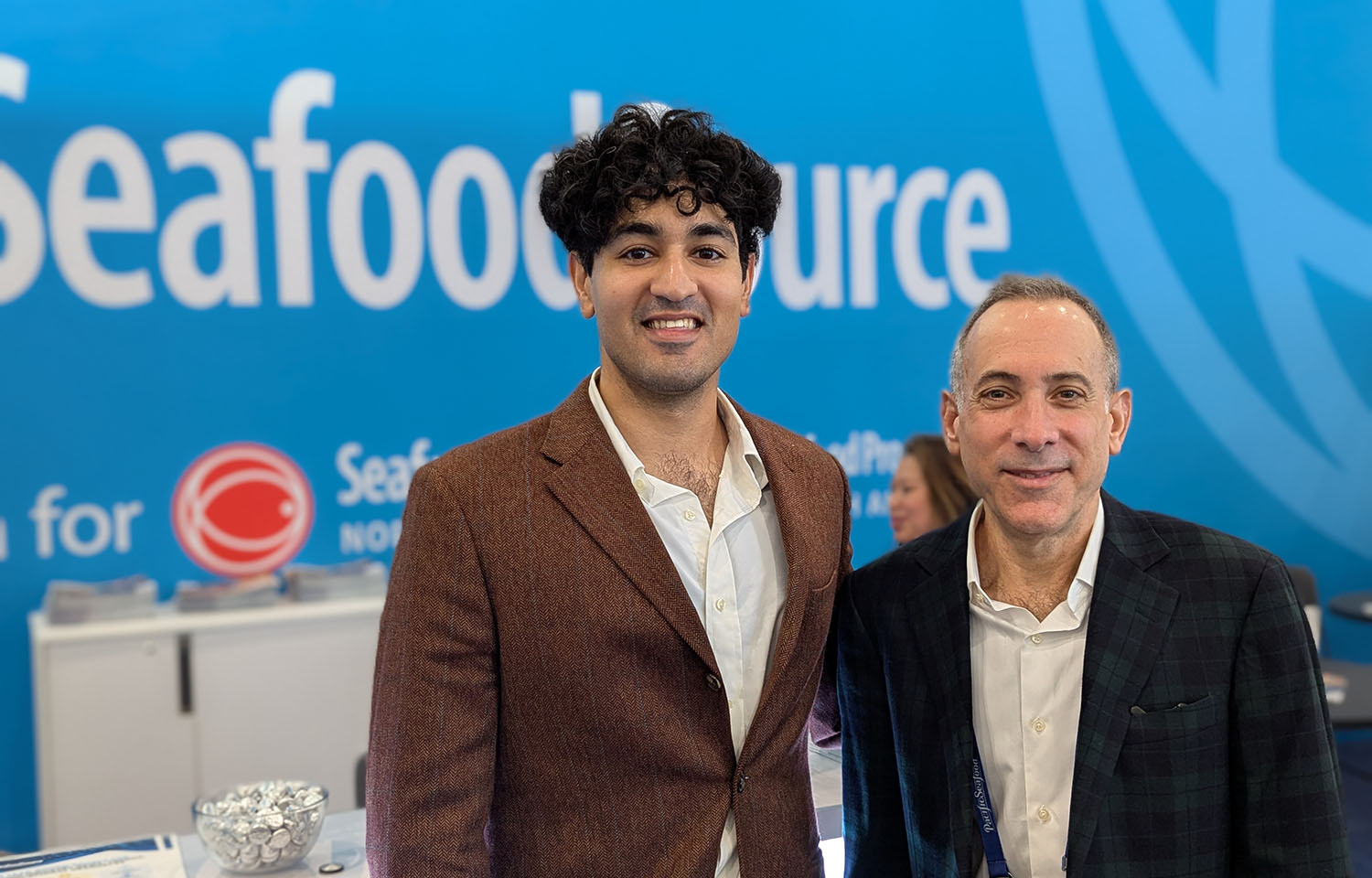
Seremoni Fish Founder Saif Khawaja told SeafoodSource during the 2025 Seafood Expo North America – which ran from 16 to 18 March – the company is approaching distribution of its technology with a new philosophy to scale up access to higher-quality fish.
“We’re structured as a pseudo-profit share with fishermen, where we build them sophisticated tooling, such as ikejime machines,” Khawaja said.
The machines are owned and operated by Seremoni and given to fishermen to use for free, and the company then, in turn, pays the fishermen a premium for their product.
“The machine is on our balance sheet, we pay them above market, we take the inventory risk, and we often guarantee them a certain amount of volume,” Khawaja said. “So, for them, they’re getting cash flow that’s above market price, and they’re getting automation that makes it really convenient.”
The improved quality of the fish allows Seremoni to earn more for it, and the end result is that while Seremoni pays fishermen more than the average ex-vessel price for their catch and is taking on the risk, it’s also still making money.
Khawaja started his company out of college, and the idea for creating it came after reading an essay by Peter Singer titled, “If Fish Could Scream.”
The essay covered how many common practices in the seafood industry treat fish inhumanely during slaughter, and as Khawaja was thinking about the problem, he also learned about ikejime and its methods.
“A light bulb went off over my head, and here we are three years later,” he said.
Khawaja started with prototypes in his dorm room and eventually managed to raise money to begin the company full time. It’s around then he met Michael Fabbro, who at the time was the CEO of New York-based recirculating aquaculture system company LocalCoho.
Fabbro told SeafoodSource when he first joined LocalCoho the company was small-scale and doing relatively rudimentary harvesting with a high amount of stress on the fish.
“I said the first thing I want to do is to find a better harvest method,” Fabbro said. “I spoke to a friend of mine in the food research space, and he was like, ‘You should do ikejime.’”
Fabbro learned more about the method and decided to pursue that practice because he thought with the company’s relatively small size, it could accomplish it by hand.
“The reality was, it wasn’t really practical to do in a commercial setting at scale,” Fabbro said.
By complete chance, one of Fabbro’s customers had heard of Khawaja’s startup and connected the two of them together.
“I was like, ‘This is exactly what I’m looking for.’ So, at LocalCoho, we deployed one of the very first iterations of the harvester,” Fabbro said.
That early iteration was in March 2023, and at the time, Fabbro said the goal was to improve the taste, texture, and quality of his fish while reducing waste.
Since that time, Fabbro has left LocalCoho and joined the executive team at Seremoni as its CEO to help the company build its brand.
Khawaja said that early work with LocalCoho was invaluable as it provided real-world experience and experimentation on his early prototypes.
“Some of the hardest things around prototyping this type of work is getting access to live fish,” Khawaja said.
LocalCoho gave them a consistent supply of one species of fish that helped them dial in the equipment, which has since come “leaps and bounds” from the early days.
“It’s almost a completely different machine at this point,” Khawaja said.
Seremoni is now capable of making multiple robotic processing systems in a month and is working to rapidly scale up its assembly.
Fabbro said the company is working with four distributors in New York, one in Chicago, Illinois, and two in Los Angeles, California. It's currently focusing on black cod, but by early summer, it will have participating boats fishing black bass; later in the summer, it will have boats bringing in king salmon.
The ultimate goal is to build Seremoni as a brand that’s associated with high-quality products – which also means the company is working to improve the whole supply chain.
“Ikejime is often thought as this one trick pony, where you just put the fish in and all of a sudden it’s amazing. But, if that fish is sitting out in the sun or if there’s really poor cold storge, there’s no point in doing this at all,” Khawaja said.
Through improving the supply chain, Seremoni is working to create a “Seremoni grade” fish that is known for its premium quality, which in the end, will help both the company and the fishers involved earn more money.
The company is working to spread its model further and increase adoption of its system – which is where hiring three new employees comes in, Khawaja said.
On 19 March, Seremoni officially announced the three hires – Sonia Buchureau, Chris Cumming, and Angelina Skowronski.
Buchureau will serve as a sales director at Seremoni, bringing previous experience from New Zealand King Salmon and Multi-X. Buchureau has helped launch and develop successful brands in the seafood space, including Ora King Salmon and Arka Antarctic Salmon.
Cummings will take on the senior sales director role after his previous experience at Pacifico Aquaculture, Verlasso Salmon, and most recently, Kvarøy Arctic.
Skowronski will join the company’s procurement team as director, bringing in her expertise in the sustainable seafood space after roles with the private sector and NGOs.
“Seremoni is a grade and a brand,” Fabbro said. “That brand will help tell the story of why this fish is more elevated to a different quality. We’ve really built the foundation of an all-star team to help bring that story to life in the market.”
