






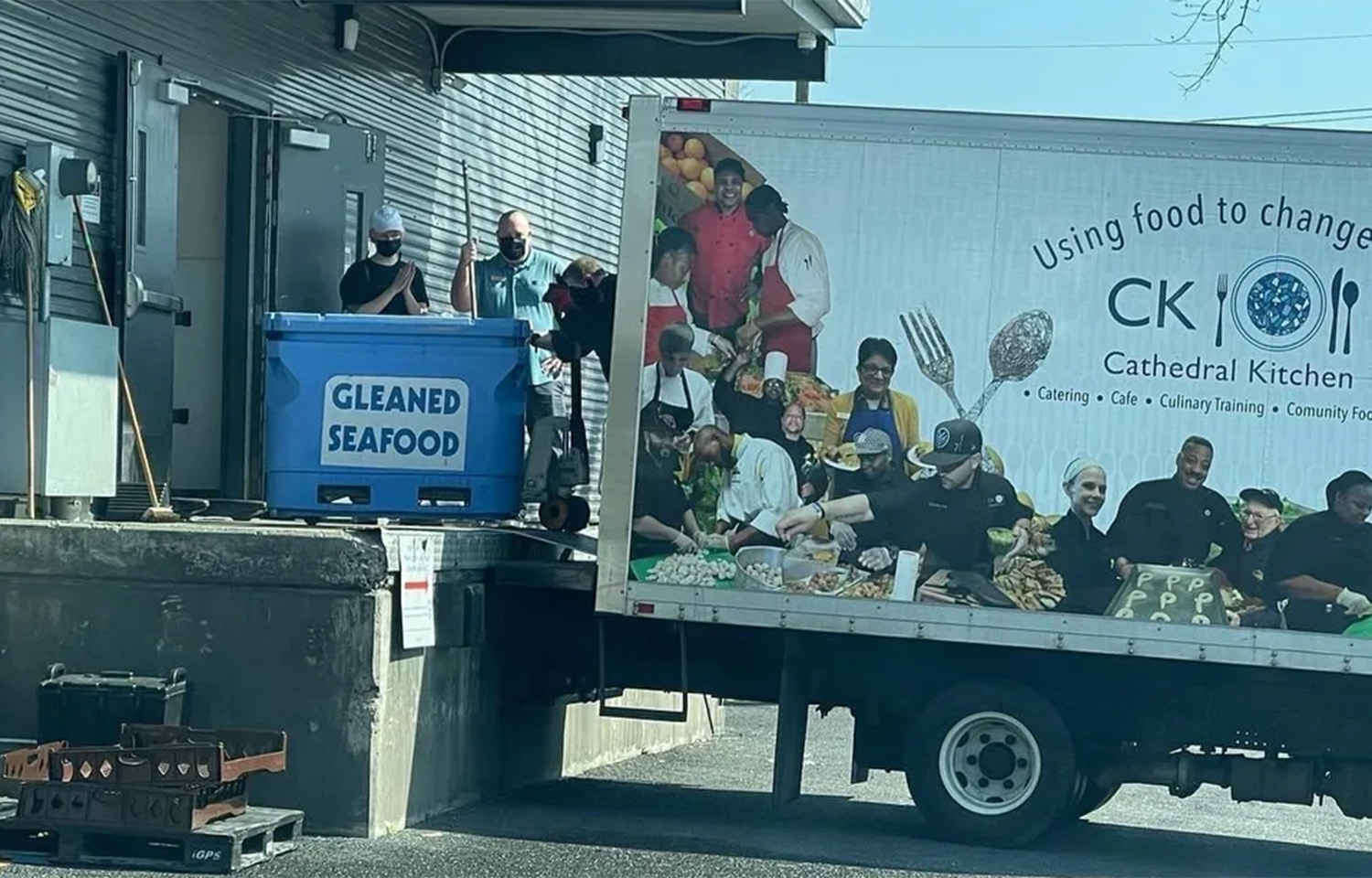
A growing program in the U.S. is working to utilize fishing bycatch to provide nutritious meals for the nation’s food-insecure population.
Americas Gleaned Seafood, based in the U.S. state of New Jersey, receives donated fish from local fishermen and distributes it to food banks, soup kitchens, and food pantries in the region. The program got its start via a 2018 letter to the U.S. Department of Agriculture (USDA) by its founder, Brick Wenzel.
Wenzel told SeafoodSource he has been a licensed commercial fisherman since 1982 and got the idea to create a gleaning program from the practices that fishermen have already engaged in for years, as well as the existing gleaning programs across the U.S. He fishes out of a fishermen’s co-op in Point Pleasant Beach and said that there’s clear documented evidence that fishermen have been donating fish to local causes since as early as 1953.
“Most people in the fishing industry, we all take fish, we donate it, we give it to our neighbors, we give it to different organizations for fundraisers for your local church group,” Wenzel said. “Basically, we have as an industry, nationwide, we’ve always contributed our fish and a lot of times it was our bycatch.”
Those charitable donations varied in nature but often weren’t accounted in one way or another – including on official bycatch statistics.
Wenzel said when he was involved with New Jersey’s Department of Agriculture and the USDA, he learned more about the officially recognized gleaning programs that already exist for the nation’s terrestrial farms.
Gleaning is a biblical term referring to harvesting leftover crops from a farmer’s field after it has already been harvested. The USDA’s definition for gleaning is taking excess fresh food from farms, garden, farmers markets, grocers, restaurants, state/county fairs, or any other source and providing it to those in need.
“I saw an opportunity to actually do that with seafood,” Wenzel said. “We started off really small at our co-op, where we had fish coming in that had no value and we would bring it to the local soup kitchens and pantries. But, we wanted to increase the program.”
One of the species that triggered the desire to increase the program was a species known in New Jersey as scup. Wenzel said that fishermen targeting the species would sometimes go out for the day without knowing what the dock price would be when they returned.
“When we leave the dock, they might be [USD] 0.50 [EUR 0.46] to [USD] 1.00 [EUR 0.92] per pound. But, when you get back to the dock, everyone has large or extra large fish, and the mediums all suddenly have no value,” Wenzel said.
Fishermen can’t know what the catch might be for other fishermen in advance and don’t want to throw out marketable fish, meaning they’ll sometimes end up at the dock with a catch that has little commercial value, he added.
“That’s where as an organization we stepped in; we grabbed those fish,” Wenzel.
In the beginning, the program was relatively small, but around the start of the Covid-19 pandemic, the program began to partner with local food banks and a local Sysco Foods processing facility to begin a larger-scale gleaning program.
As the program started to gain traction, it gained additional funding from Feeding America via Tyson Foods, as well as a marketing grant from a program with the National Football League, which took it from a fledgling idea to a nonprofit organization.
“That’s really how the program got started; we identified there was fish being wasted, that there was a need, and that we had traditionally donated these fish in the industry – it’s just that we formalized it,” Wenzel said. “We got our federal fisheries dealers permit, and we started tracking. When we glean fish, we identify each fish and weigh it.”
A key aspect of the program is actually ensuring that fishermen are donating the fish without any financial or tax benefits to ensure that any fish Americas Gleaned Seafood receives isn’t accounted for in the commercial quota.
“Let’s take sea bass for example … sea bass usually has a high market value. So, if they were giving fishermen [USD] 0.10 [EUR 0.09] for their sea bass, that volume of fish would then come out of their quota – where they might have instead been getting [USD] 4.00 [EUR 3.67] a pound for it,” Wenzel said. “As long as fishers don’t get that penny and don’t get that tax write-off because it’s truly discards and it’s proved to be a gleaning product, then it comes out of the set-aside within the fisheries management plan.”
Wenzel said he’s actually had to advocate against programs that pay fishermen.
“Every time I speak with legislators, they say, ‘Oh no, we want to give the fishermen something to do this,’ and I’m like, ‘Please, no, don’t!’” he said.
Another big benefit of the seafood gleaning program is it accounts for a fishery’s bycatch and adds to the official statistics available for a fishery without requiring an on-board observer. Fishermen who are participating in the gleaning program are bringing their bycatch to the dock where it is officially recorded – improving fisheries management.
That part of the program is particularly relevant now that the U.S. Government Accountability Office has reported that the National Marine Fisheries Services’ bycatch monitoring isn’t meeting standards.
Americas Gleaned Seafood, as it has evolved, has moved into directly delivering recently caught bycatch to food pantries and food banks to help provide food-insecure people with healthy proteins. According to Feeding America, almost 1 million people are some form of food-insecure – meaning there’s plenty of need for the source of protein.
Wenzel said the program is starting slow and is working its way to different areas of the U.S. He also said that the program is gleaning from more than just fishers – it will also take unwanted or unneeded fish from other sources. The most unusual was a Monmouth University program that was raising catfish and tilapia.
“They called us one day because they heard about our program, and their fish were getting too big for their tanks,” Wenzel said. “So, we ended up gleaning tilapia and catfish from the university.”
Gleaning also has the indirect benefit of introducing people to new species they wouldn’t have sought out, so when the food-insecure become more financially stable down the road, they might seek it out after learning how good it is, Wenzel said.
Wenzel explained the ultimate goal is to get gleaning built into the country’s fisheries management as a means of both helping the food-insecure and managing bycatch.
“It’s a slow process,” Wenzel said. “It’s going to take longer because we want to get it right.”
