

Chilean fishing and salmon-farming firm Blumar has decided to halt a USD 30 million (EUR 26.8 million) investment in a frozen food plant in the central Chilean city of Coronel as it waits to see how national legislation regarding industrial fishing quotas plays out.
The plant project – which had already had received required permitting – “was scheduled to be passed by [Blumar’s] board of directors and approved during 2025 to begin construction toward the end of this year, but it was postponed,” Blumar CEO Gerardo Balbontín said.
An estimated 400 people would be employed at the plant, the company said.
The national legislation in question is a bill called the “ley de fraccionamiento” locally, which would replace the existing Chilean fishing law and proposes to modify the distribution of catch quotas in 18 fisheries across the nation.
The move is seen by its proponents as correcting an historical wrong, taking away quotas from the industrial fishing sector and awarding them to artisanal fishers.
Large fishing firms have said the bill threatens their companies’ economic feasibility and puts thousands of jobs at risk, such as the 2,000 jobs currently in place at Blumar – roughly divided evenly between its fishing and salmon-farming operations.
Should it be approved, the new law would apply until 2040, with annual adjustments made according to the performance of both the industrial and artisanal sectors, seeking a new distribution of quota for species including anchovy, sardines, hake, horse mackerel, and cuttlefish.
“This is a very bad law that is based on purely ideological principles. Acquired rights are being violated,” Balbontín previously told local press. “The company is considering resorting legally to all means necessary in the event that the law advances as it is.”
If implemented, the law would have the greatest impact on Blumar’s mackerel-fishing operations, potentially leading to the decommissioning of one of the vessels in its fleet, Balbontín added.
The company is also a partner in Talcahuano, Chile-based PacificBlu – a firm that processes and commercializes hake – which said that if the bill being discussed in congress becomes law, it will be forced to close down completely at the beginning of 2026.
During the bill’s negotiations, the Chilean government used a 30 March shipwreck between a Blumar fishing vessel and an artisanal boat as an example as to why the industrial sector needs to be kept in check.
Balbontín said he regretted that the shipwreck, which may have involved Blumar employees, was getting placed in the same discussion as debates over the fishing quota bill.
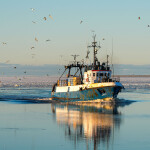
In the March disaster, a Chilean prosecutor charged certain crew members of the fishing vessel Cobra – which belongs to Blumar – in connection with the shipwreck of the artisanal boat Bruma.
“Unfortunately, that accident occurred at a time when [the fishing bill] was being discussed, and things have tended to get mixed together,” he said, calling on stakeholders to refrain from using the incident for political purposes. “In the Lower House … there was a tendency to use the argument, but they are completely different things. One is a tragedy, something that is affecting the mood of the company and the sector a lot, and the other is a legislative process that we oppose and have been following constantly.”
The tragedy is presumed to have killed Bruma’s seven crew members.
Following the accident, the Cobra was seized for inspection, and an expert assessment of its hull and electronic equipment reportedly discovered it had traces of paint and other elements that could correspond to the crashed boat. The prosecutor is alleging the Cobra collided with Bruma, and the industrial vessel’s members have since admitted they heard a noise of some sort but never suspected they had been in an accident. Blumar said it would collaborate with authorities on all fronts.
One of the Cobra’s two lookouts, 58-year-old Juan Sanhueza, went missing after the incident, shortly before he was supposed to go to the prosecutor's office to testify. His testimony was considered key to clarifying what happened between the Cobra and the artisanal boat, but he was found dead in a vacant lot on 9 April. Suicide has been suspected, but medical authorities are working to determine if a third party was involved.
In a brief statement, Blumar said it would continue to collaborate in any way necessary to help clarify the circumstances of Sanhueza’s “unfortunate disappearance and death.”
“We wish to express our sincere condolences to Juan Sanhueza's family, his friends, and his colleagues, with whom he shared so many years at the company,” Blumar said. “The confirmation of his death is a hard blow for everyone. Juan, a crew member of the ship Cobra and an employee of our company for almost 30 years, will always be remembered.”
