






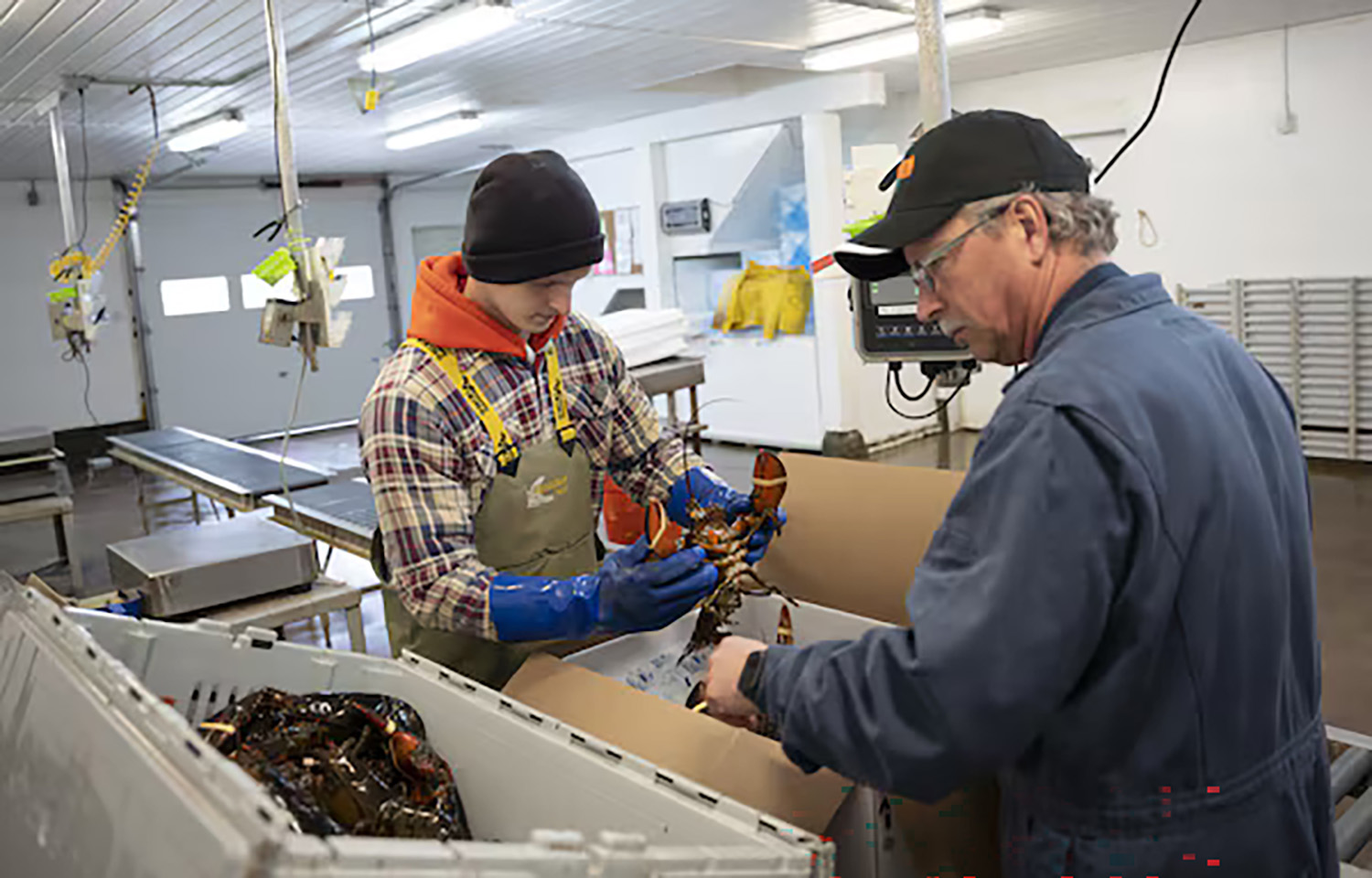
Canada’s live lobster sector is suffering under a set of intense pressures, according to Tangier Lobster Managing Director Stewart Lamont.
Lamont, a 40-year veteran of the live lobster trade whose Nova Scotia, Canada-based firm provides premium hard-shell lobster year-round to 14 countries, explained that “horrific competition” with “too many players chasing too few fish” is largely to blame for a situation in which “we have players in the market who are not motivated by profit but by share.”
Additionally, global economic markets have experienced a downturn, resulting in the fact that “companies just didn’t do their normal sales."
“I would say that international demand may be down 35 to 40 percent,” Lamont told SeafoodSource. “The live lobster industry in Canada is in a historically difficult place.”
In such an environment, many companies are willing to sell their product at a lower price in order to dominate market share, Lamont explained, which drives prices down for everyone and puts pressure on premium lobster suppliers like Tangier to lower their prices so severely that they cannot make a profit.
Lamont said recently he’s often had to buy lobster at CAD 9.00 (USD 6.47, EUR 5.60) and sell it for around CAD 11.25 (USD 8.08, EUR 7.00), “which is not an acceptable margin given our costs.”
It’s not just firms like Tangier that are suffering, according to Lamont, who said the problems flow throughout the entire value chain.
“Here in Atlantic Canada, the banks are not pleased with our return on investment. Fishermen are also seeing the same issue; if you purchased a new rig or have licenses you need to pay for, you need a big price and big catch,” he said.
Though the market dynamic of players willing to sell a lower-quality product for less and cost-sensitive buyers taking that product has always existed, Lamont said what has changed is that suppliers like Tangier can no longer command the premium prices they once could.
For many years, Lamont said, Tangier charged its clients about CAD 0.75 to CAD 1.00 (USD 0.54 to USD 0.72, EUR 0.47 to EUR 0.62) above the average price for live lobster. Clients were willing to pay that premium, he said, because they were confident in Tangier’s quality, as well as its ability to supply premium product during seasonal supply dips, when many of its competitors could not do the same.
Now, Tangier can only charge a premium of about CAD 0.40 to CAD 0.50 (USD 0.29 to USD 0.36, EUR 0.25 to EUR 0.31) above the going rate
Lamont said that now, Tangier has to “choose between competing with the going levels or doing what we always do,” and though Tangier hasn’t lost clients, many of them are buying less than they had in the past, with some now buying half their product from lower-cost suppliers.
“Our quality may be better, [but] they can designate our product for their most demanding clients and give the other product to their cost-sensitive clients,” Lamont said.
As for other issues affecting the seafood traders across the globe, Lamont said that rising fuel prices do not seem to affect his clients too much, unless those high prices are unevenly distributed.
“Fuel prices are a factor … but it’s not a dealbreaker [right now] because it’s hitting everyone similarly. Even if it’s a bad playing field, as long it’s a relatively level field, our clients don’t seem to be very affected,” he said.
The war between the U.S. and Iran, however, has meaningfully reshaped his business, especially in terms of lost opportunity.
“From 1 January until the war [broke out], we had so much interest developing in the Middle East,” Lamont said. “More than any other market in the world … we had three or four majors [clients] with interest in the Middle East. We’ve not shipped a pound to the Middle East in the last two months. Our existing business was devastated, and our potential new business just withered away understandably. We’re still in contact, we’re still quoting, but the game is up for the time being until they have some semblance of normalcy.”
These factors add up to a dispiriting outlook for the Canadian lobster trade, according to Lamont.
“Our Atlantic live lobster sector is in crisis in plain sight. [With] poor quality in the wintertime and undue competition through the entire course of the year, companies are willing to pack for prices that they cannot afford. They know that, but desperate people do desperate things,” he said. “Some companies are going to have to fall by the wayside by choice or by necessity; there really is no other option right now. Unless we get the nerve to ignore [companies which buy high and sell low], a lot of companies in the live lobster sector are going to show losses.”
