






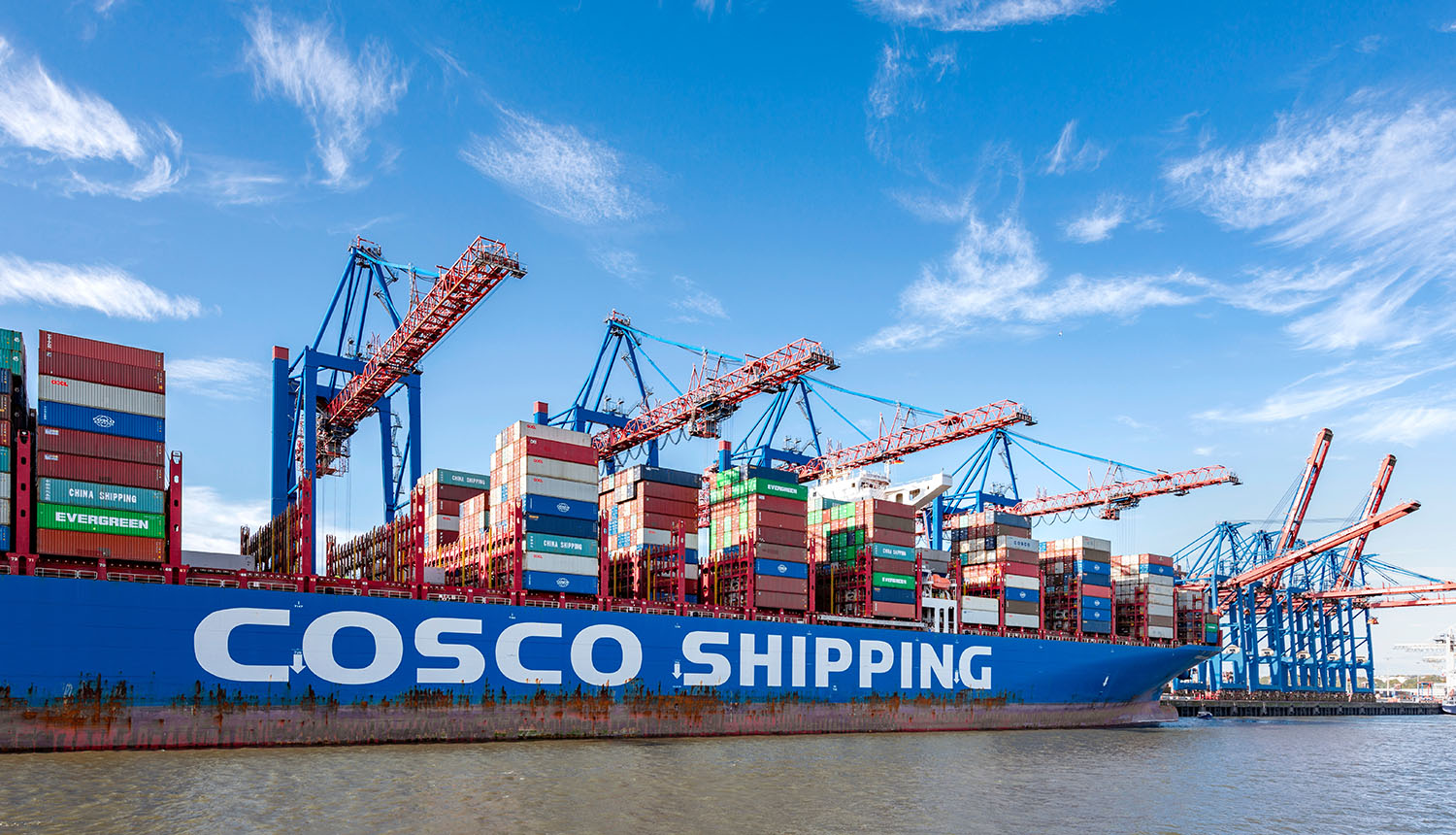
The Chinese Ministry of Transportation announced on 10 October that the nation will begin charging American-built, -owned, and -flagged vessels port service fees in direct response to an April announcement from the Office of the U.S. Trade Representative (USTR) that the U.S. would charge Chinese vessels for entering U.S. ports.
The USTR's plans, which are set to take effect 14 October, will require Chinese-owned and -operated vessels to be charged at a rate of USD 50 (EUR 42) per net tonnage and Chinese-built vessels at a lower rate of USD 18 (EUR 16) per net ton or USD 120 (EUR 103) per discharged container, depending on which is higher.
China’s Ministry of Transportation referenced this plan directly in its announcement of its own new fees, saying that the American policy “constitutes a serious violation of international trade principles and the China-U.S. Maritime Transport Agreement, severely disrupting maritime trade between China and the U.S.”
In its new plan, China will raise fees over time, starting with a rate of RMB 400 (USD 56, EUR 48) per net ton on 14 October and increasing to RMB 640 (USD 90, EUR 77) per net ton on 17 April 2026.
By 2028, the Chinese policy is set to charge RMB 1,120 (USD 157, EUR 136) per net ton.
Net tonnage is not a measure of weight; instead, it amounts to a vessel’s commercial carrying capacity, excluding spaces that are not used for revenue generation. Though some of the world’s largest container ships, when full, have a deadweight tonnage of up to 200,000 tons, their net tonnage is much less.
For reference, the Japanese-owned container ship Ever Given, which famously got stuck in the Suez Canal in 2021, had a deadweight tonnage of nearly 200,000 tons. Its net tonnage was roughly 99,000.
Though there are many exceptions and ways that companies could avoid the port fees, under the basic USTR plan, ships of this largest size could be charged nearly USD 5 million (EUR 4.3 million) for entering U.S. ports.
The Chinese plan, meanwhile, as it will stand on 14 October, will charge RMB 400 (USD 56, EUR 48) per net ton, meaning the world’s largest U.S.-owned container ships could be charged USD 5.5 million (EUR 4.7 million).
Bloomberg reported that a Clarkson Research analysis of 2024 shipping activity suggests that “only 7 percent of U.S. port calls by internationally trading ships would have fallen within the scope of the measures; though for car carriers, the figure would have been close to 50 percent.”
U.S. President Trump has previously said he is scheduled to meet with Chinese President Xi Jinping in South Korea at the upcoming Asia-Pacific Economic Cooperation Forum (APEC) to discuss the trade policies of the two nations, though China has not confirmed the meeting.
On 10 October, however, Trump suggested that the meeting might be canceled in response to Chinese policy around rare earth metals.
