






Norwegian cod has long been a firm favorite in the United Kingdom, but dramatically reduced quotas have lessened the product’s availability and made it much more expensive for the British buying public.
Not wanting to lose revenues from one of its most important seafood markets, Norway’s seafood industry is stepping up its promotion of some abundant alternatives.
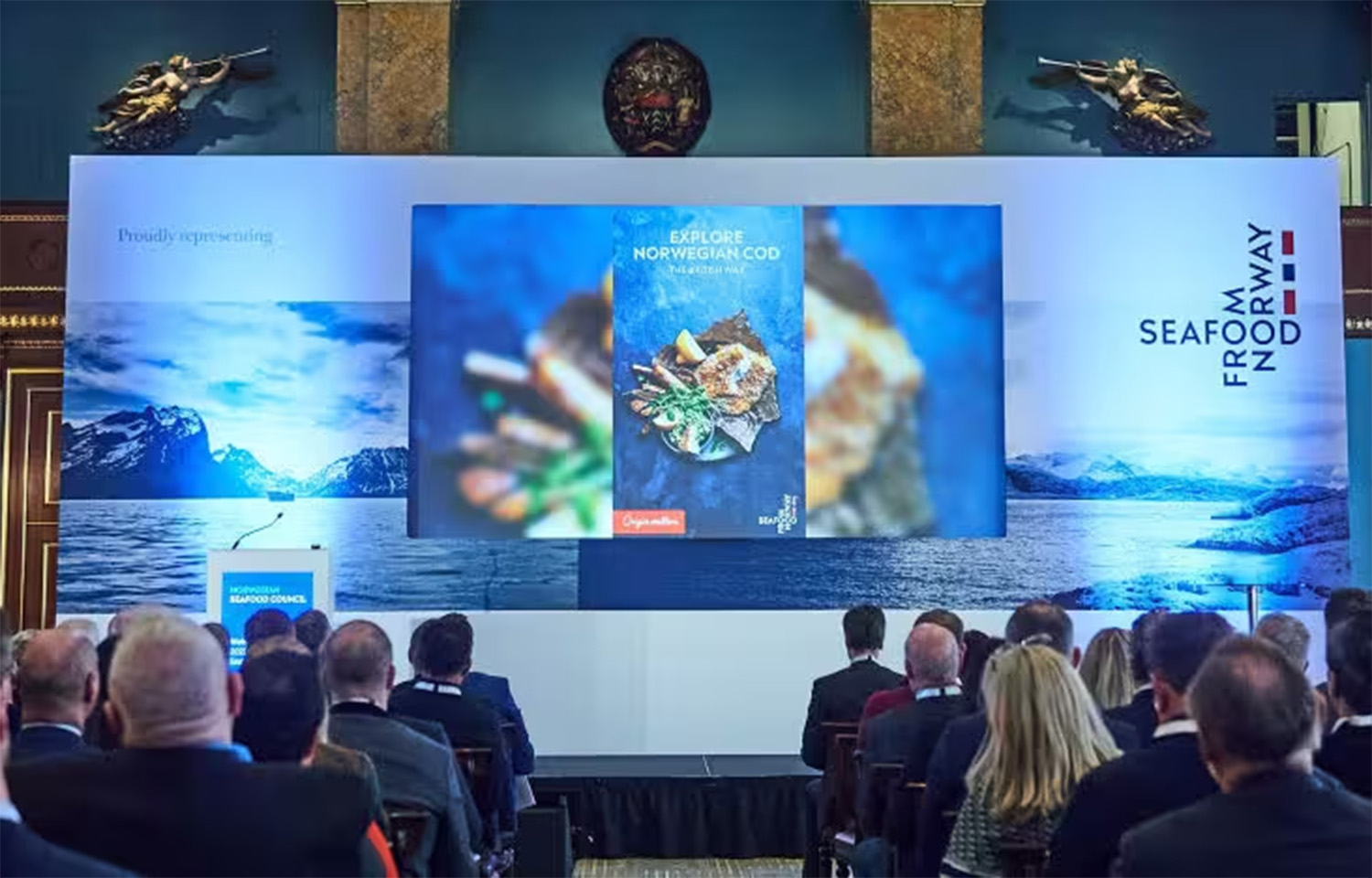
At the 2025 Norway-U.K. Seafood Summit, held in London’s Fishmongers Hall, both the Norwegian Fishermen’s Sales Organization and the Norwegian Seafood Council (NSC) championed the country’s coldwater prawns (Pandalus borealis) as a ready replacement for cod in retail and foodservice channels.
The two groups highlighted that coldwater prawns remain ever-popular in U.K. retail, with supermarket sales accounting for over 80 percent of the volume of the species’ sales, versus warmwater shrimp, where 42 percent is sold at retail. Crucially, the Barents Sea quota, and subsequent supply of these prawns, is experiencing a strong upturn.
New NSC data determined that in 2024, U.K. retail sales of coldwater prawns grew by 2 percent to 14,600 metric tons (MT), with cocktail prawns providing the main growth for the past five years. The analysis also found that more of the product is being sold as refreshed cooked and peeled, with families and people aged over 50 accounting for most of the consumption.
Norwegian Fishermen’s Sales Organization Marketing Manager Synne Guldbrandsen also told the summit that the Barents Sea catch increased 37 percent last year to just over 75,000 MT, the majority of which was caught and landed by Norwegian vessels.
This year, the scientific advice allows for the catch to double to 150,000 MT. As such, the Barents Sea will account for half the global supply of coldwater prawns, Guldbrandsen said. By comparison, the Barents Sea cod quotas have been reduced four years in a row, including a 25 percent cut in the total allowable catch (TAC) for 2025, which will reduce the supply to just 340,000 MT.
NSC Analyst Josefine Voraa said the quota increases for coldwater prawns provide further opportunity for Norwegian prawns in the U.K. market, where they have already been filling the gap left by shrinking supplies from Greenland and Canada.
She said that increase is coinciding with a recovery in British consumers’ prawn consumption, with increased sales in retail and foodservice aided by an easing in inflation rates. Indeed, the United Kingdom has become Norway’s number one end market for the product, helped by a zero-tariff on cooked and peeled prawns since 2023, and a 2025 zero-tariff on frozen and fresh shell-on prawns.
“This will be fundamental for future growth,” Voraa said, explaining that on previous occasions when Norway’s prawn quotas have increased, so too have its exports of the product to the United Kingdom.
“Will history repeat itself?” she said.
But what’s going to be important moving forward, Vorra said, is differentiating coldwater and warmwater prawns in the U.K. market and addressing purchasing barriers, with NSC’s analysis finding that at present the majority of consumers “don’t know or simply don’t care.”
Pointing out that sustainability remains high on the agenda for U.K. consumers, and also that they are willing to spend more money on such products, she said Norwegian products need to be packaged and marketed as “responsibly, wild-caught.”
“We must start communicating this because [U.K.] people do care,” she said. “Some consumers need more inspiration – they need new recipes. But others [place more] importance of sustainability, so you need to have campaigns that speak on these different [levels].
Offering a buyer perspective, Hilton Foods Seachill Head of Seafood Purchasing and Strategic Sourcing Nicola Hunter said that older generations of U.K. customers know and continue to seek out the sweetness and the texture offered by coldwater prawns, so the challenge and “growing pressure” is attracting younger generations to the product.
Key to this will be marketing on the right platforms, Hunter said.
“There are lots of ways to convey messages around the health benefits of eating coldwater prawns, and also the fact that you are buying something that is literally packed full of flavor, that tastes great to eat,” Hunter said. “That 150,000 MT TAC is a catch that’s there to be exploited in a sustainable way, so it’s about how we get that across to consumers. Let’s switch the dial, and move people away from thinking it’s all about price.”
According to NSC’s data, in total, the United Kingdom imported 78,000 MT of coldwater prawns and warmwater shrimp products in 2024, valued at GBP 579 million (USD 745.1 million, EUR 691.8 million). These totals represented year-on-year increases of 7 percent and 2 percent, respectively.
While coldwater prawns can serve as an alternative species at retail, they don’t fit the bill as a stand-in for cod in United Kingdom’s fish and chip industry. However, the summit acknowledged that the trade could benefit from alternative whitefish species, amid a perfect storm of challenges.
Generating around GBP 1.2 billion (USD 1.6 billion, EUR 1.4 billion) a year in revenues, and accounting for some 30 percent of all the whitefish sold in the United Kingdom and 10 percent of its potato crop, the fish and chip trade is both an integral and iconic component of the country’s food landscape. However, National Federation of Fish Friers (NFFF) President Andrew Crook said costs are escalating and alongside soaring energy bills, the steep reduction of whitefish quotas – particularly cod – in recent years has led fish and chip shops to also contend with supply issues and price rises. The addition of 35 percent tariffs on Russian fish imports have added to the financial pressures.
Russian fillets are currently being sold into Europe for around 30 percent less than they are in the United Kingdom, and that’s impacting the market, he said.
“There’s always going to be demand for cod and haddock in the fish and chip industry, but now consumers are going to have to get used to paying for it,” Crook said. “In my own shop, I’ve had to put my prices up twice in the last six or seven weeks. I’m lucky in that I’m trading in an affluent area, but not all shops are as fortunate. There are shops out there in deprived areas, and I think they're going to have to become more general takeaways and diversify a little bit more than I probably will.”
Putting up prices is a one-dimensional approach to the challenge and doesn’t offer a long-term solution for everyone, said Sarah Heward, Owner of award-winning Scottish fish and chip restaurant The Real Food Café. She said there’s justification for the repositioning of wild-caught whitefish, whereby it becomes recognized in foodservice channels as a premium protein, and fish and chips comfortably features alongside steak rather than its current positioning – often among processed centre-plate offerings.
“In this situation that we’re in, there’s surely a case for looking at some kind of realignment – and trying to get some parity for our premium product,” she said.
While this is a direction Heward said conversations need to head in, she also acknowledged that realizing such targets will require the massive re-education of both consumers and industry.
In the meantime, alternative whitefish species are being touted as a means to overcome the industry’s reliance on cod and haddock. According to NFFF figures, some 62 percent of the fish sold in fish and chip shops is cod, while 25 percent is haddock. U.K. shops largely use frozen-at-sea (FAS) fillets, sourced from large Icelandic, Norwegian, Russian, and Faroese trawlers operating in fishing grounds in the Arctic waters of the Barents Sea and North Atlantic.
“There are some definite challenges,” Crook said. “I know some shops are looking at different species just to try and get a price point, which is a good option for many. But I think people will always want cod and haddock – we are very much reliant on it.”
This reliance is also testing the industry’s suppliers. Nor Seafoods’ Sales Manager Johan Oksholen said that while there’s some evidence of resilience – sales numbers for the United Kingdom, his company’s second largest market, were up by 14 to 15 percent in January – he warned that the supply situation continues to be very tight.
“We’ve seen that buyers are still wanting the cod, but of course, there's a price point to everything. There are challenges, and there isn’t enough cod for everyone, so we need to look at alternatives. That's the challenge for the whole industry,” Oksholen said.
From the industry side, Crook agreed that saithe is a great-tasting fish, but its off-white color may prove off-putting for some customers. And yet, at the right price, they may look beyond that, he said.
Heward said that in her experience selling alternative species is a challenge.
“In my business, we are order-takers. We are not salespeople. And it’s not easy selling new species - it [requires] a cultural shift. We are culturally a nation of haddock eaters in Scotland and cod in England. So again, it’s back to education. That’s what we’ve got to be doing in our business, and I can’t believe we're the only ones who are trying to do that. We already have some support from the NFFF, but some wider support would be very beneficial.”
Crook said there’s still room for cod, but it’ll take creativity on operators’ parts to make things work.
“I think shops have got to get a little more creative, start using the knife a little bit better, and also offer alternatives. I've taken large cod off my menus because the per kilo sales price wasn’t high enough [versus the purchase price] … I've still got regular and small cod on the menu, which suits me because I can earn more from it,” Crook said.
He said that there’s no single solution for every business in the trade, but insisted he’s confident that if the NFFF keeps talking to them and they continue to share ideas, then many of them will ride the storm and emerge the other side.
“It's going to be a challenging year or couple of years, but the industry will get through it,” he said.
