





Data from October and November 2025 shows Indian shrimp exports found a way to succeed despite U.S. tariffs, according to industry blog ShrimpInsights.
“Growth was front-loaded and mid-year driven, but the imposition of higher U.S. tariffs in October led to a visible shift in trade flows rather than an outright slowdown,” ShrimpInsights Founder and Analyst Willem van der Pijl said in a recent trade update.
India rapidly shifted trading partners, van der Pijl said, and “lost U.S. demand was largely absorbed by alternative markets, keeping total exports on an upward trajectory toward year-end.”
He added, however, that some of the export volume being reported was likely due to differences in the tastes of U.S. consumers and those from China and Vietnam, where India has redirected much of its exports. The latter markets favor headless, shell-on (HLSO) shrimp, while U.S. markets tend to prioritize peeled shrimp.
The top product coming out of India was raw vannamei. The nation exported 562,382 metric tons (MT) between January and November, marking a 9 percent year-over-year increase. The fastest growing category was value-added products, of which India exported 70,370 MT between January and November.
Van der Pijl said that raw vannamei had performed better since the imposition of tariffs, but value-added products, which are popular in U.S. retail and foodservice, took a hit. The category dropped to 7,033 MT in exports in October, a 4 percent year-over-year decline, and 7,077 MT in November, a 1 percent year-over-year decline.
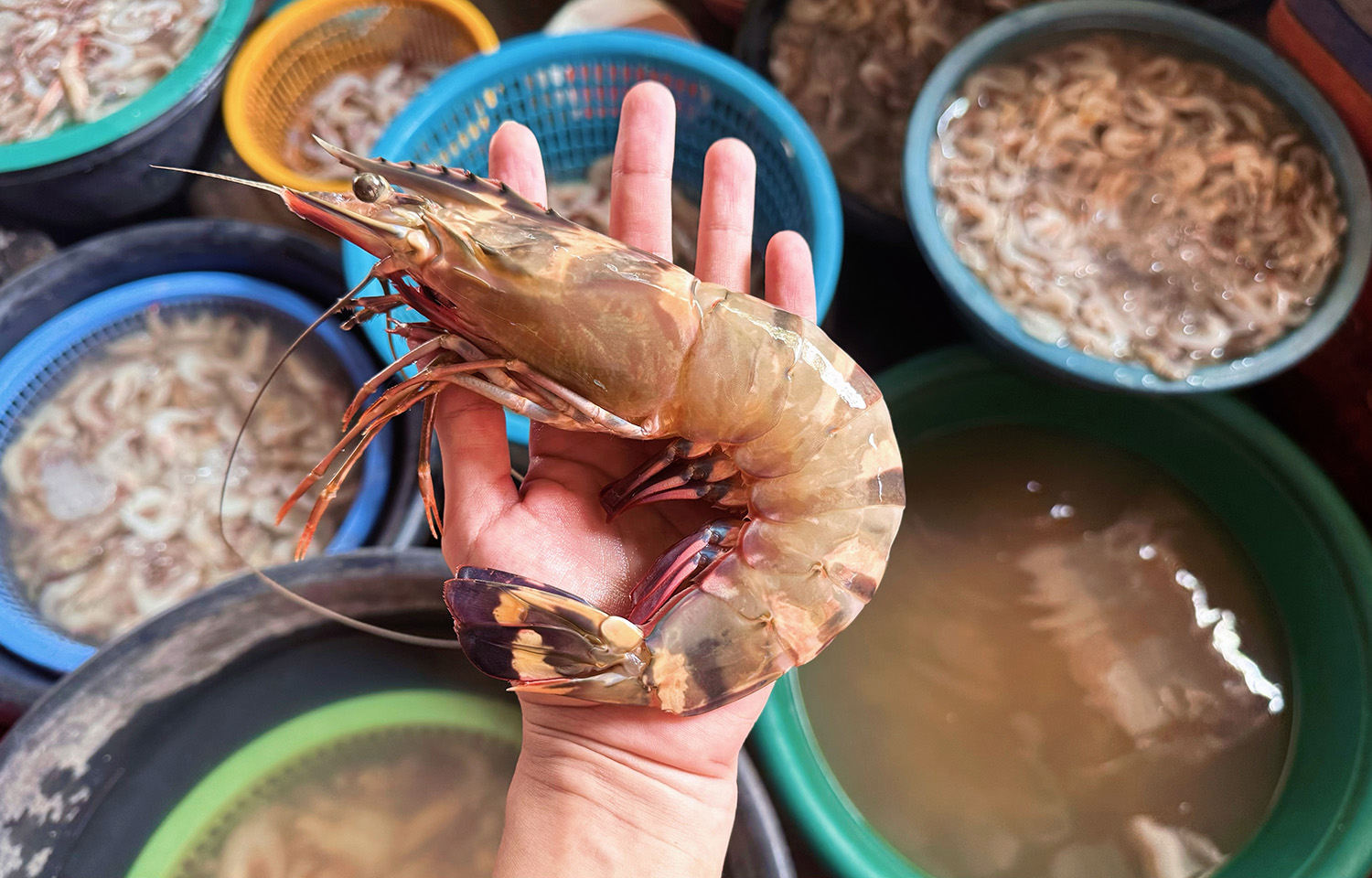
Raw monodon, commonly known as the giant tiger prawn, was especially resilient in the face of tariffs, which van der Pijl attributed to its popularity in Asia and the E.U.
Van der Pijl called 2025 “a clear turning point in India’s export geography,” saying that the U.S. market for Indian shrimp had meaningfully changed.
In comparison to 2024, October 2025 exports to the U.S. fell by 26 percent, while November totals fell by 18 percent. The U.S. was still the biggest year-to-date market for Indian shrimp, with a January to November import mass of 258,749 MT, but that number represented a 6 percent year-over-year decline that van der Pijl said was likely to widen in coming months.
China was the second biggest year-to-date market, with imports of Indian shrimp up 10 percent year over year to 141,002 MT. Both October and November showed strong year-over-year growth of 18 percent and 42 percent, respectively.
The E.U. also saw its imports of Indian shrimp rise after tariffs were implemented. Year-to-date exports were 107,649 MT by November, 38 percent higher than the previous year. October saw a whopping year-over-year growth of 79 percent, while November saw 58 percent growth.
India also grew its exports to Vietnam, with a year-to-date export volume of 64,022 MT, marking 81 percent growth year over year.
Van der Pijl said that the recently announced E.U.-India free trade agreement was an “important milestone for India’s shrimp sector” but said that tariff relief was not likely to occur in 2026, as such an agreement would typically require 12 to 24 months of work before ratification.
“In this context, the E.U.-India FTA should be seen less as an immediate volume catalyst and more as a strategic anchor: It reduces long-term policy risk, supports investment planning, and strengthens the case for the E.U. as a core destination market for Indian shrimp, given that access to the U.S. remains uncertain,” van der Pijl said.
