






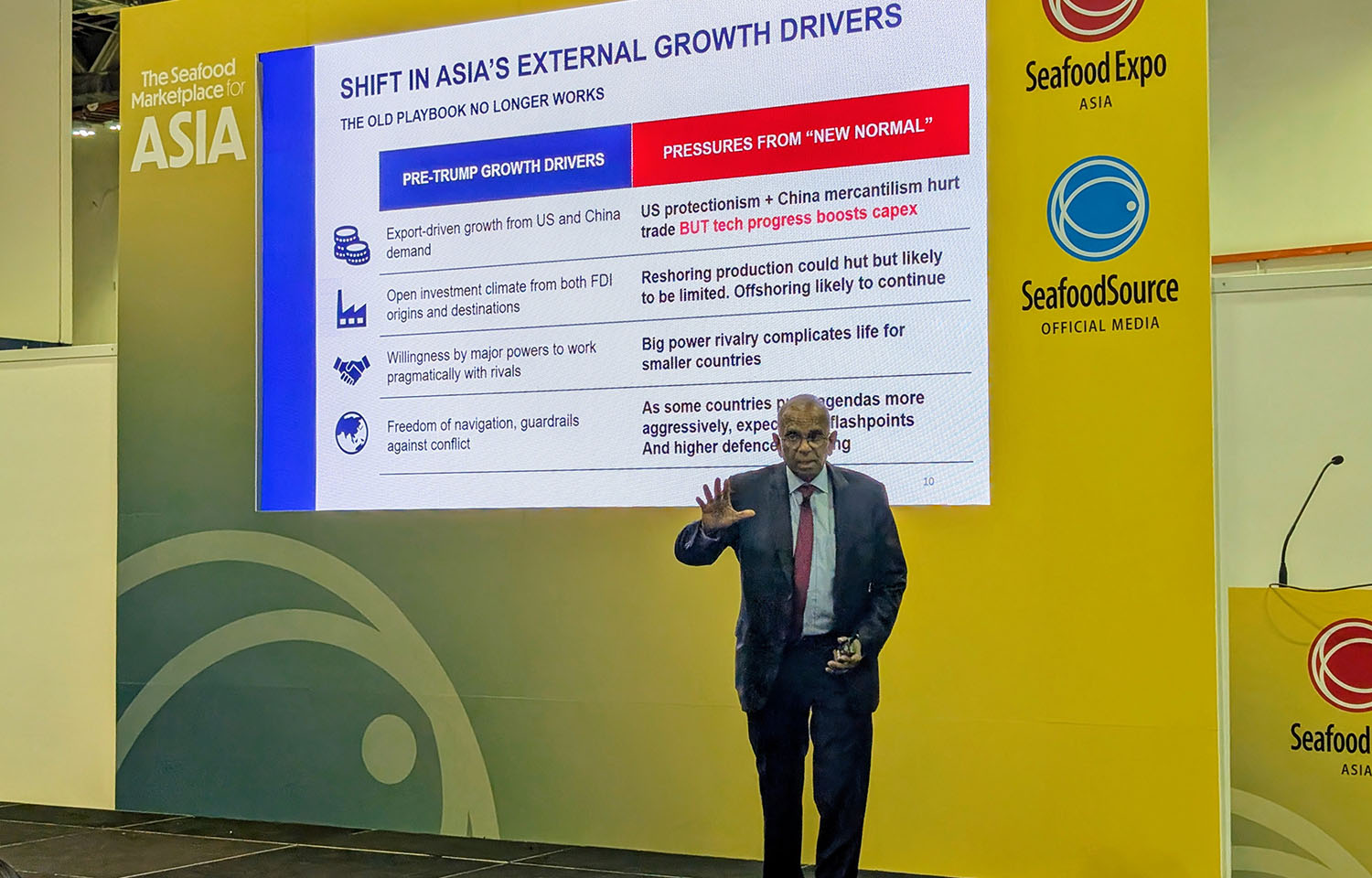
Southeast Asian countries could take advantage of opportunities arising from ongoing trade uncertainty and become relative winners compared to other nations around the world, according to economist Manu Bhaskaran.
“As always in these kinds of events, there will be opportunities,” Bhaskaran said. “Within Asia, I believe that while the countries in this region – Southeast Asia in particular – will certainly take a hit from the trade wars and all the other problems that we will see, we also have great opportunities that can help us do relatively better than other parts of the world.”
Bhaskaran’s comments were delivered during a keynote address at Seafood Expo Asia, taking place 10 to 12 September in Singapore at the Sands Expo and Convention Center. Bhaskaran is a partner at the Centennial Group, a strategic advisory firm based in Washington, D.C., and the founding CEO of Centennial Asia Advisors, the group’s Singapore-based subsidiary.
In his address, Bhaskaran said that while the U.S. has previously acted as a stabilizing force in the world, in recent years, that dynamic has shifted.
“The anchor of the system used to be the U.S.,” he said. “The United States was a powerful country that because it is so big in the world, it was in its own interest to provide the rest of the world with certain services.”
China, too, at one time seemed poised to take on a hegemonic role, but domestic challenges such as an overcapacity in production, an aging population, and other economic challenges have hindered its growth. In fact, some of China’s policies may be detrimental to emerging economies, Bhaskaran said.
However, global uncertainty is creating opportunities for Southeast Asian nations, with some in a better situation to take advantage of the current climate than others, according to Bhaskaran.
“I think the winners will probably be Vietnam, Malaysia, and Singapore,” he said. “Philippines I think will be OK if the politics is all right, but the other countries, I think they struggle because of various domestic and other challenges that they face.”
The economist pointed to an American Chamber of Commerce in Shanghai report released 10 September that showed U.S. businesses shifting their investments from China to Southeast Asia as one way in which the region is likely to benefit.
“In the past year, 47 percent of companies have redirected planned investments away from China – the highest level since this question was first asked in 2017,” the chamber noted in a release. “Southeast Asia remains the top destination for rerouted investment as well as for operations that are moved out of mainland China.”
Of course, that investment won’t be distributed evenly across Southeast Asian nations, Bhaskaran noted.
“Within Southeast Asia, which countries benefit will depend on the particular sector, and if it is a sector where the domestic market is more important – you are selling to the domestic market – Indonesia will get it,” Bhaskaran said. “But, if it is for export production in a very competitive sector, then probably it will be Vietnam, Malaysia, or maybe Thailand.”
For Bhaskaran, the countries that will succeed the most in this moment are those that are open to trade, have future-oriented industries, and strong financial institutions.
“Overall, tariffs are not a good story, but because we have better rates than China or India, we are relatively in a better position,” he said.
