






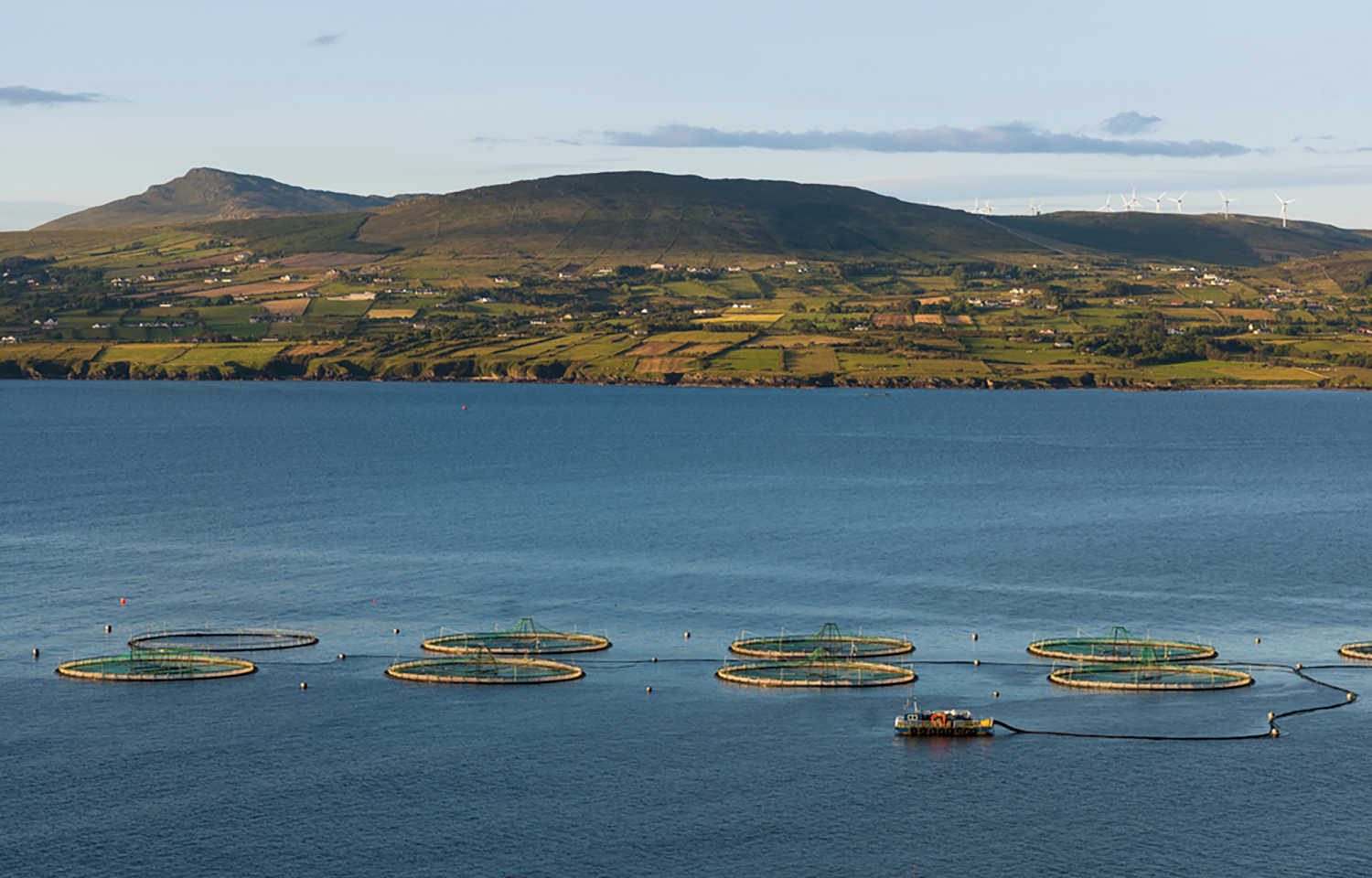
According to a new report from the Bord Iascaigh Mhara (BIM), an Irish agency tasked with growing the nation's seafood sector, the total value of the Irish aquaculture industry rose 25 percent in 2024 compared to the year prior.
The agency’s “Business of Seafood 2024” report highlighted that Irish aquaculture production was worth EUR 211 million (USD 241.5 million) last year, driven largely by a 51 percent increase in salmon production year over year. The sector reached over 14,000 metric tons in output, which was the highest figure since 2017.
“Salmon remains the primary driver of profitability for Irish aquaculture and continues to shape the overall performance of the sector year over year,” the report said. “However, such dominance comes with risk. Fluctuations in salmon harvests can distort the overall view of aquaculture performance, obscuring underlying challenges in the sector. Those challenges were clear in other parts of the sector in 2024.”
Challenges were abundant for Irish oyster and rope mussel producers, who experienced a particularly challenging year due to what BIM described as high mortality rates and poor export demand.
As for the country’s fishing sector, the report highlighted that the industry’s output totaled just about EUR 461 million (USD 528 million). That figure was composed of EUR 324 million (USD 371 million) from Irish vessels, which represented a 4 percent year-over-year increase, and EUR 136 million (USD 156 million) from foreign-flagged vessels, which represented a 13 percent decrease from 2023.
Ireland relied heavily on mackerel in 2024, which made up half of the nation’s landings in 2024, leaving the fleet “vulnerable” to changes in E.U. quotas, the report said.
“Mackerel prices reached record highs due to tight supply and strong global demand, but quota cuts limited the overall benefit to the fleet,” the report said.
According to BIM, the country’s fleet has likewise come to rely on nephrops – a category which includes crabs, lobsters, langoustines and Dublin Bay prawns – making for a “narrow base on which much of the demersal fleet now depends.”
Ireland’s processing sector made up the lion’s share of seafood value in 2024 and was worth EUR 947 million (USD 1.1 billion), with EUR 648 million (USD 742 million) of that total stemming from whitefish processing.
That EUR 947 million figure represented a 3 percent year-over-year decrease, but the report said that the decrease doesn’t tell the full story and that 2024 helped lay the groundwork for further growth.
“The E.U.-funded Brexit Adjustment Reserve (BAR) fund delivered EUR 37 million [USD 42.3 million] in 2023 [to Ireland’s processing sector]. A further EUR 1.3 million [USD 1.5 million] was delivered through Ireland’s Seafood Development Program, co-funded by the E.U. and the government of Ireland in 2024. This enabled helping processors to invest in energy efficiency, automation, cold storage, and product development and is helping the sector prepare for future challenges while strengthening its position in international markets,” the report said. “A wave of investment is transforming the industry, supported by significant public capital.
Ireland’s seafood exports grew 9 percent by value in 2024 to EUR 677 million (USD 768 million).
In terms of export markets, Ireland remains dependent on the E.U., which bought EUR 385 million (USD 436 million) of seafood in 2024 – up 6 percent on 2023. The U.K. bought EUR 125 million (USD 141.7 million), which was up 21 percent. Asian markets bought EUR 78 million (USD 88.4 million) worth of Irish seafood in 2024, which was up 15 percent year over year.
“Despite the very real challenges facing the sector including quota pressures, inflation, and biological pressures, the resilience and determination of industry operators across fishing, aquaculture, and processing are clearly reflected in these results,” Timmy Dooley, Ireland’s minister of state at the Department of Agriculture, Food, Fisheries, and the Marine, said in the report’s foreword.
