
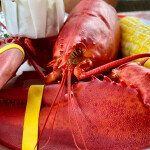
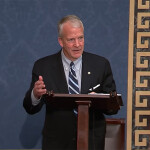


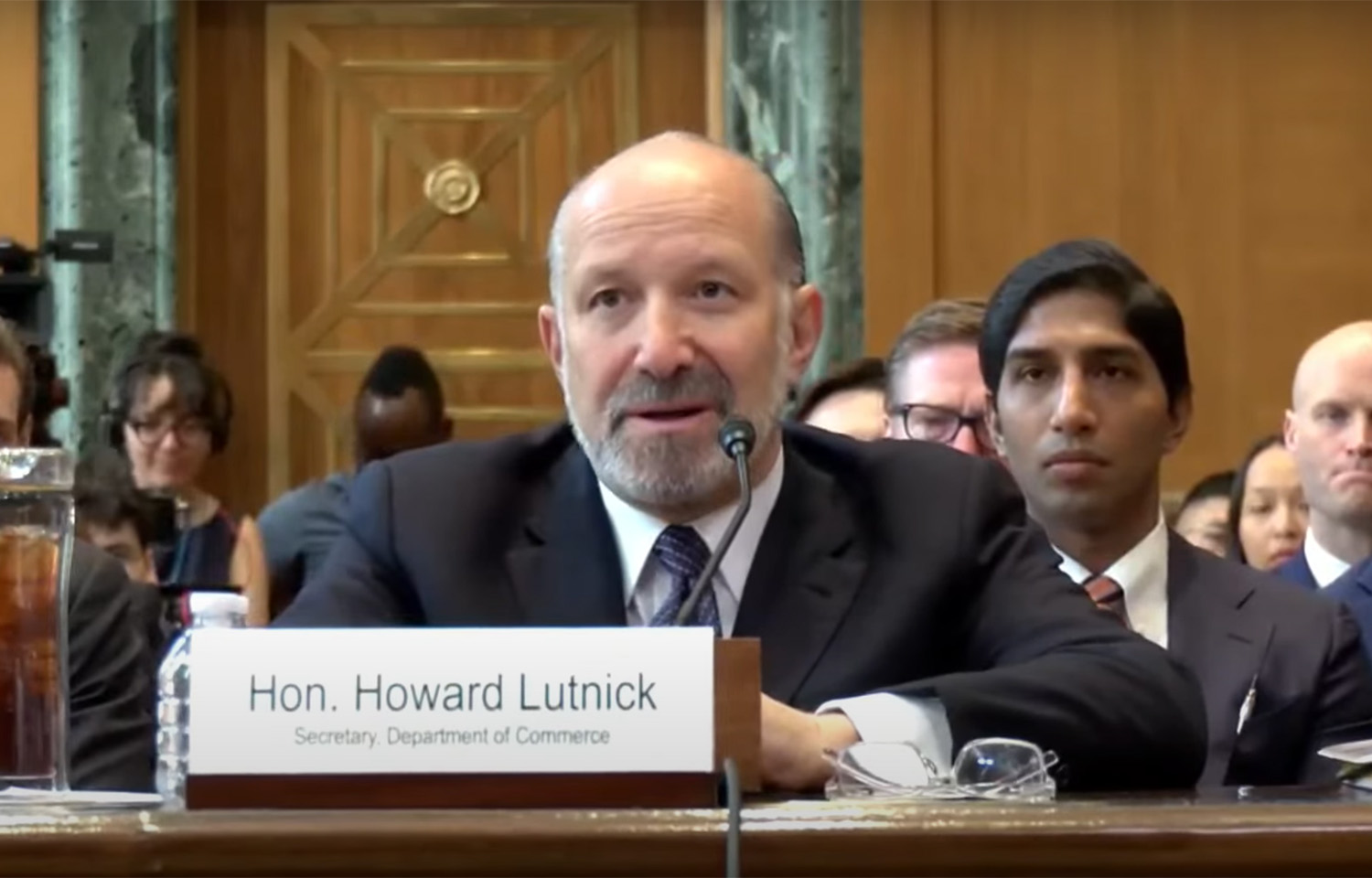
U.S. Secretary of Commerce Howard Lutnick vowed to protect and support Maine lobster during a hearing on his department’s budget plans, while suggesting that Maine lobster processed in Canada would likely be unaffected by new tariffs.
“This administration views the Maine lobster industry as an American treasure, and we need to protect it,” Lutnick told lawmakers during a 4 June budget hearing before the Senate Appropriations Committee.
Lutnick’s comments on the Maine lobster fishery came following questioning by U.S. Senator Susan Collins (R-Maine), who was looking for clarity on how federal regulators would interpret U.S. President Donald Trump’s new executive order “Restoring Gold Standard Science.” According to the White House, the order requires “that agencies practice data transparency, acknowledge relevant scientific uncertainties, are transparent about the assumptions and likelihood of scenarios used, approach scientific findings objectively, and communicate scientific data accurately.”
“Over the last 5 years, confidence that scientists act in the best interests of the public has fallen significantly. A majority of researchers in science, technology, engineering, and mathematics believe science is facing a reproducibility crisis,” Trump said in the order. “Unfortunately, the Federal Government has contributed to this loss of trust. In several notable cases, executive departments and agencies (agencies) have used or promoted scientific information in a highly misleading manner.”
The executive order specifically cites a 2021 biological opinion regarding North Atlantic right whales, which used a worse-case scenario for projecting the population of the endangered marine mammals. That biological opinion led NOAA Fisheries to impose stringent regulations on the Maine lobster fishery in order to protect the whales, even as some in the agency questioned the accuracy of those projections.
“In 2022, the Biden administration proposed regulations that posed a threat to the very existence of the lobster fishery,” Collins said during the 4 June hearing. “If implemented, it would have shut down the lobster industry. The Maine delegation worked as a team, and we were able to successfully block those regulations and prevent them from going into effect for a period of years.”
NOAA Fisheries was sued over the regulations, and in 2023, the U.S. District Court of Appeals for the District of Columbia ordered NOAA Fisheries to vacate the biological opinion, arguing that the agency had gone too far.
“What the court found was that the service acted in an arbitrary and capricious way and blocked the regulations from going forward,” Collins said. “But obviously it's costly to go to court and to do that.”
Following up, Collins asked Lutnick how Trump’s executive order would protect commercial fisheries from that situation happening again.
“We think this capricious lack of rigor in our science has got to end, so the gold standard executive order saying only real science, not opinion-based science, has to be the rule,” Lutnick said. “So we protect our fishermen; we protect our ranchers. These are key things that this administration is going to drive for.”
Collins also took the hearing as an opportunity to question Lutnick on the president’s proposed tariffs on Canada.
“Canada is our closest neighbor, our dear friend, and our largest trading partner. So I have been very concerned, and I know the department and you personally are working very hard on this issue, about tariffs on Canadian products. Our lobster, our potatoes, our blueberries, are largely processed in Canada, and then come back across the border,” Collins said.
According to Lutnick, those products are unlikely to face tariffs if they fall under the United States–Mexico–Canada Agreement (USMCA).
“The overriding principle is USMCA. So if the products are actually made in Canada and actually made in the United States, they come back and forth and it's easy for them to fall under the USMCA, and that has no tariff,” Lutnick said.
Previous guidance issued by U.S. Customs and Border Protection (CBP) also stated that any good which has at least 20 percent of its value originate domestically will be exempt from tariffs. However, the federal government has not released a list of which goods will remain exempt from tariffs or how Trump’s newly proposed tariffs will affect goods that were previously exempt under USMCA. Seafood importers have assumed CBP’s guidance would exempt U.S.-caught seafood subsequently processed in foreign nations and imported back into the U.S., although uncertainty remains.
Lutnick assured Collins that he would check with the Office of the U.S. Trade Representative to ensure the Maine products mentioned – including lobster – are exempt from tariffs under the USMCA. He also insisted unprompted that the tariffs are critical to stopping fentanyl from being trafficked into the U.S. from Canada.
“We needed to close the border and make sure fentanyl was not coming into the country. And people say, ‘Oh, Canada doesn't do much in fentanyl,’ but if you look at the fentanyl rings in Canada, they're often manned by Mexican cartels, so we needed to shut that and so those outside of USMCA do pay a tariff, but those inside of USMCA are free of tariff,” Lutnick said.
