



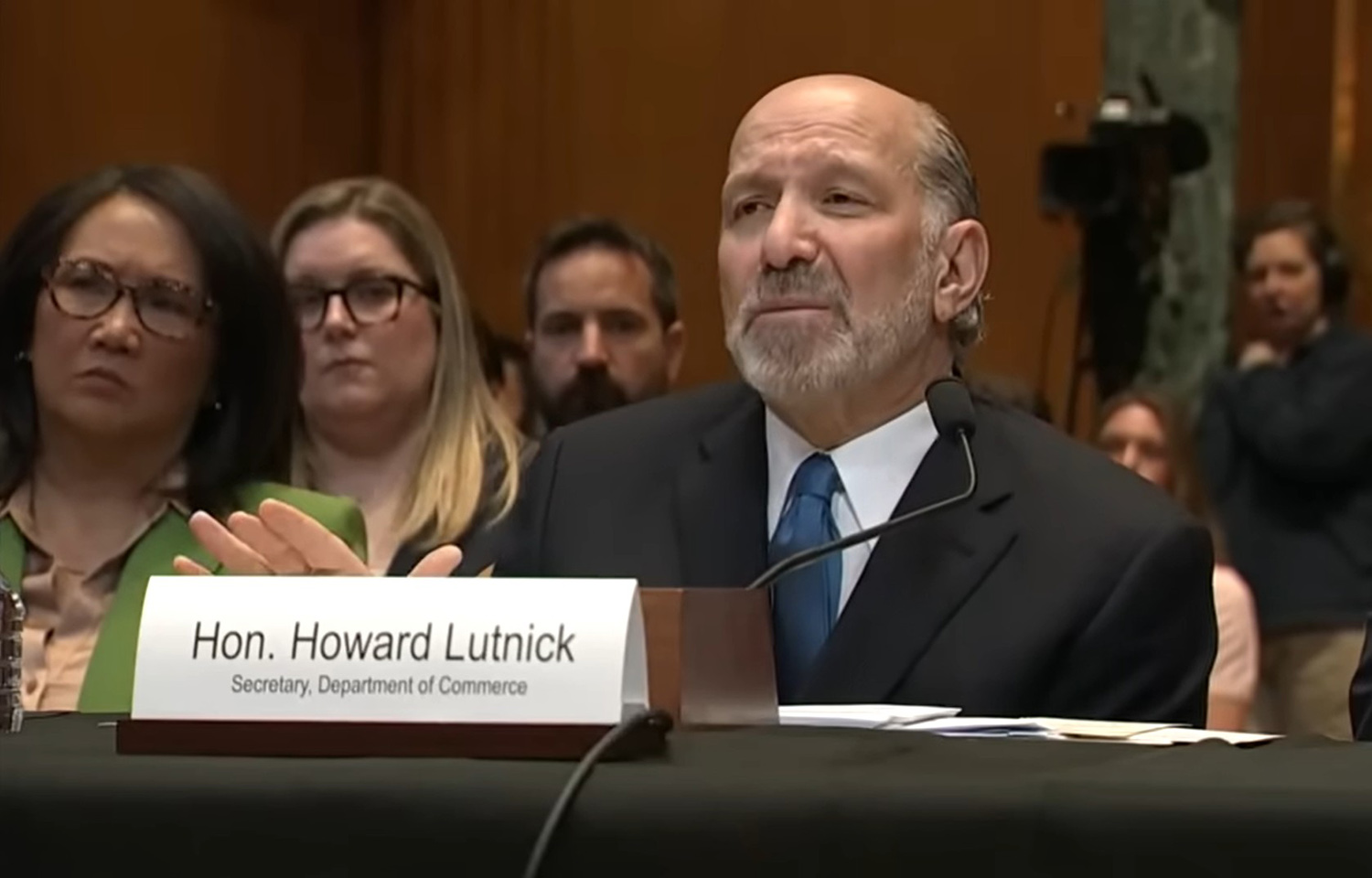
U.S. Secretary of Commerce Howard Lutnick commented on a handful of fisheries issues under questioning by lawmakers on the Senate Appropriations Committee during an 22 April hearing.
Senators demanded answers from the Trump administration official on regulations surrounding Maine lobster, the backlog of fishery disaster determination requests, and NOAA Fisheries’ capacity to conduct surveys in the face of budget and staffing cuts during a hearing ostensibly about the Department of Commerce’s fiscal year 2027 budget.
U.S. Senator Susan Collins (R-Maine), who chairs the Appropriations Committee, asked Lutnick to work with the Maine lobster industry in dealing with North Atlantic right whales. The species is highly endangered with roughly 380 left in existence, and according to NOAA Fisheries, the main threats facing the whales are commercial fishing gear entanglements and vessel strikes.
Pressure on the government to place more stringent regulations on Maine lobstermen hit a peak with a 2021 biological opinion that used worst-case scenarios to justify severe restrictions, though a court later vacated that opinion and Congress passed a law imposing a five-year moratorium on any new regulations of the lobster industry. That moratorium is set to lift after 2028, and Collins asked Lutnick to work with Maine lobstermen on any forthcoming rulemaking process.
“I'm asking today for your commitment to ensure that the Department will work with the lobster sector – they are the best stewards imaginable – and also with me and the rest of the Maine and New Hampshire delegation to ensure that future regulatory actions will fully incorporate the most current population data for right whales, real-time monitoring technologies, and region-specific risk assessments, rather than relying on outdated assumptions that may no longer reflect the actual right whale distribution, or fishing patterns,” Collins said.
“I hope to be considered the greatest friend of the lobstermen, who are a great asset, and you know I think that they are a great asset to our country,” Lutnick replied. “We promise you that we will use the best data and the most precise data to make sure that our decisions are right for America and ... right for the lobstermen of Maine. We should not be using outdated data; we should use the best data to make sure that we are protecting and doing the right thing for our great lobstermen.”
Collins also asked Lutnick about ropeless gear, which she called “prohibitively expensive” and potentially unsafe, requesting that the federal government pursue multiple technical solutions that can reduce entanglement risks, not just ropeless gear.
“That is an easy commitment for us. We will never pick just one winner. That makes no sense for America; the key to America is great innovation,” Lutnick said. “Everything can't just be well, that's a good idea, but it's darn expensive. That's just not the American way, and it's not the Department of Commerce's way, and it's not NOAA's way.”
Collins highlighted the concerns of Maine lobstermen with ropeless gear earlier in the month. She also sought assurances from Lutnick to support Maine’s lobster industry last year.
Later in the hearing, U.S. Senator Lisa Murkowski (R-Alaska) asked Lutnick whether his agency could fully execute the fisheries surveys necessary to regulate commercial fishing given the budget cuts proposed for NOAA Fisheries.
“We’re just seeing impacts due to climate change, due to additional predations, other factors that are out there, and we worry about the sustainability of our fisheries, but we know what has guided us through all of this – all the ups and downs – is when we have adequate stock assessment, adequate surveys, and support for our regional fishery management council, and we’re worried that NOAA’s ability to provide the information is increasingly limited by staffing and funding shortages,” Murkowski said. “So, looking at the FY27 funding levels, can you give me the assurance that I need to be able to tell folks back home that the adequate resources are going to be there for the survey and stock assessments that really underpin our fisheries management system?”
Without directly addressing Murkowski’s staffing or funding concerns, Lutnick assured her that NOAA Fisheries would have the resources necessary for those assessments. Lutnick also highlighted the use of unmanned technology to support fisheries surveys.
“We are going to use better technology, unmanned – you know, just, you can use enormous technology to do a better job, work with your fishermen themselves to have them be participants in that survey to make it better, more accurate, and make sure that we can unleash American fishermen and the great fishermen of Alaska,” Lutnick responded.
The White House topline fiscal year 2027 budget request includes a USD 135 million (EUR 115.2 million) increase in NOAA’s budget for “shipbuilding and unmanned systems programs,” which it said will support fisheries management.
Murkowski then pressed Lutnick on the backlog of requests to NOAA Fisheries for fishery disaster determinations.
“We have disaster requests out there for Bering Sea snow crab; we have numerous fishery disaster determinations, allocations, spending plans, so we need to know, again, the steps that you’re taking within the department to ensure fishery disaster declarations and funding allocations are processed efficiently,” Murkowski said. “I had asked for a list of what is out there and pending, and it – in fairness – is stuff from back in 2022. We’ve got one from ’22, several of them from 2023, 2024. So, these are backlogged. There’s no dispute as to whether or not they should be declared.”
According to NOAA Fisheries’ website, it does not appear that the agency has issued a fishery disaster determination since U.S. President Donald Trump took office again for his second term.
“Think about what happens to that fisherman who thought they were going to be able to get a little bit to tide them over until the next season. That fisherman may or may not still own a boat, so we need to know that you’re going to be prioritizing that,” Murkowski continued.
“I completely understand,” Lutnick said. “The program just had so little transparency that no one knew what was going on, and I am committed to changing that model, making sure it is transparent, because I understand when a fisherman can’t fish, that is the definition of a disaster, and I understand it and ... we will work hard to make it more transparent and more efficient and faster.”
Lawmakers have been pushing for improvements to the fishery disaster determination process for years. Former U.S. President Joe Biden signed a bill into law to streamline the system on his way out of office.
