


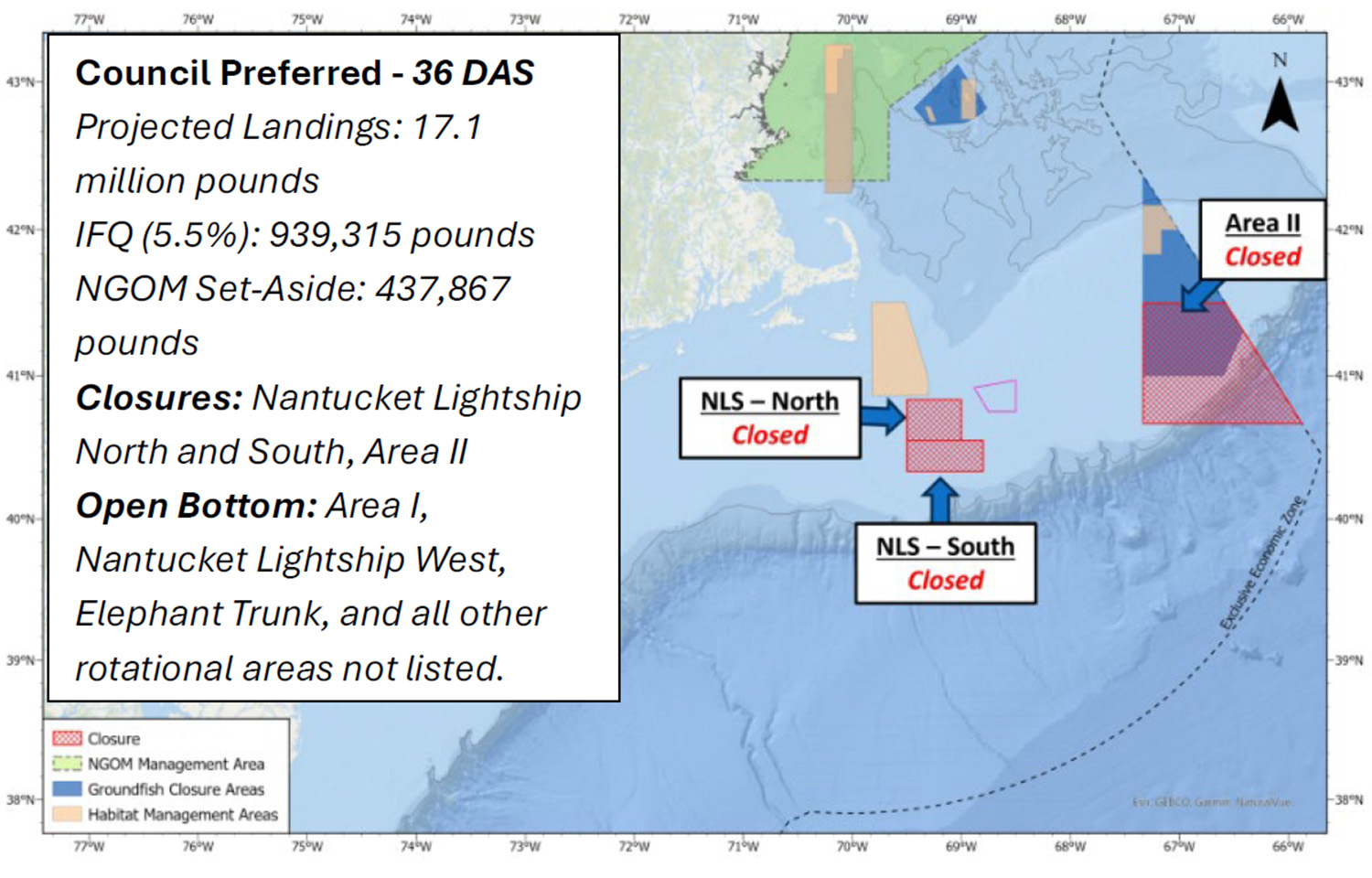
The New England Fishery Management Council (NEFMC) has approved Framework Adjustment 40, setting the rules for the Northeast U.S. scallop fishery for 2026 and projecting landings of 17.1 million pounds.
That 17.1 million pound project is down from the 19.75 million pounds projected for 2025, which itself was a 28 percent drop from the 27.4 million pounds projected for 2024. The decreased quota fits with NEFMC’s predictions in 2024, which suggested the years following would be challenging for the fishery.
Those landings are based on 36 days-at-sea (DAS) for full-time Limited Access permit holders and 14.4 DAS for part-time Limited Access permit holders. No Access Area fishing trips will be allowed in 2026, and the Nantucket Lightship North and South areas, as well as Area II, will both be closed to fishing.
“The decision followed extensive debate on alternatives ranging from the Scallop Committee’s recommendation of 34 DAS to the Advisory Panel’s preferred option of 38 DAS,” a release from the NEFMC said. “Scientific analysis indicated low overfishing risk under all alternatives. The discussion included testimony from Massachusetts State Senator Mark Montigny and numerous industry representatives.”
The 36 days-at-sea was lower than the 38 that the scallop industry was pushing for, and in correspondence sent to the council ahead of the meeting, some vessel owners said that even 38 days was lower than necessary.
“The 38 DAS alternative was not only initiated and supported by industry, but it also passed the Advisory Panel as its preferred alternative. Together, these actions demonstrate broad alignment between industry input and the Council’s advisory process,” Timothy Eilertsen, who operates in the scallop fishery, said.
Eilertsen added that the 38-day option would have still been below the regulatory threshold and below modeled fishing mortality levels where biological concerns would have begun to increase.
“The model demonstrates that 38 DAS remains a precautionary and biologically responsible effort level; therefore, reducing access further would require justification beyond conservation need,” Eilertsen wrote.
As NEFMC approved the scallop-fishing measures for 2026, it also adopted a new long-term strategic plan to guide future management of the Atlantic sea scallop fishery for the next three to five years. The council held several sessions with the industry and developed the plan over the course of the year.
The new plan has several key objectives, including improving the management capacity and flexibility of the council amid the changing environment of the management area. The plan identified that suitable habitat in Georges Bank “appears to be more resilient” to rising ocean temperatures but that suitable habitat is patchy in distribution and there are still knowledge gaps between the environment and recruitment dynamics of sea scallops.
It also acknowledged that irregular recruitment of the species and warming bottom sea temperatures could cause problems in the future that the NEFMC needs to be prepared to address.
To that end, the plan supports industry-based data collection, supporting independent efforts to create an efficient reporting platform for that data and the potential separation of Mid-Atlantic and Georges Bank resources in fishing management to be able to better adjust to the changing environment.
