


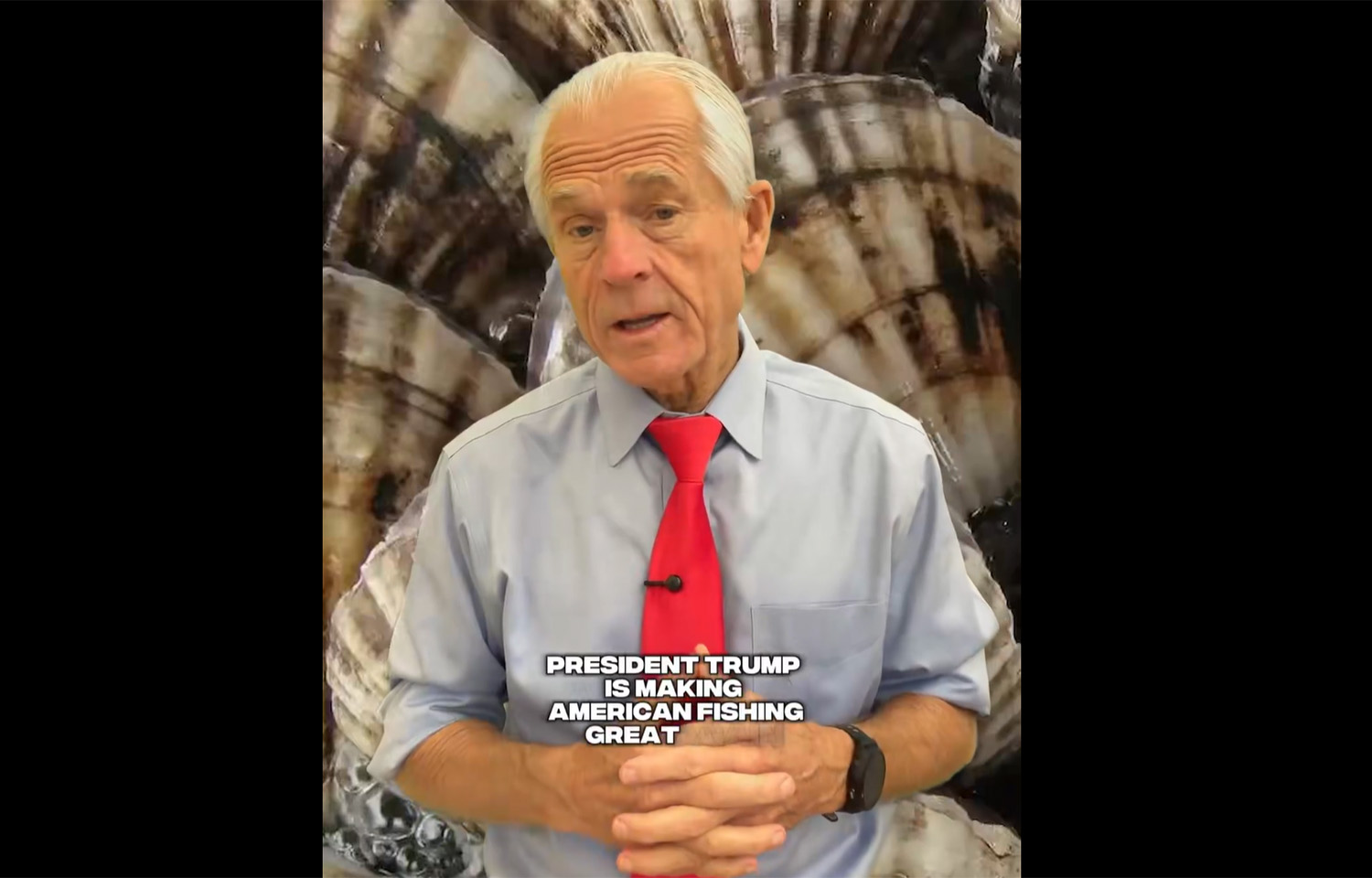
The administration of U.S. President Donald Trump is touting its designation of National Scallops Day, the opening of the Northern Edge of Georges Bank to scallop fishing, and permit stacking as a means of boosting the fishery.
The administration recently sent a deregulatory wish list to regional fishery management councils, which included a range of different recommendations like modernizing fleet capacity in the area managed by the Mid Atlantic Fishery Management Council and shifting the management of red snapper away from the South Atlantic Fishery Management Council.
Included among those asks was reopening the Northern Edge of Georges Bank to rotational scallop fishing in the area managed by the New England Fishery Management Council (NEFMC), the declaration of a National Scallops Day, and the push to unlock “permit stacking” for scallop vessels.
In a recently released video on social media, White House Senior Counselor for Trade and Manufacturing Peter Navarro said Trump is “making American fishing great again.”
“America has the largest wild scallop fishery in the world. Atlantic scallops are a premium American protein, yet imports now supply roughly 85 percent of what Americans consume by weight,” Navarro said. “The insanity is clearest on Georges Bank. Canada lawfully harvests scallops on its side of the line, while American boats remain locked out of the adjacent U.S. northern edge by regulators.”
Navarro said Canada landed more than 7 million pounds of scallops in Georges Bank, “roughly the same amount America imported from Canada,” in 2024.
“That’s not a supply problem. That is a policy failure. President Trump and NOAA are moving to fix it by restoring lawful science-based access to the Northern Edge of Georges Bank,” Navarro said.
Multiple fishing associations welcomed the announcement when it came out, calling it a boon for the industry.
“We are grateful to President Trump and his team for listening to the men and women of the scallop fleet and acting on their behalf,” Sustainable Scalloping Fund President John Lees said. “Permit stacking and Northern Edge access will make our fishery more competitive, more sustainable, and more valuable to the American families who depend on it. This is what it looks like when Washington puts American fishermen first.”
Each year, NEFMC either opens or closes different areas of the region’s scallop fishery based on survey and fishing data. In recent years, projected landings have fallen from the historically high harvest of 60 million pounds in 2019 to a projected 17.1 million pounds for the fishery in 2026.
When the council was making recommendations on the scallop fishery in 2026, it also adopted a long-term strategic plan designed to guide future Atlantic scallop measurement through the next three to five years, including guidance to improve management capacity and the flexibility of the council. The NEFMC’s Scientific and Statistical Committee recently released a report that found scallops are on a declining trend, with lower recruitment of young scallops meaning that trend will likely continue.
Part of that strategy was to separate out the Mid-Atlantic and Georges Bank resources to manage them separately. Research found the habitat in Georges Bank “appears to be more resilient to rising ocean temperatures.”
Another potential consideration was developing an access area on Northern Edge, which is in the Closed Area II Habitat. According to the council, access to that area may require mitigation, as it is the only protected juvenile cod habitat for the Georges Bank Atlantic cod stock, though that stock is now being handled differently after new regulations were passed.
