






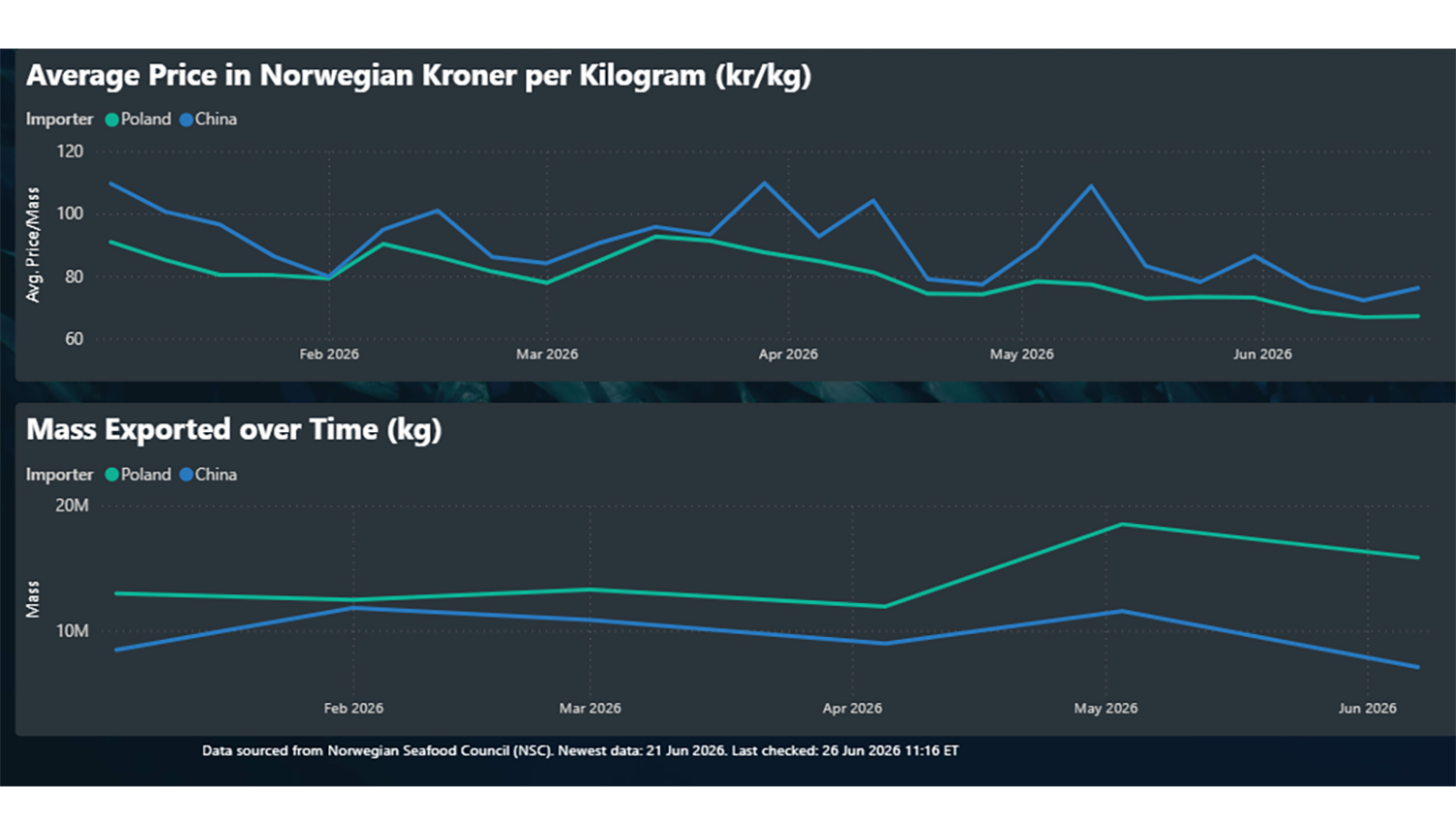
Norwegian exports of fresh salmon were up again in Week 25 (15 June to 21 June), according to data produced by the Norwegian Seafood Council and aggregated by the SeafoodSource Pricing Portal.
The biggest export market in Week 25 was, as usual, Poland, where much of the world’s processing of Norwegian salmon takes place. Poland saw a significant week-over-week (WoW) uptick in export mass from Norway in Week 25, bringing in 6.7 million kilograms of fresh whole salmon, a WoW increase of 2.23 million kilograms.
This increase is likely explained by Polish processors capitalizing on this month’s historically low prices for Norwegian salmon.
The second biggest export market in Week 25 for the whole fresh category was China, which bought 2.39 million kilograms. The Netherlands came in third, with 2.33 million kilograms, and France came in fourth at 1.67 million kilograms.
Of the largest markets this week, Poland saw the lowest average prices, with an average of NOK 67.53 (USD 6.81, EUR 6.02) per kilogram. France saw an average of NOK 69.68 (USD 7.02, EUR 6.21) per kilogram, the Netherlands an average of NOK 71.24 (USD 7.18, EUR 6.35) per kilogram, and China an average of NOK 75.08 (USD 7.57, EUR 6.69) per kilogram.
In the past year, lower prices for Norwegian salmon have appeared to boost the growth of the Chinese market for Norwegian exports, with Norwegian Seafood Council China Envoy Sigmund Bjorgo recently telling China Daily that he believes China could soon eclipse Poland to become the biggest export market for Norwegian seafood.
A SeafoodSource review of export prices in these markets since the start of 2026 showed that despite consistently seeing the highest prices of any of the top four markets, China was also consistently the second-largest export market for Norwegian salmon. There were even a few weeks this year, during Chinese cultural events, when the Chinese market was the world’s largest market for fresh Norwegian salmon.
What’s more, this year’s data suggests that the Chinese market does not immediately contract even when prices rise dramatically week to week, as they did in early May, when prices rose to NOK 109.14 (USD 11.00, EUR 9.73), nearly NOK 30 (USD 3.02, EUR 2.67) above the rates seen in the other big markets.
Despite those sharp price increases and others experienced throughout the year, the Chinese market continued to import relatively consistent levels of Norwegian salmon. The growing strength of Asian markets more generally was recently confirmed by data produced by the NSC and U.K.-based Seafish.
All of this suggests that low prices may not be the only factor at play in China’s growing salmon market.
In a comment on a LinkedIn post about historically low prices for Norwegian salmon, Chilean salmon sector veteran Carlos Palma said that what he’s seen recently in China has replicated the “dynamic years ago in Brazil, where sustained price reductions transformed salmon from a niche imported product into a mainstream retail category.”
It is not isolated lower prices, Palma said, but consistent price competition that permanently reshapes markets.
“If Norwegian salmon becomes consistently more competitive, retailers and importers may increasingly rely on Norwegian supply, strengthening its position before these markets fully mature,” Palma said. “I wouldn't be surprised to see this pattern repeated in India, Southeast Asia, parts of the Middle East, and even second-tier cities across Latin America. Lower prices reduce the barriers to entry for retailers, foodservice operators, and consumers, creating new demand rather than simply redistributing existing volumes.”
