
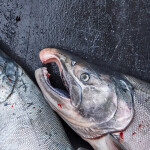

Scottish salmon has officially secured “protected geographical indication” (PGI) status within the E.U., prohibiting salmon from any other country from being labeled as originating from Scotland.
Alongside the new status, the E.U. has also decided to remove the previously protected name “Scottish farmed salmon,” and the bloc will now use the label “Scottish salmon.” Scottish trade body Salmon Scotland said the move aligns with the U.K.’s PGI, which was established in April 2024 by the U.K. Department of Environment, Food, and Rural Affairs.
“Scottish salmon is a premium product, so this decision ensures that European consumers know they are eating the best salmon in the world when they purchase our fish,” Salmon Scotland Chief Executive Tavish Scott said in a release. “The E.U. PGI will boost consumer confidence across the continent and help us further grow our export market, delivering jobs and investment for rural communities in Scotland.”
The geographical designation will apply to salmon from “the coastal region of mainland Scotland, Western Isles, Orkney, and Shetland Isles,” according to Salmon Scotland. The trade group also said it should not have any impact on Scottish wild salmon, as the product is no longer commercially available for consumption.
Wild salmon was previously given PGI status in 2012, but wild catches of the species continued to drop in the years that followed and the retention of salmon caught in coastal waters has been prohibited since 2016.
Salmon Scotland said packaging on salmon from Scotland will “still make it clear that salmon are farm-raised.”
“Our salmon farmers work hard to rear their fish, and this recognition by the European Commission is testament to the commitment of all those who continue to meet the growing demand for Scottish salmon at home and abroad,” Scott said.
UK Government Scotland Office Minister Kirsty McNeill said the new rules will help Scotland maintain the reputation of its salmon.
“As part of our Plan for the Change, the U.K. Government's Brand Scotland initiative is fully backing Scotland’s world-class food and drink sector, including securing a trade deal with the E.U. that will remove red tape for businesses such as Scottish salmon producers to export to the continent,” McNeill said.
Salmon has become the U.K.’s largest food export, and exports hit a value record of GBP 528 million (USD 698 million, EUR 602 million) in H1 2025, and are on track to exceed GBP 1 billion (USD 1.32 billion, EUR 1.14 billion) in value for the first time.
The E.U. is the biggest destination for Scottish salmon – with France dominating its export purchases. France purchased GBP 462 million (USD 611 million, EUR 527 million) worth of Scottish salmon in 2024, making up half of all exports.
Scotland has capitalized on France’s Label Rouge quality mark, which was established in the 1960s as a means of placing and indicating stringent quality standards for food producers. The country has made the label central to its marketing strategy in France, and recent changes to Label Rouge have benefitted Scotland’s salmon farming industry.
Salmon Scotland said roughly a third of the salmon sent from Scotland to France carries the label, and the PGI will help the country grow its market in both France and other E.U. countries.
