






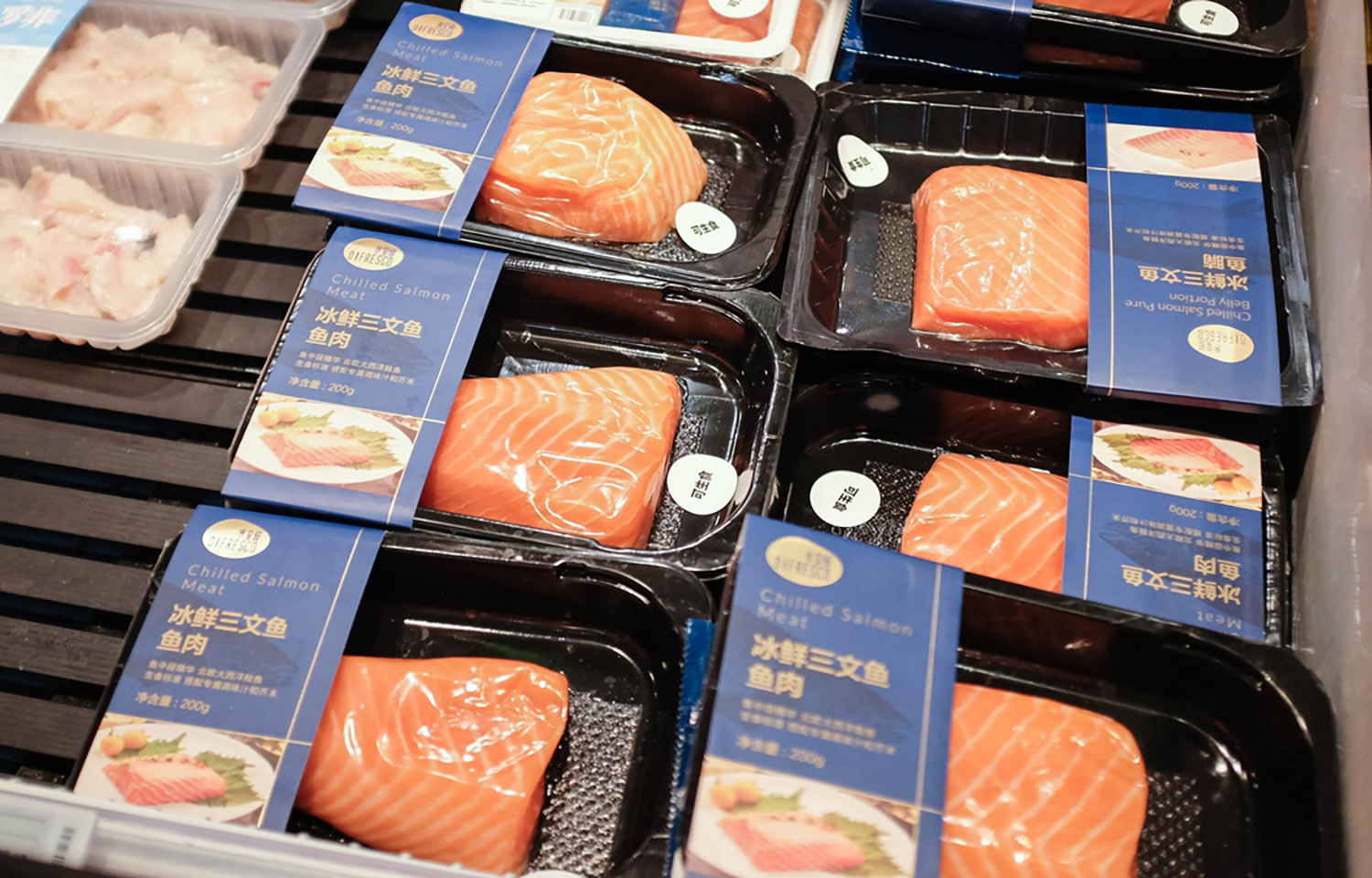
Weak consumer purchasing power in China, a low availability of large-sized salmon in Norway, and a shift in processing operations to Vietnam have contributed to weakening Norwegian seafood trade to the world’s largest consumer market to start 2024.
Sales of Norwegian salmon into China fell in the first half of 2024, according to the Norwegian Seafood Council’s (NSC) office in China, with salmon shipments were down 14 percent by volume and 17 percent by value year over year from January to May 2024.
“NSC does not give sales predictions since this can influence price-setting in markets, but in general terms, we can see a somewhat weaker development so far this year compared to last year,” Jan Eirik Johnsen, interim head of the NSC’s office in Shanghai, said. “But, this is still the second-best January-to-May results for Norwegian salmon to China. One of the reasons for the reduction in export is lower availability of big sizes of salmon that the Chinese market is demanding.”
Norway's mackerel sales in China have also declined, according to Johnsen.
“The big picture is that less Atlantic mackerel is exported for reprocessing in China. Last year saw a 44 percent drop in the export to China compared to the year before. This trend is also continuing this year,” he said.
Norway has steadily upped its efforts to spur demand for mackerel in China. Victoria Braathen, who is now the director of the NSC’s U.K. operations, told SeafoodSource in 2019 while she was the director of the council’s Chinese operations that a mackerel-focused partnership between COFCO and Pelagia illustrated “the potential of Norwegian mackerel both in foodservice and for home cooking” in China.
“The domestic market for mackerel has always been a small part of the total export to the market, and our impression is that the market is still developing,” Johnsen said. “It is hard to get facts on the development since most of the mackerel is consumed in the foodservice sector and then Japanese restaurants, but in retail, we have seen positive development the last few years, with more stores carrying Norwegian mackerel.”
However, Norway has begun to send less mackerel to China for processing purposes, Johnsen said.
“The two main reasons for this are the weakening of the yen making processing in China more expensive, but also the fact that fillets processed in China have a tariff into Japan, whereas fillets produced in Vietnam don’t have any tariffs," he said. "Vietnam was almost as big a destination for Norwegian mackerel last year as China but has surpassed China by a large margin this year.”
The NSC has also focused marketing money in recent years on creating a premium market for Norwegian cod, with advertising campaigns in China’s first-tier cities promoting it as “Norwegian Arctic Cod.”
Those efforts seem to have paid off, as Norway's cod exports to China increased 11 percent by volume and 19 percent by value year over year from January to May, Johnsen said.
“This is a strong development considering that overall exports of cod from Norway fell by 10 percent in the same period,” he said.
Johnsen said he believes in the second half of the year, salmon sales trends will fall in line with cod.
“Going forward, the gap compared to last year is forecasted to close. Looking at the total supply of salmon to China, our view is that the demand is at a solid level,” he said.
That projection may be the reasoning for continued outreach efforts in China by Norwegian salmon firms. At the recent SIAL F&B industry trade fair in Shanghai, Norwegian salmon firm Hitra Salmon exhibited with its sole representative in China.
The opening of a new freight service between Norway and China, introduced in early July, may also help salmon trade between the two countries in the latter half of 2024 and beyond. The Nanchang-Oslo service, operated by Capital Airlines using an Airbus A330, will bring e-commerce deliveries to Norway for Scandinavian customers and pick up Norwegian salmon for the return journey.
