



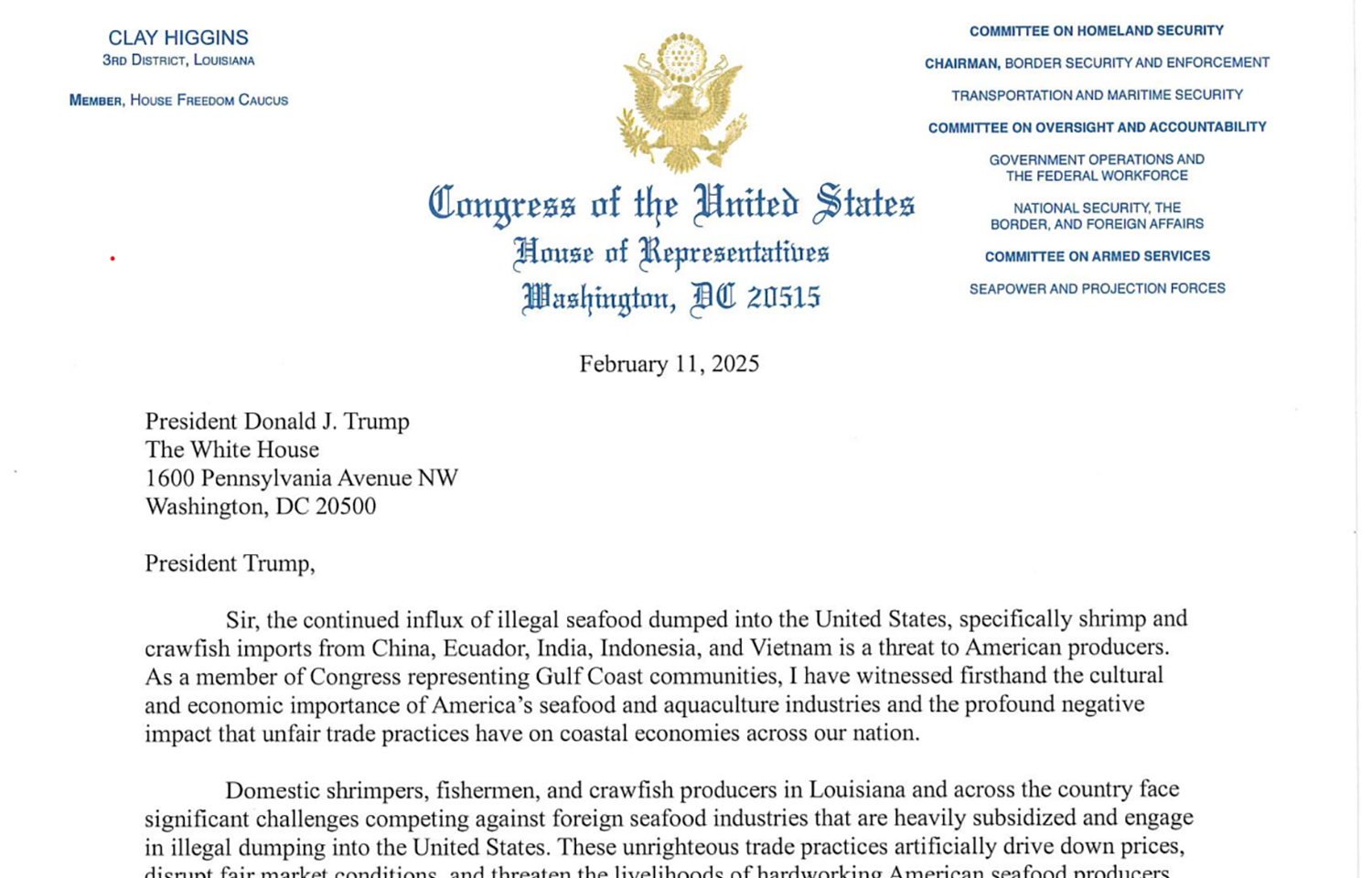
U.S. Representative Clay Higgins (R-Louisiana) recently sent a letter to the administration of U.S. President Donald Trump that offered simple advice on Trump's tariff policies: To save American seafood, tax imports from China, Ecuador, India, Indonesia, and Vietnam.
Higgins shared the letter he sent to the president on social media platform X with the caption, “Protecting the American seafood industry requires aggressive action.”
In it, he argued that the U.S. government’s seafood trade policies were harming the American seafood sector. The U.S. International Trade Commission has made similar claims, arguing that manufactured confusion about shrimp origin creates unfair competition between lower-priced foreign shrimp and higher-priced domestic shrimp.
“Domestic shrimpers, fishermen, and crawfish producers in Louisiana and across the country face significant challenges competing against foreign seafood industries that are heavily subsidized and engage in illegal dumping into the United States. These unrighteous trade practices artificially drive down prices, disrupt fair market conditions, and threaten the livelihoods of hardworking American seafood producers,” Higgins said in his letter.
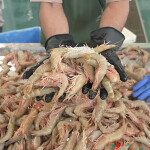
The countries targeted in the letter include the biggest importers of shrimp to American markets – India, Ecuador, and Indonesia – and others which have rapidly increased their shrimp production in recent years – China and Vietnam.
Higgins called for the “administration to use all available enforcement tools, such as imposing antidumping and countervailing duties, implementing stricter testing protocols, and taking decisive actions, including levying tariffs of up to 100 percent or destroying shipments that fail to meet U.S. health standards, to ensure a level playing field for American producers.”
Action to protect the seafood industry, Higgins said, will “extend a lifeline to coastal states at risk of losing vital industry and economic engines.”
The Southern Shrimp Alliance (SSA) also issued a statement about seafood tariffs on 11 February, echoing Higgins's claims.
“The absence of any tariffs on foreign shrimp has played a huge role in the dominance of imports in our market,” the SSA release said. “The U.S. International Trade Commission estimates that 94 percent of the volume of shrimp consumed in the nation is imported from other countries. In 2021, the United States set a record with roughly 2 billion pounds of imported shrimp products valued at USD 8 billion [EUR 7.7 billion].”
According to the SSA, 90 percent of that weight came from India, Ecuador, Indonesia, and Vietnam. The SSA release also pointed out that these countries impose tariffs on any imports of U.S-origin shrimp.
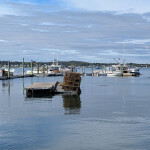
Further, the SSA said in October 2024 that NOAA’s 2023 data, which had just then become fully available, suggested a “historic collapse in dockside prices and historic lows in landing volumes.”
That data showed that June 2023 landings in the Gulf of Mexico, which the Trump administration has renamed the Gulf of America, for instance, were the lowest recorded in the previous 22 years of record-keeping; South Atlantic landings that month were the third-lowest on record.
The SSA said that U.S. landings NOAA reported between January and June 2024 amounted to 25.9 million pounds, or 11,748 metric tons (MT), and represented a 45.8 percent drop from the historical average of 47.7 million pounds (21,636 MT). Certain states were more affected than others, with North Carolina reporting a 92.8 percent drop in landings, Florida recording an 87.6 percent decline, and Mississippi recording a 78.7 percent decline.
"It is impossible to explain to anyone in this industry why it is fair that we open our doors to shrimp from every corner of the earth when our trading partners have maintained high tariff barriers to any shrimp we might sell them,” SSA Executive Director John Williams said on 11 February. “The industry has no objection to international trade, but the terms of trade must be fair and they cannot continue to put America last."
Meanwhile, Trump signed an executive order on 13 February ordering his advisors to calculate new tariff levels for U.S. trading partners. According to the New York Times, the order "directed [the president's] advisers to come up with new tariff levels that take into account a range of trade barriers and other economic approaches adopted by America's trading partners."
It seems likely that any recalculated tariffs would include measures to combat foreign shrimp undercutting U.S.-sourced shrimp in the American market. As Trump signed the order, Nerendra Modi, the prime minister of India, the biggest importer of shrimp to the U.S., was visiting the White House to discuss his own nation’s tariffs on U.S. imports.
