





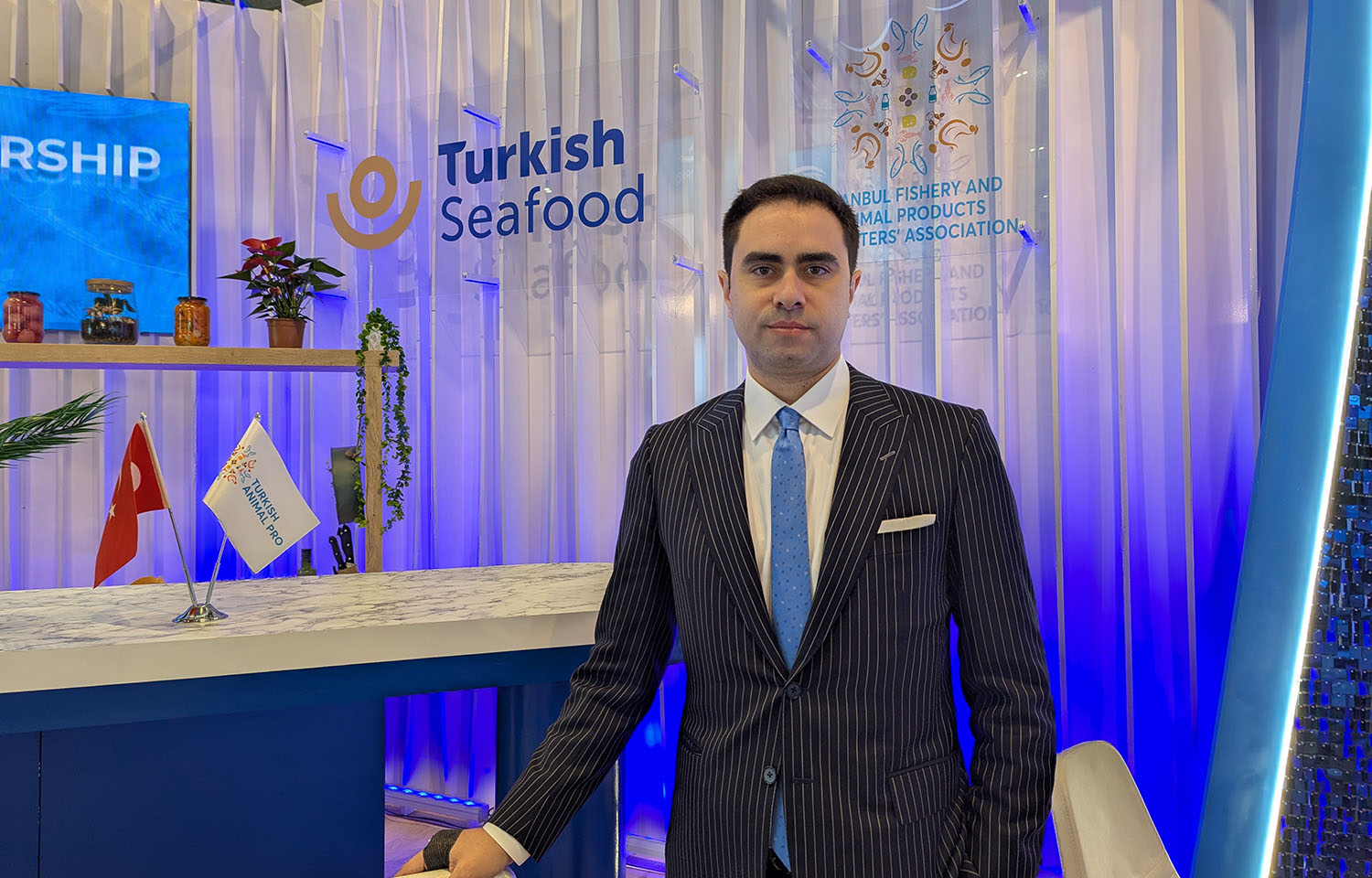
The latest edition of Seafood Expo Global/Seafood Processing Global marked the 20th year that Turkey had a national pavilion for the country’s seafood exporters.
A lot has changed since it first hosted the pavilion, Istanbul Fisheries and Animal Products Exporters Association Vice President Ogulcan Kamal told SeafoodSource during the event, which ran from 21 to 23 April in Barcelona, Spain.
The pavilion at this year's show hosted 16 different seafood producers, representing a swath of different species including sea bass and “Turkish salmon trout.”
Kamal said seafood exports are becoming a more and more valuable part of Turkey’s economy and hit a new high in 2025.
“Last year, 2025, was a record year for the Turkish seafood exports. We have reached 1 million tons of production, and [USD] 2.2 billion [EUR 1.87 billion] of export value,” Kamal said.
Of that total, Kamal said the vast majority of exports – at least 80 percent – is made of four different species: sea bass, sea bream, Turkish salmon trout, and bluefin tuna. According to government statistics, 600,000 metric tons (MT) of the production volume was made of aquaculture products, while the remaining 400,000 MT was fisheries, both inland and in the nation's two adjacent seas.
Since Turkey first started hosting companies at the national pavilion at Seafood Expo Global in 2006, the country’s seafood export value has ballooned by 40 times.
“Twenty years ago, total Turkish seafood export value was [USD] 50 million [EUR 42 million],” Kamal said.
The country is aiming even higher in 2026, targeting USD 2.5 billion (EUR 2.1 billion) in exports for the year, he said.
“Turkey is exporting to around 110 different countries worldwide and is still growing and expanding our production volume and capacity,” Kamal said.
It is only recently that a major proportion of the country’s production and exports has been sourced from aquaculture, and Turkey has a few advantages for strong aquaculture production, Kamal said. Its location between the Mediterranean and Black seas gives it two different types of salinity, which gives it more production options than many other countries.
“The salt percentage is different, so you can adapt different species in different seas,” Kamal said. “There are not a lot of countries with that advantage.”
The country also has rich freshwater resources, which are allowing the company to branch out into different methods of production. As the aquaculture sector grows, it has continued to focus on innovating, Kamal said.
“What we are applying now in Turkey are the best practices inside the sector, and now we see development in land-based facilities, production facilities, as well as processing facilities in Turkey,” he said.
Turkey’s location is also a big advantage for exporting seafood, Kamal said. As the bridge between Asia and Europe, the country is a short flight to several major seafood markets, allowing it to service most major markets.
Governmental support has also been a huge boon for the country, both in terms of production and in promoting the country’s seafood abroad. Kamal said the government has historically been accepting of new aquaculture areas in its bodies of water and, more recently, has shown support for a shift to land-based recirculating aquaculture system facilities. He said more companies are looking into developing land-based facilities to avoid the environmental variability that can come from climate change.
“It allows you to take control of your production environment,” Kamal said.
The government also assists with companies’ marketing efforts abroad. Attendees at Seafood Expo Global can secure government funding for their participation in the pavilion, as a means of encouraging Turkish seafood producers to attend and showcase products.
“We are really traveling everywhere,” Kamal said.
The Istanbul Fisheries and Animal Products Exporters Association is also looking to put additional effort into the Chinese market and has begun to attend trade shows there as well.
“We see the potential and we see the growth, so we said, ‘Why not. Let’s participate with a bigger group there,’” Kamal said.
Turkey recently began exporting seafood to China after the two countries signed a trade agreement in October 2025, which allowed it to send aquatic products to China for the first time.
“We see development in bluefin tuna and also for trout in the Chinese market,” Kamal said, adding that the country has taken notice of Norway’s recent success in the country and is “eager to follow” into the world’s largest seafood market.
