






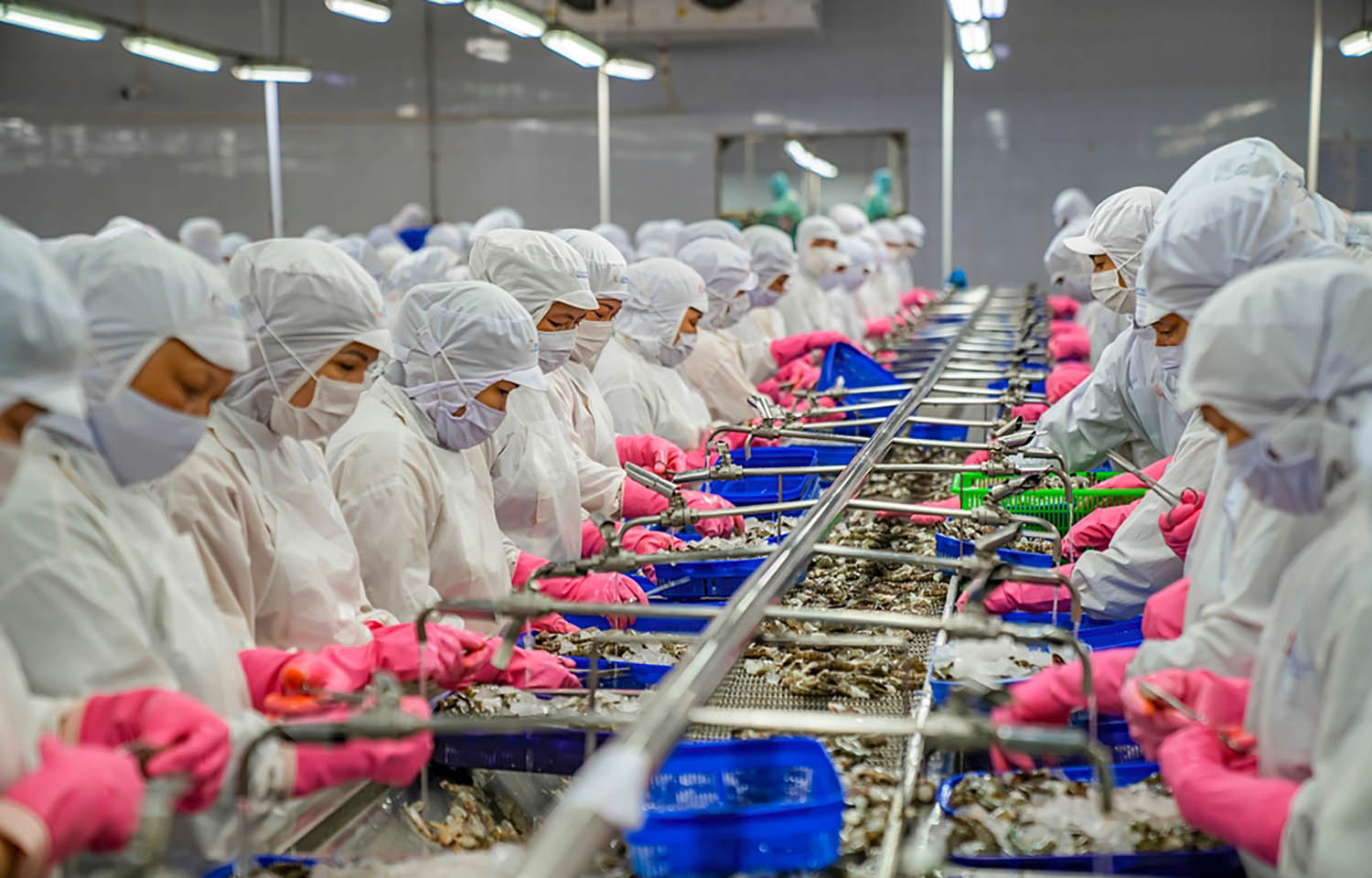
The Southern Shrimp Alliance (SSA), a Tarpon Springs, Florida, U.S.A.-based nonprofit representing the U.S. domestic shrimp industry’s interests, has praised the U.S. Department of Commerce (DOC) for its recent decision to maintain Vietnam's designation as a non-market economy.
Following nearly a year of review, the DOC announced on 2 August it will continue to classify Vietnam as a non-market economy, meaning that products exported from Vietnam to the U.S. will continue to face different treatment in antidumping and countervailing investigations, rather than solely considering actual production costs in Vietnam.
“The U.S. commercial shrimp fishery is collapsing, and while one part of the DOC tells fishermen that they won’t consider whether imports have caused a fishery disaster, another part of that agency spent almost a year on the Vietnamese Communist Party’s claim that they operate a market economy,” SSA Executive Director John Williams said. “While we cannot make sense of why this was ever an issue, we are, nevertheless, grateful that the DOC came to the right conclusion.”
In response to the DOC’s announcement, Vietnam’s Ministry of Industry and Trade said it would review the DOC’s arguments and plans to submit a renewed request for Vietnam to be recognized as a market economy.
On 3 August, Vietnamese Ministry of Foreign Affairs’ spokesperson Pham Thu Hang also said she was disappointed with the DOC’s decision, but affirmed that relevant Vietnamese agencies will continue to collaborate closely with U.S. partners to maintain strong bilateral relations.
The SSA, along with other domestic industry groups, has vehemently opposed continued requests from Vietnam to become a market economy. U.S. senators have expressed similar sentiments, urging the DOC not to grant market economy status to Vietnam in order to protect the interests of U.S. industries.
In a letter dated 25 July, John Boozman and Tom Cotton, U.S. senators from the state of Arkansas, said granting market economy status to Vietnam could strengthen cooperation between Vietnam and China. That could be an issue, they said, as China could use market economy status in Vietnam to increase transshipment through the country and move some operations there to take advantage of the country’s potentially newfound preferential treatment.
The U.S. is a leading destination for seafood from Vietnam, particularly shrimp and pangasius. Vietnamese seafood exports to the U.S. from January to June this year totaled USD 782.3 million (EUR 717.2 million), an increase of 10.5 percent from USD 707.9 million (EUR 649 million) in the same period in 2023, according to Vietnamese customs data.
Shrimp made up USD 303 million (EUR 277.8 million) of that total, a 1 percent rise year over year. The value of pangasius exports from Vietnam to the U.S. grew 14 percent in the period, rising to USD 160 million (EUR 146.7 million) in the first half of this year.
This growth came amid preliminary determinations the DOC made over countervailing duties on 26 March, in which the DOC imposed a duty rate of 2.84 percent for most Vietnamese shrimp companies. However, one company, Thong Thuan Company, faced a countervailing duty of 196.4 percent, which the DOC said was “based on adverse facts available.”
The same month, the DOC also announced an increase in antidumping duties for five pangasius exporters from Vietnam, following a period review spanning from 1 August 2021 to 31 July 2022.
Given the challenges the U.S. market is posing to the Vietnamese seafood industry, the Vietnam Association of Seafood Exporters and Producers (VASEP) said in a statement on 6 August that Vietnamese companies should focus on expanding exports to other major markets like Europe, Japan, Korea, and China. This strategy will not only lessen reliance on the U.S. market but also provide opportunities for the Vietnamese seafood industry to achieve sustainable long-term growth, according to VASEP.
Minh Phu Seafood, a top shrimp producer from Vietnam, has already begun to implement this strategy. Though the U.S. has traditionally been one of its key markets, the company, in recent years, has faced heavy competition from shrimp firms in Ecuador and India, prompting it to pivot shrimp sales away from the U.S.
