




High costs of entry, coupled with permitting barriers and the difficulty of maintaining modern fishing vessels, has the U.S. seafood industry’s workforce at an inflection point.
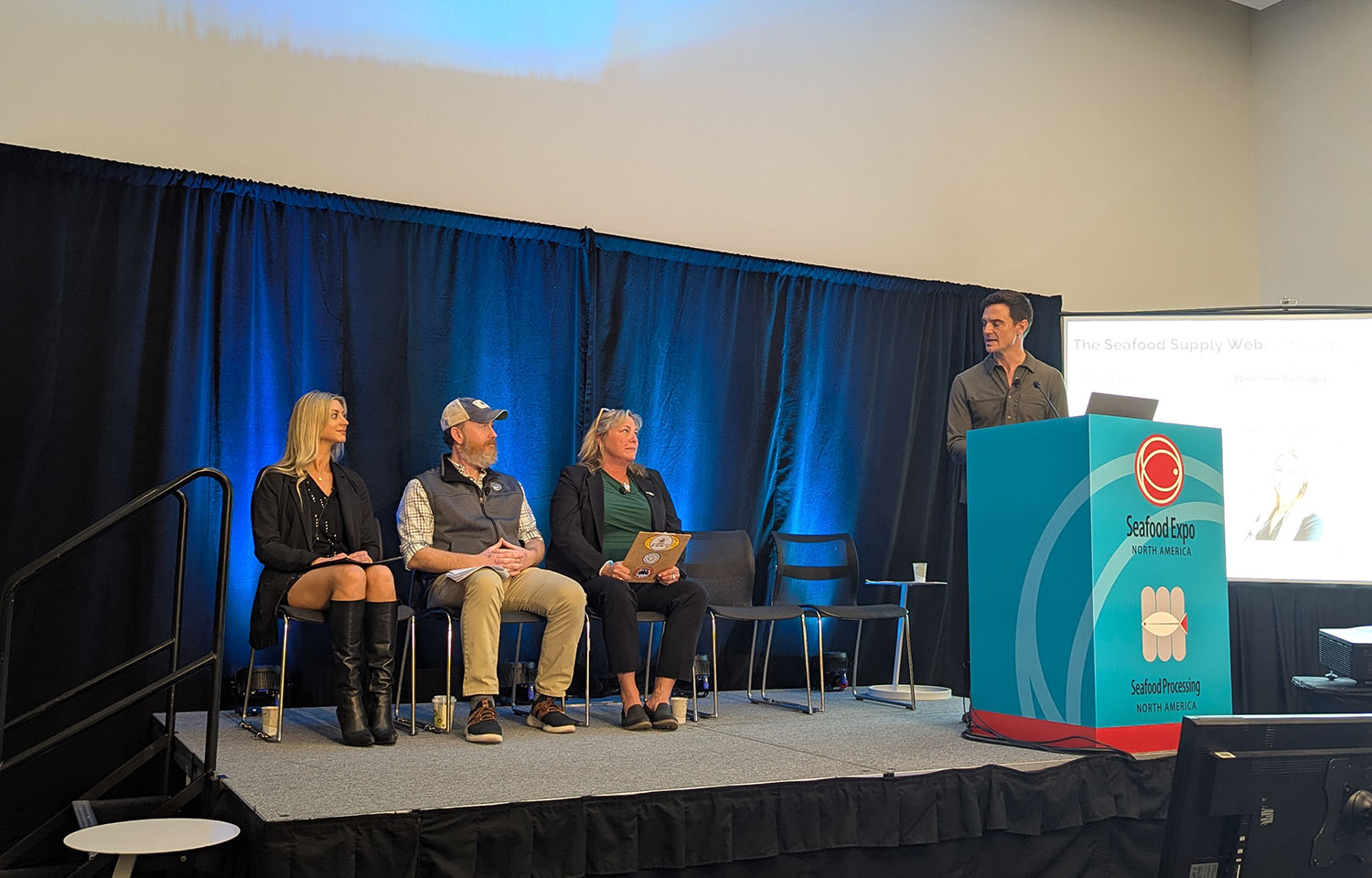
Ocean Strategies Principal Brett Veerhusen, speaking at a panel during the 2025 Seafood Expo North America – which ran from 16 to 18 March in Boston, Massachusetts, U.S.A. – said the average age of a fisherman in the U.S. is increasing thanks to a high barrier to entry. Veerhusen said the Magnuson-Stevens Act, which was designed to better manage U.S. seafood stocks, has helped reduce overfishing but has also led to increased consolidation – which leaves little room for new fishermen.
“We’re at this inflection point in the seafood industry of trying to struggle with maintaining a modern fleet and a modern workforce, with increased management difficulty and higher financing costs and barriers to entry,” he said.
New England Young Fishermen’s Alliance (NEFYA) Founder and Executive Director Andrea Tomlinson said she first understood how intense the difficulties are while running a community-supported fishery in the U.S. region of New England.
“We’re in Portsmouth, New Hampshire, and no new young people were coming into the captain’s wheelhouse,” Tomlinson said. “One of our deckhands, a real popular guy on the seacoast, bought his captain’s vessel and was living on the vessel with the help of his grandparents. They couldn’t afford to pay the mortgage for the vessel and afford an apartment. So, he’s living on the vessel – and he couldn’t afford a permit to fish the vessel.”
Tomlinson said the permits that young fisherman need just to start fishing could cost up to USD 300,000 (EUR 264,000), which on top of the cost of a vessel, mean fishermen face a huge barrier to entry to start fishing.
The situation isn’t unique to New England.
Gulf Reef Shareholders Alliance Deputy Director Eric Brazer said the “greying of the fleet” is impacting Southern fisheries, too. The alliance is the largest organization of commercial snapper and grouper fishermen along the Gulf Coast, and he, too, has seen barriers to entry grow and participation in fishing either get older or fall away completely.
Brazer said some of those barriers comprise a lack of the supporting resources needed in order for fishing to be practical as a career choice. Things like fuel, ice, and processing facilities fishermen sell their catch to are all important – and are also increasingly scarce in certain communities as working waterfronts disappear and expensive tourist-oriented businesses move in.
“This happens everywhere along all the coasts. Key West, [Florida], is a place near and dear to my heart. Right next to it is Stock Island. I don’t know how many of you have been to Stock Island recently, but you’re more likely to get a USD 25 [EUR 22] burger than see working waterfront,” Brazer said. “Cost of living is getting much, much more expensive, and it’s harder and harder for fishermen to live near their boat, so some of them either have to live on their boat or travel quite a ways to get to their boat.”
The fisheries management process has also led to frustration among some in the industry, driving many to find other careers.
Both NEFYA and the Gulf Reef Shareholders Alliance are working to try and lower that management burden while also educating younger members of the industry on how to navigate it.
“We’ve tried to really lean into it, especially with the younger generation, and try to work with them to get them to embrace the management process, to get them to meetings ... and start to build those relationships with the people who ultimately make the regulations they have to live under,” Brazer said. “Sometimes, the easiest part of being a commercial fisherman is actually going out and catching fish – even that’s not easy.”
Tomlinson said NEFYA is taking a similar approach and helps train young men and women who have worked on vessels in the skills they said they lacked.
“We did a lot of scoping work for it, and what they said they needed was business management – how to get a loan, how to get their taxes done,” Tomlinson said. “They said they wanted ways to diversify their marketing strategy, they wanted ways to get into different fisheries, they wanted to learn how to sell directly to the customer, and they wanted to understand fisheries management a little better.”
NEFYA has a nine-month program for young fishers that is working to bridge the gap between where the industry is at and where regulations currently stand.
“What we’re really trying to do is get industry and regulators to start talking,” she said. “If you’re not speaking up for a fisherman, oftentimes they’re not comfortable doing it for themselves. We’re trying to bridge those gaps and get our workforce a little bit more powerful in the small- and medium-boat commercial fishing industry.”
Tomlinson said getting more young fishermen on advisory panels and regional councils to help find solutions to the many issues the industry faces is important, and the education component of NEFYA is key to that. Getting involved with those panels can also be difficult. For the average fisherman, taking the time to understand 800 or more pages of literature about a particular advisory panel meeting can be a daunting task without any guidance.
“It’s a real transition for someone who hasn’t had a formal fisheries education to be able to absorb that information,” Tomlinson said.
Tomlinson highlighted a program started by the Gulf of Maine Research Institute called the Marine Resource Education Program which has been teaching industry members about how to advocate for fisheries in an effective way.
Another part of NEFYA’s training is public speaking classes so that when it comes time to speak up, the men and women in the industry can do so effectively.
“Trust me, all fishermen and women are dreading public speaking, but we have made professional public speakers out of these people,” Tomlinson said. “It’s so important for people in the fishing industry to be able to advocate for themselves and speak to what their issues are and talk about solutions.”
J.J. McDonnell & Co. Business Development Manager Stephanie Pazzaglia one solution to the aging fleet and the barriers to entry is companies recognizing the problems that fishermen supplying them with their catch face. J.J. McDonnell has programs to help fishermen in the Chesapeake Bay with some of their overhead and logistical costs to make it easier to fish.
“We provide a lot of our fishermen vats and ice to take that burden away. We are also picking up the fish with our refrigerated trucks and really trying to make that as easy as possible so they can really focus on the fishing,” Pazzaglia said.
Fishermen in the Chesapeake Bay region are facing many of the same cost pressures, with escalating costs along the coast and a lack of land-based resources.
“It’s expensive to live on the coast, and everyone wants to. No one wants to live next to a packing house,” Pazzaglia said. “That’s a real part of it, and they’re really necessary for these fishermen to be able to come in to pack out their boat.”
Another key to ensuring the fisheries are robust is ensuring the end market is there for the catch, she said.
“We want to continue to promote fish that we have here in the U.S. because having access to fresh, responsibly sourced food here is super important; it’s something that we should never take for granted,” Pazzaglia said.
