






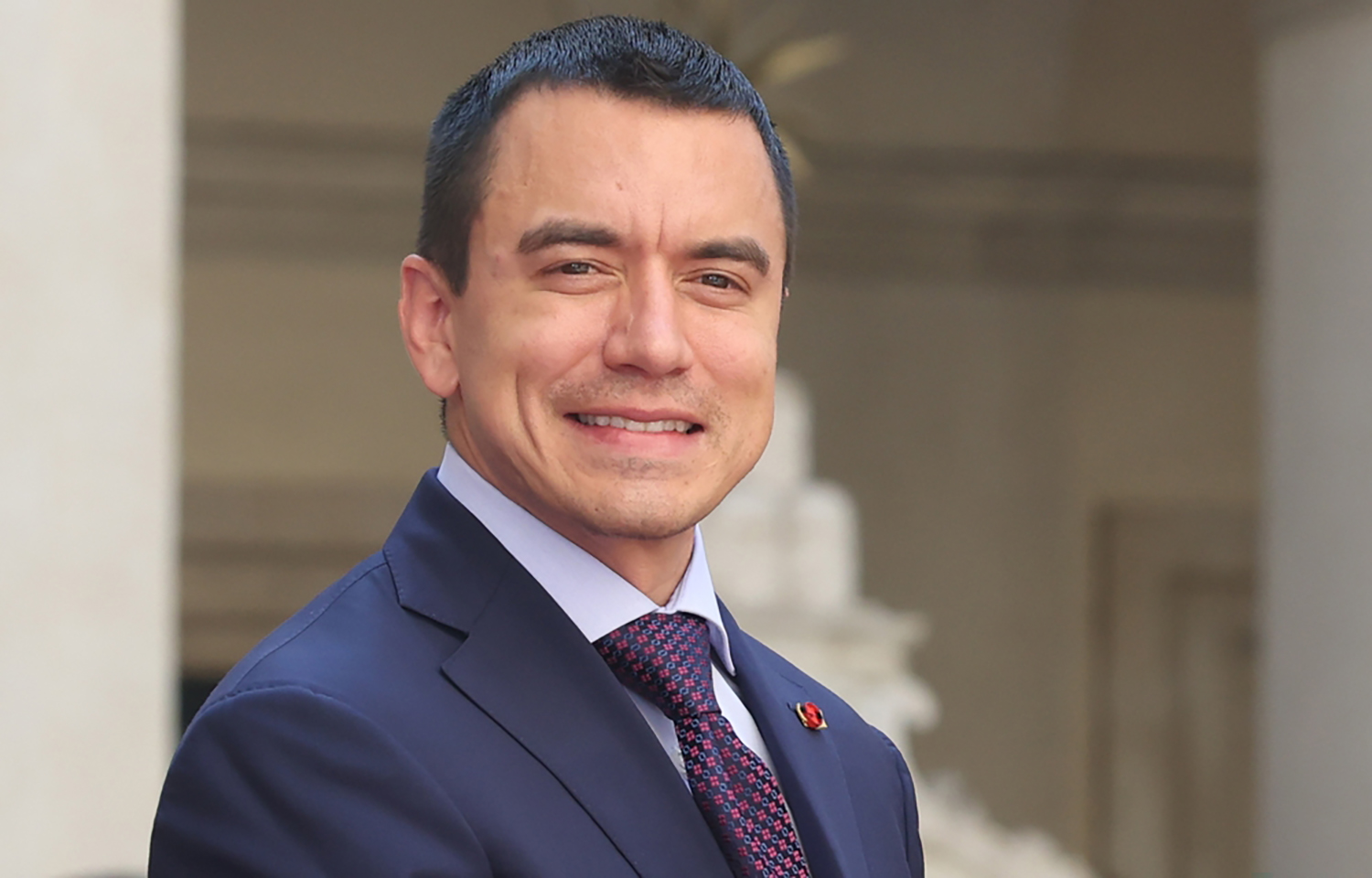
As part of efforts to review the government’s reach and streamline its services, Ecuador President Daniel Noboa recently announced intentions to merge multiple ministries within his administration, including the Vice Ministry of Aquaculture and Fisheries, into one broader entity.
Ecuador's Executive Decree 425 mandates the merger of the Ministry of Production, Foreign Trade, and Investment and the Ministry of Agriculture and Livestock, which houses the Vice Ministry of Aquaculture and Fisheries, into the Ministry of Economy and Finance, all of which together will be renamed the Ministry of Economic and Productive Development.
The decree has been met with skepticism by the nation’s fishing industry.
“While reducing structures, eliminating duplications, and optimizing resources appear to be legitimate objectives, there are differences between rationalizing public administration and weakening capacities that have taken decades to build,” Ecuador’s National Chamber of Fisheries said in a release. “The possible reorganization of fisheries and aquaculture competencies within a new mega-merger of ministries merits precisely that reflection.”
National Chamber of Fisheries President Bruno Leonel similarly noted that the move has the industry on edge.
“In our dialogues with the authorities, we are always asking that the fishing issue be handled with technical and not political criteria. At the moment, we have a very specific concern: The president announced a merger of some ministries with the aim of achieving efficiencies and probably saving money,” he said on national television. “But, we are concerned that by being merged into different ministries, the timely technical management of the Vice Ministry of Aquaculture and Fisheries may be affected.”
Besides technical management, he also pointed to the nation’s “yellow card” that the E.U. has imposed since 2019 for Ecuador’s supposed deficiencies in controlling illegal, unreported, and unregulated (IUU) fishing, explaining that the merger is unlikely to help the country lift the trade restriction.
“Europe is concerned about the continuous change of [fishing] officials, among other things, and that is why we still cannot get rid of the yellow card,” he said.
Even with the yellow card, 60 percent of canned Ecuadorian tuna was exported to the E.U. in 2025 for a total of USD 1.1 billion (EUR 955 million) – up 14 percent from the previous year. Deputy Minister of Aquaculture and Fisheries Ivanova Cereceda recently told Forbes Ecuador that the country represents 35 percent of the European canned tuna market despite the sanction, and expectations are for greater growth with the eventual elimination of the yellow card.
More broadly speaking, National Chamber of Fisheries Executive Director Rafael Trujillo warned in a blog post that fishing and aquaculture should not just be considered another sector within the Ecuadorian economy, as they constitute one of the pillars of Ecuador’s non-oil exports, generate hundreds of thousands of jobs, contribute billions of dollars in foreign exchange, and position Ecuador among the main world players in the production of tuna and shrimp.
Lessons should have already been learned, he explained, after a previous ministerial reshuffle resulted in the fisheries authority losing some of its autonomy, resulting in delays in the issuance of health and catch certificates, as well as administrative difficulties that hindered exports.
“The real risk is in diluting technical expertise within large structures, where multiple priorities will inevitably compete,” he said, adding that while other sectors can withstand slower administrative processes, fishing operates under biological schedules, strict compliance with the commercial requirements of markets, and international fishing commitments that require immediate responses.
Every hindrance, including the E.U.'s yellow card, translates into economic losses, uncertainty for exporters, and opportunities that are taken advantage of by competing countries, he said.
“Ecuador needs a more efficient state, without a doubt, but it also needs an intelligent state. An intelligent state knows how to distinguish between spending that must be reduced and capacities that must be preserved,” Trujillo said.
Outside of ministerial consolidation, the government also announced the country established a productive executive committee for the country’s tuna sector, seeking to identify and execute concrete solutions to strengthen productivity, competitiveness, and growth in the industry.
During its first session, the committee defined seven strategic focus areas: access to markets and overcoming trade barriers; simplification of procedures and strengthening of the state's operational capacity; addressing production costs and the tax regime; infrastructure; domestic market and informality; external risks and multilateral governance; and institutionality and coordination.
In this sense, the committee aims to make the country’s tuna sector a trailblazer, possibly leading to the establishment of executive committees in other productive sectors and provinces across Ecuador to identify restrictions to growth, promote productive diversification, and strengthen technical and institutional capacities.
The move, which marks a new step in the Ministry of Production, Foreign Trade, and Investment’s Productive Development Strategy and Competitiveness Policy, is receiving technical support from Harvard University’s Growth Lab – an institution that aims to advance research and policy solutions to foster inclusive economic growth.
Harvard's Growth Lab will assist in the application of specialized tools in diagnosing growth opportunities, strengthening national capacities to design and implement public policies that boost productivity and investment in the country.
The process also has the backing of the Development Bank of Latin America and the Caribbean, CAF.
The two institutions are “allies that provide world-class methodologies to strengthen the formulation of public policies aimed at productive development … [and] transform the sector’s main problems into concrete actions, with defined managers, execution deadlines, and permanent monitoring,” Ecuador’s Ministry of Production, Foreign Trade, and Investment said on its website.
