






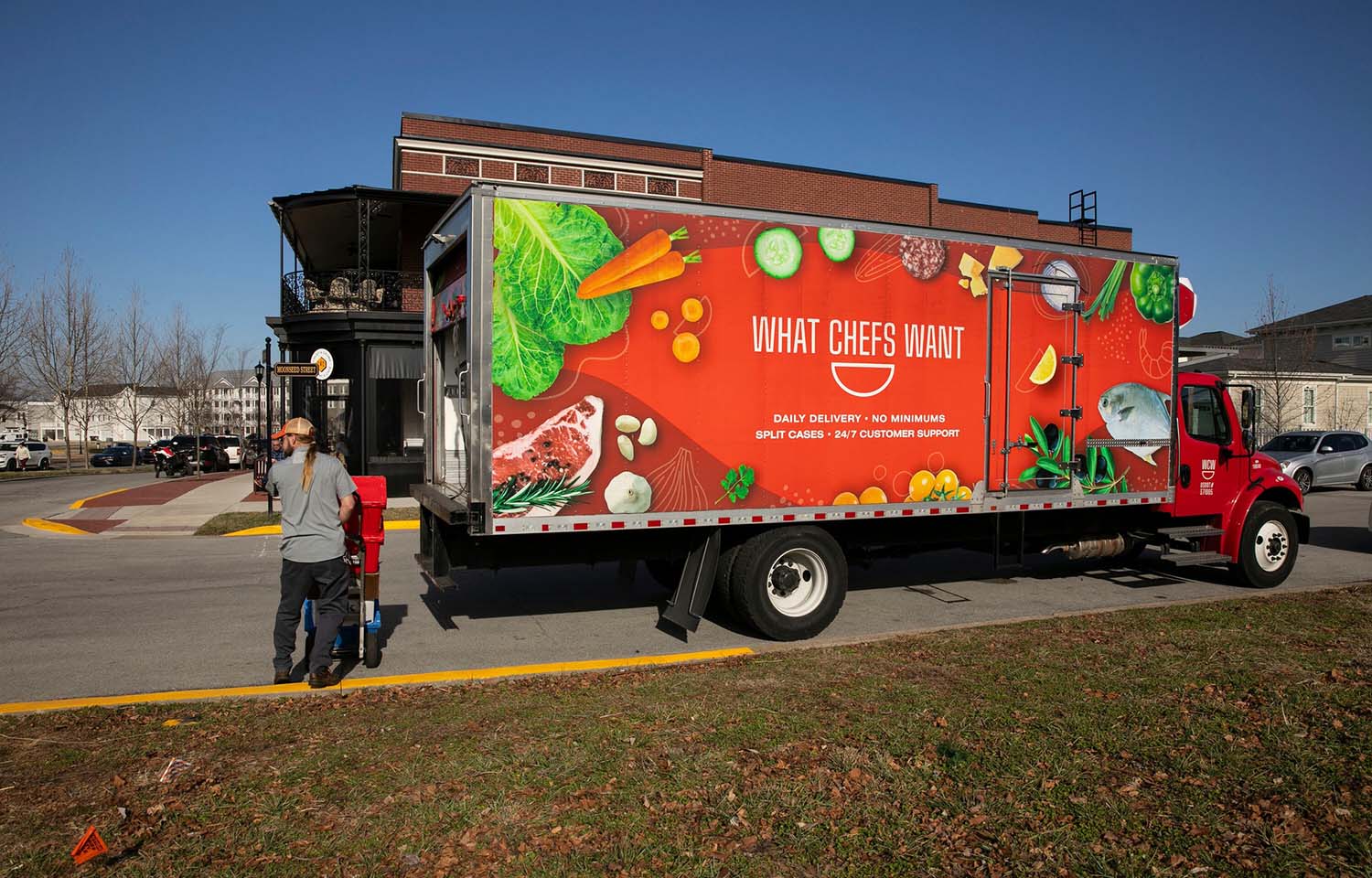
Nearly 20 years ago, a longstanding ice business based in Louisville, Kentucky, U.S.A., that was founded in 1904 branched into produce for the first time.
Now under the name What Chefs Want, that small ice company is actively constructing new distribution facilities across a swath of U.S. states to keep up with demand for its specialty wholesale food delivery service, which covers everything from onions to specialty seafood species.
What Chefs Want Chief Production Officer John Thomas told SeafoodSource the company’s shift and rapid expansion is largely thanks to the efforts of Ron and Mollie Turnier, who took over operations of what was then called Grocers Ice & Cold Storage Co. in 1991. He said that the couple returned to Louisville to help run the icehouse, and Ron quickly was looking to capitalize on ways the space could be used outside the ice business.
“The ice business isn’t that busy in the winter, so he was like, ‘What am I going to do with all of this space?’” Thomas said.
Thomas explained Turnier was then clued into a produce business called Creation Gardens that was a one-van operation supplying specialty produce to restaurants. The owner of Creation Gardens was planning to stop running the business, so Turnier stepped in to purchase it and begin running it out of the ice house space.
That business formed the seeds of what would eventually become What Chefs Want after a rebrand from Creation Gardens in 2018.
The current name of the business comes from its former tagline, which is rooted in the original philosophy and method it operated under: Ask chefs what they need and provide it to them quickly and with flexibility.
According to Thomas, the philosophy started soon after acquiring Creation Gardens in 1997, when Turnier began to examine what it was Louisville needed out of the business.
“He didn’t know anything about produce,” Thomas said. “He said what he did know was there were a bunch of third-generation Italian produce companies in the area, and Louisville didn’t need another one.”
In light of that, Turnier went around to the accounts the company was serving and asked them directly what they wanted.
That question was all the business needed to get its direction.
“Ron told me he doesn’t remember what they said they wanted, just that they wanted to be asked because nobody had ever asked,” Thomas said.
The other wholesalers at the time were just giving chefs options of what they provided, rather than asking what they could provide that would make their lives easier, Thomas said. At the start, that’s exactly what the company did, whether that be seven-day-a-week delivery or later cut-off times.
The company began to expand from there, in part through its own expansions and in par through acquiring other companies inside the space. It also began to add more gourmet products to the produce trucks to expand on its margins while still providing that same level of service chefs requested.
Part of that service entails understanding the needs of chefs, which can vary from restaurant to restaurant. Thomas said some chefs may not want to order full cases of certain items or want flexibility on certain items when they’re trying a new special.
“They don’t know how many halibut specials they’re going to sell tonight, so Ron’s like, ‘I’ve got to make this easier for them,’” Thomas said. “When we were smaller, we did twice-a-day delivery; if you called us in the morning, we’d bring it to you in the afternoon. Again, what chefs want.”
From Creation Gardens, What Chefs Want eventually purchased other companies. It acquired Ernest Williams in Nashville, Tennessee, in 2011, Murphy Produce in Nashville and Speiss Specialty Foods in Cincinnati, Ohio, in 2014, and then Thomas’s former company Mattingly Foods in 2015.
Thomas said initially, Turnier approached the company with intent to purchase the products but eventually ended up buying the company outright to make things work within the model and opened up shop inside the building it was using.
“That was 80,000 square feet, so we thought we’d never fill it up. We’re expanding that building right now to 160,000 square feet,” Thomas said.
The company moved into seafood in earnest in 2017 with the purchase of Bluefin Seafood, bringing with it more than 300 fresh and frozen seafood products.
Thomas said over the years, the What Chefs Want model has continued to evolve, shifting somewhat away from strict service to chefs as the company acquires other firms with different types of customers.
“We’ve gotten into a lot of different segments,” he said. “We bought a business in Cincinnati that did school business, so we got into the school business. We’ve bought companies in the retail business. Ron always jokes it’s not just what chefs want anymore, it’s what do retailers want or what do schools want?”
Thomas said Turnier will often say the company is a “hardliner” rather than a broadliner, as it tries to tackle the difficult aspects of the supply business that others don’t always fit into.
“We sell everything broken cases, so if you want to buy one jar of tahini paste, if you want to buy one can of caviar, if you want to buy two lemons, two fillets – we’ll cut two ribeye steaks for you and send it to you tomorrow,” Thomas said.
Thomas said a lot of the acquisitions that What Chefs Want has made over the years are similar to the original one that got the company its start: family-owned businesses where the ownership is aging out and looking for a successor to take on the business.
A lot of the time, the expertise in those businesses stays on, just like Thomas did when his company was acquired, and What Chefs Want works to keep them on board to hold onto that knowledge.
“We bought Ambos Seafood, and Drew Ambos is here with us today. They’re fifth generation in Savannah, [Georgia]," Thomas said. “They know that market, and they know the customers. We could go in there and be arrogant and go, ‘We know what you want,’ but we don’t do that. We ask what you want.”
Smaller, family-run operations are also the kinds of restaurants that the company thrives in serving, Thomas said.
Throughout it all, the company has continued to place a focus on innovation and changing things quickly, according to Thomas. He said that largely stems from Turnier's leadership and ability to change tactics quickly based on perceived needs.
“What I learned about our company is Ron can walk in one day and say, ‘We’re not doing this any more. We’re going to do this instead,’” Thomas said. “Part of our success is not being afraid to fail.”
More recently, the company has continued expanding its capacity. In 2024, it became the largest independently owned wholesale food distribution company in the Southern U.S. with the purchase of Phoenix Wholesale Foodservice in Atlanta, Georgia, which opened a 140,000-square-foot hub in Austell, Georgia. The company broke ground on a new 62,000-square-foot facility in Louisville in October, as well.
Nevertheless, the core goal, according to Thomas, remains the same: Give chefs what they want.
“I’ve been in the room with Ron dozens of times where he’s told the customer, ‘If I don’t bring you value, I don’t deserve your business,’” Thomas said.
