


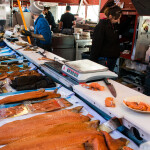

At the boutique Bergères market in Puteaux, France, on the outskirts of Paris, OSO’s cooked shrimp are stylishly spread in a position of honor at the stall of Poissonnerie Goube.
Run by owner Jordan Goube, who holds the prestigious title of Meilleur Ouvrier de France, a lifetime award presented by the French Ministry of Labor to master fishmongers, the seafood presented by Poissonnerie Goube to customers is specially selected for its quality.
The OSO shrimp are not cheap at EUR 5.69 (USD 6.25) per 100 grams, but they still sell briskly. One young French couple buying a kilogram of the shrimp said they would serve them cold on top of a fresh baguette for dinner.
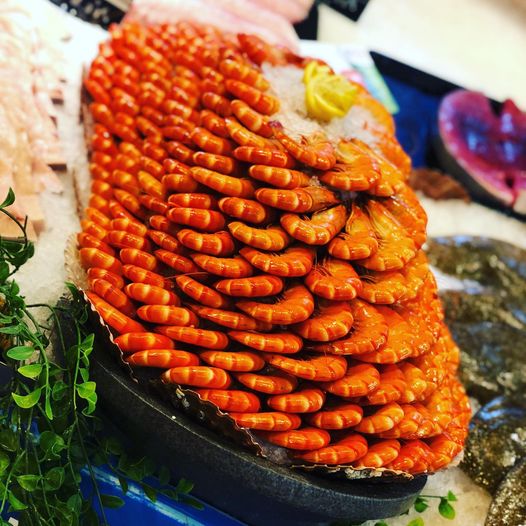
“We buy these every week,” Sandhia Sehnert told SeafoodSource in April. “They are so special – firm with a lot of flavor.”
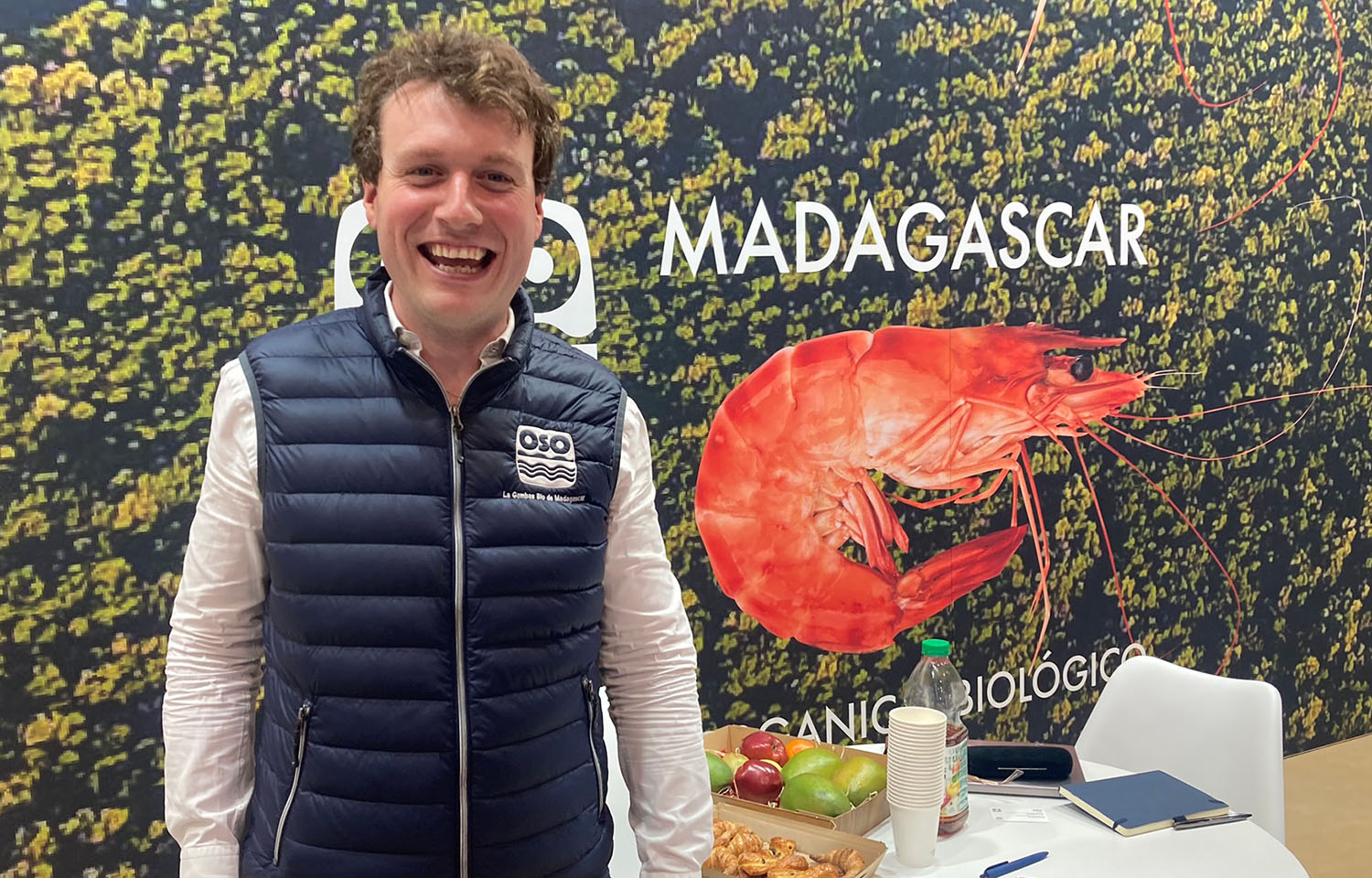
For George Wrigley, OSO’s sales manager of retail and export, being chosen as a featured item by Poissonnerie Goube is both an honor and a business strategy.
With just 1,500 metric tons (MT) of annual production out of a low-impact, organic farm in Madagascar, OSO is relying on quality rather than quantity to grow its business. For Wrigley, the price willingly paid by Parisian gourmands shows buy-in to the company’s extensive efforts to produce and market a prawn that is thoughtfully grown and carefully prepared.
“The approach we've taken with our product is really oriented toward gastronomy and the fishmonger – from the production all the way through to the cooking,” he told SeafoodSource at the 2024 Seafood Expo Global.
Founded as a fishing company in Madagascar and Mozambique, OSO (initially known as Offshore Shipping Operations) sold its eight vessels and its quota 20 years ago to pivot into shrimp farming. With a guiding hand from then-Marks & Spencer Global Sourcing Manager Andrew Mallison, brothers Mathias and Gautier Ismail founded a shrimp-farming operation designed to be as low-impact as possible. They chose a bay in the northern part of Madagascar with access to the open ocean.
“They decided to create the first farm ... to replicate what nature does in growing prawns,” Wrigley said. “This was before the European Organic certification even existed, so the general idea was not to do organic but just produce at a level that promotes animal welfare and minimizes environmental problems.”
After the E.U. Organic certification was created, OSO applied and attained certification in 2013. To adhere to the organic standard, OSO’s black tiger shrimp are grown at a density of six to eight prawns per square meter, with 5 tons of production per hectare. It conducts no mechanical water recirculation or treatment, and it operates its own broodstock and hatchery facilities using imported organic feed from France.
Since its inception, OSO’s primary market has been Paris. In 2009, OSO merged with seafood wholesaler Maison Reynaud, which has a strong connection with Paris’s Rungis International Market, one of the world’s largest wholesale food markets. The merger – creating a company named R&O – was timed excellently, as it overlapped with a shift in France’s prawn market from wild-caught to farmed.
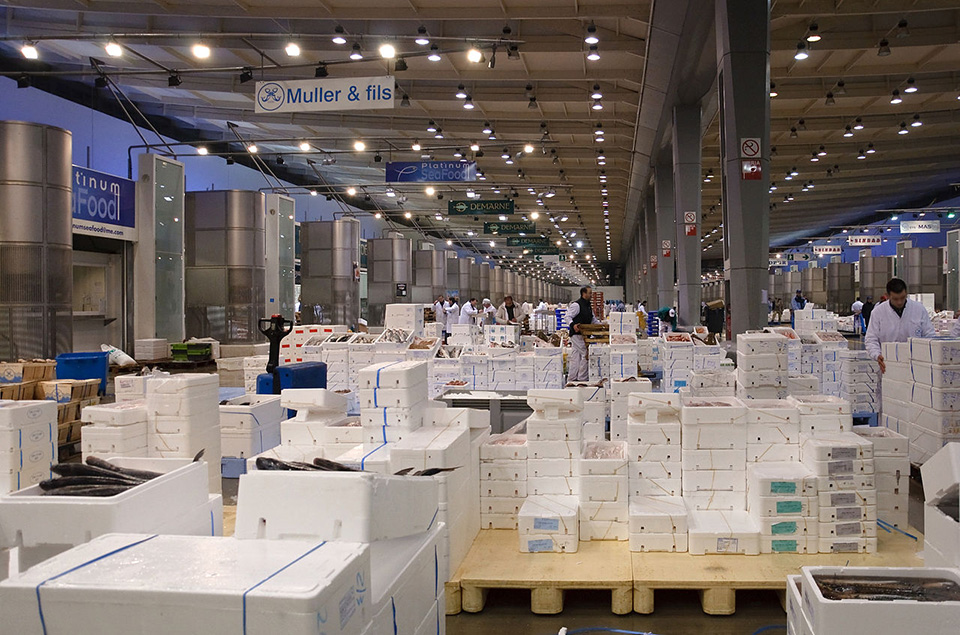
“We worked together to orient the market toward freshly cooked prawns,” Wrigley said.
Today, 80 percent of OSO’s shrimp is brought into France frozen and then cooked the same day it is sold at fish counters and fishmongers’ stalls across Paris and beyond, using a specially developed technique that involves a succession of immersions, starting from defrosting to cooking at 84 degrees Celsius and then shocking them again with freezing water.
“The fishmonger sends us an order through their supplier in the morning, unless they are big enough to call us directly. That wholesale company then calls us and gives us an order. These orders will come into us and then we give them to our cooking center where they cook the prawns on the day," Wrigley said. "They deliver the prawns cooked with a shelf life of six days guaranteed. That will last them the week, but if they want to reorder on Tuesday, Wednesday, or Thursday, they can because we’re based in a big logistics hub with a factory setting, from which we can dispatch through the whole of France and also Belgium, Switzerland, and other places in Europe.”
OSO is also present with some retail products in Co-op in Switzerland and Belgium, as well as in Citerella in the United States, Woolworth’s in South Africa, a few retailers in Japan, and the Four Seasons in the Seychelles. OSO used to have a much larger presence in the U.K. but still sells around 200 MT there annually, primarily via three raw frozen products sold in Marks & Spencer outlets.
“Unfortunately, because of Brexit, it's now difficult to sell freshly cooked products to the U.K. due to duties, so we rely more on local distributors there,” Wrigley said.
With limited production and a focus on fishmongers, OSO has no plans to concentrate on retail sales except for some niche markets, Wrigley said.
“Retail is not at all in our DNA,” he said.
OSO has begun offering some additional products beyond its head-on, shell-on standard, including fully peeled prawns and added-value skewers, and it recently launched sushi-grade carpaccio. The raw product is offered as part of Reynaud’s larger selection of raw fish cuts and preparations for Japanese restaurants in France, and the company has also made its sushi carpaccio available in 320-gram boxes for around EUR 15.50 (USD 17.60).
“It's all done in Madagascar, fresh from the water,” Wrigley said. “The reason we can get a sushi grade is the result of time from harvest to freezing, which is extremely rapid – 15 minutes max. That really gives not only the quality when you're eating it, but it also enables us to have a safe product.”
OSO has also started to offer modified atmosphere packs that can extend the shelf life of its shrimp to 11 days, primarily to extend the distribution range of the prawns for more far-flung European clients.
OSO is also constantly working to reduce its environmental impact, but plastic is necessary for the modified atmosphere packs, and for summer market days in France, the company still relies on poly boxes, according to Wrigley.
“France loves markets, and there are markets open every day of the week. As soon as it gets a bit hot, there is no material available at the moment that competes with the thermal characteristics of poly boxes. So, we've sort of stuck with it until we find a better option,” he said.
OSO would like to grow but will do so carefully, Wrigley said.
“Our property in Madagascar is about 4,000 hectares, but our actual production is just on 400 hectares. We have another site a few miles east where we would have the same environment where we can build more ponds, potentially specially designed for larger-sized shrimp, which the U.S. market especially demands,” Wrigley said. “But, everything must be done completely under control. The aim is to sell what we have and constantly determine where we are every year on our offers and stock. We will always put the health of our shrimp and the health of our local and global environment first in our decision-making.”
To that end, the company is seeking carbon-neutral certification and has planned for the planting of more than 1 million mangrove trees in Madagascar since its founding. It also has several community-oriented initiatives designed to improve the lives of the Malagasy people who live near the farm.
In fact, the company sees its social mission as extending beyond Madagascar – into France and beyond.
“We call it a model of almost reverse globalization, where there is this Malagasy company entering the capital of France, entering a French company, and really turning it around from the Malagasy perspective,” Wrigley said.
The next year will be spent investigating how the company can do better at providing a comprehensive, premium-level seafood experience to fishmongers as well as to restaurants, he said.
“The name of the game for distributors until a few years ago was vertical integration. If you were the wholesaler, you were the middleman, and your added value was getting squashed. You needed the capacity to do what we did and have a producer integrating a distributor with a cooker with filleting operations so it's a one-stop shop,” Wrigley said. “Even fishmongers nowadays don't have the time to fillet fish, and they have fewer trained staff. So, we have to help them, and now we're seeing the value has to be grasped even further. We are now looking at how we can better accommodate restaurants with our range of products and services.”
