



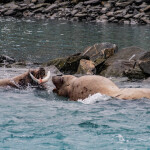

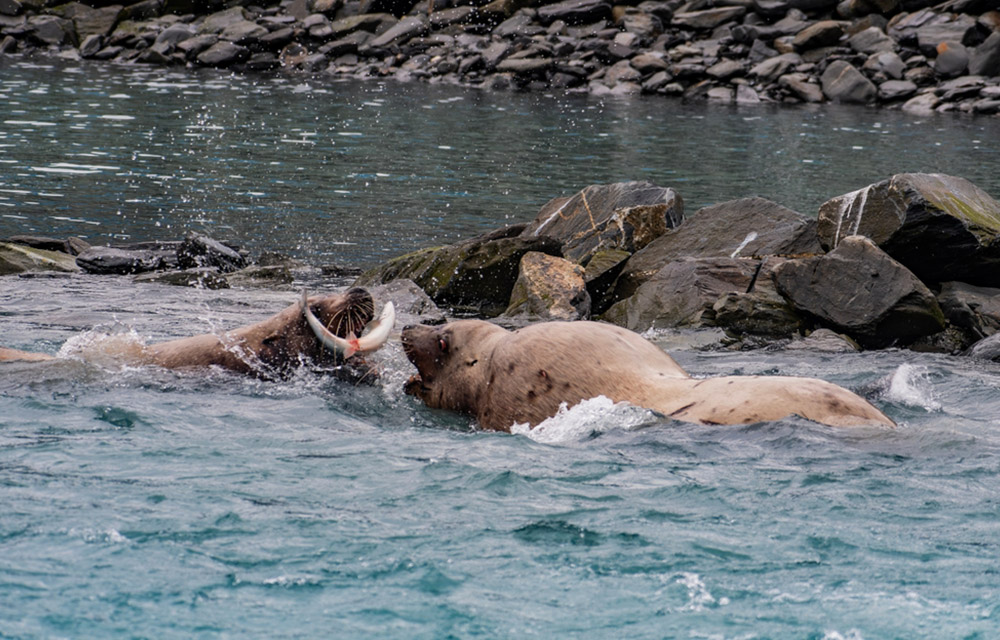
The U.S. House Natural Resources Committee has approved a bill that would allow the state of Washington and area Tribes to kill more seals and sea lions that prey upon recovering salmon populations.
“I am pleased the House Natural Resources Committee voted in a bipartisan manner to advance my bill,” U.S. Representative Michael Baumgartner (R-Washington) said in a release. “This bill, born in collaboration with many of the Tribes in Washington who have federally recognized treaty fishing rights, is an important step in the right direction to protect salmon populations in the Pacific Northwest. I look forward to continued bipartisanship as we work to get it signed into law before the end of this Congress.”
The Northwest Endangered Salmon Predation Prevention Act builds upon legislation adopted in 2018 that authorized state and Tribal governments to kill sea lions in parts of the Columbia River basin to decrease their predation on salmon. NOAA Fisheries claims those cullings saved an estimated 110,000 adult salmon from predation, but the agency admitted that the program has only had a limited impact on fish recovery.
The new legislation expands the cullings to include seals, makes it easier for Washington state and Tribal authorities to kill the marine mammals, and increases the areas where culling can take place.
“Pinniped predation undermines all the work states, Tribes, the federal government, water and power users, and stakeholders across the region have done to support salmon recovery,” U.S. Representative Bruce Westerman (R-Arkansas) said during a 15 September markup of the bill. “Current law limits the geographic scope of lethal management on the Columbia River, resulting in unmitigated predation in key areas. The current permitting process is arduous, and the best method of take is inflexible, costly, and precludes best wildlife management practices.”
The legislation is supported by the Columbia River Inter-Tribal Fish Commission and the Northwest Indian Fisheries Commission.
During the markup, U.S. Representative Jared Huffman (D-California) countered that lawmakers needed more engagement from stakeholders before expanding the culling program, pointing to lengthy dialogue that took place before the 2018 law was adopted.
“I do want to be clear. I’m not categorically opposed to culling; it is one tool in the toolbox of science-based wildlife management. If we’re going to expand that program and create a similar one for all coastal Washington, we need to engage in a similar dialogue. We need to be careful, and we need to get it right.”
According to Huffman, that 2018 legislation focused specifically on sea lions traveling hundreds of miles upstream and feeding on masses of salmon trapped in choke points, whereas the new bill would expand cullings to marine waters and coastal areas.
“It is not targeted. The evidence that removals will help salmon in these areas is less clear cut and is largely based on studies conducted far upstream in the Columbia River,” Huffman said.
The committee ultimately did approve an amendment written by Hoyle limiting the area the legislation applies to freshwater. The committee also adopted an amendment recognizing previously negotiated Tribal roles and engagement in pinniped management.
Huffman also raised objections over the lack of federal scientists available to conduct analysis on the program as well as outdated marine mammal stock assessments.
“If we’re going to ask NOAA to estimate allowable take levels and provide permits for take to improve salmon returns, as this legislation purports to do, we need current science to inform both pinniped take levels and the expected outcomes for salmon. It is quite plain that without that scientific certainty, legality will be in question,” Huffman said, noting that NOAA still had not provided answers to questions the committee raised in a July hearing on the bill.
“Since our last hearing on the bill, there should have been more direct engagement with the Columbia River Basin Treaty Tribes and the communities in my district and others impacted by the legislation,” U.S. Representative Val Hoyle (D-Oregon) added, pointing to concerns raised by the Siletz Indians and the Confederated Tribes of the Grande Ronde.
“The people who fish these waters [and] manage these resources depend on healthy salmon populations [and] deserve a meaningful role in shaping this legislation,” she said. “Why weren’t all the affected Tribes in Oregon at the table from the start? I’m frustrated their voices haven’t been adequately included in the process.”
Following Hoyle’s remarks, the committee adopted her amendment to the bill directing NOAA Fisheries to study sea lion predation on salmon along the Oregon coast.
Environmental NGO Oceana criticized the committee’s action, noting that there are more pressing solutions for supporting salmon recovery than killing more pinnipeds.
“This bill is appalling and scientifically indefensible. Killing seals and sea lions is simply not going to recover endangered salmon,” Oceana Fisheries Campaign Director Ben Enticknap said in a release. “Restoring threatened and endangered salmon populations requires addressing human activities like dams, habitat degradation, fishing, and climate change. Focusing on killing marine wildlife will do nothing to address the main challenges facing salmon recovery.”
