



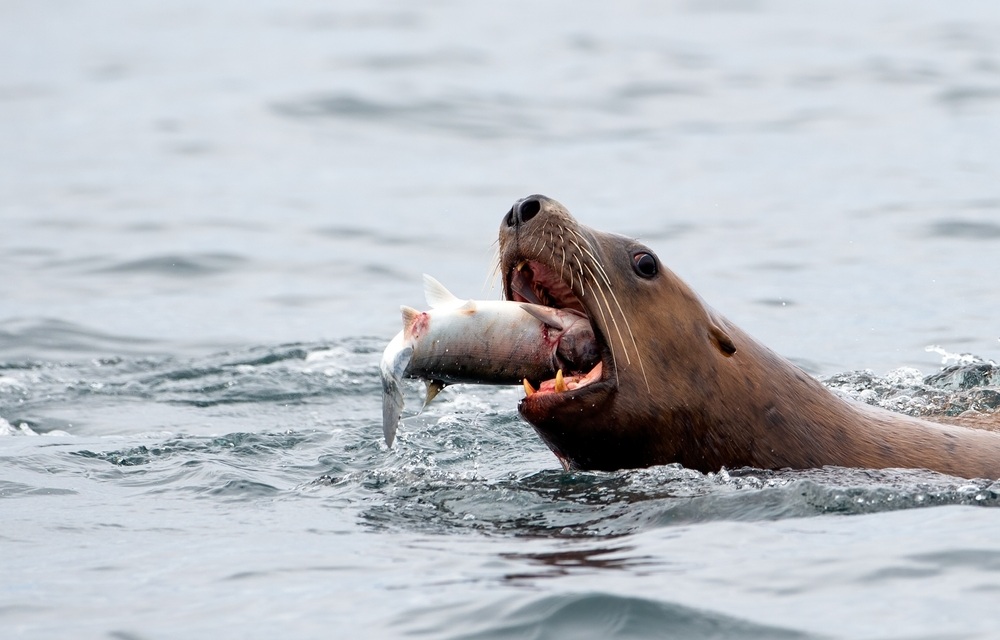
The U.S. House Water, Wildlife, and Fisheries Subcommittee held a hearing on sea lion predation on salmon and the effectiveness of killing the mammals to slow down the trend.
Under the Marine Mammal Protection Act (MMPA), sea lions skyrocketed from a population of roughly 10,000 in the 1950s to 250,000 today. That spike has been seen as a success story for the MMPA, but it’s also had a major impact on salmon populations, which are a key food source for pinnipeds. By traveling upriver to avoid their natural predators – orcas – sea lions are able to feast on already struggling salmon populations. Since 2002, California and Steller sea lions have eaten roughly 98,000 salmon at just two sites: Bonneville Dam and Willamette Falls, Oregon.
“In the decades since the enactment of the MMPA, pinniped populations have exploded and are dominating ecosystems across the Pacific Northwest and devastating salmon and steelhead populations listed under the Endangered Species Act,” U.S. Representative Harriet Hageman (R-Wyoming), who chairs the subcommittee, said in opening the hearing. “The National Marine Fisheries Service has found on repeated occasions over the last two decades that pinniped predation is a leading factor in preventing the recovery of these salmon species. One study found that by 2015 across the Pacific coast, pinnipeds consumed six times the number of Chinook salmon that were captured through commercial and recreational fishing combined. The imbalance between unchecked pinniped populations and their threatened endangered prey causes significant challenges throughout the Pacific Northwest.”
That predation has undermined the federal government’s attempts to help salmon recover in the Pacific Northwest, which includes tens of millions of dollars in funding every year.
To help protect the fish, in 2018, Congress authorized state and Tribal governments to ignore the MMPA and kill pinnipeds consuming salmon in the Columbia River basin. The initiative has seen some instances of success; according to NOAA Fisheries, an estimated 110,000 adult salmonids have been saved from sea lion predation due to the authorized takings.
“At Oregon's Willamette Falls, removing approximately 20 male sea lions from the area reduced predation on winter steelhead from 25 percent to just 1.5 percent,” Hoyle noted. “This is a success story, and it shows what's possible with adequate resources and scientific monitoring.”
Columbia River Inter-Tribal Fish Commission Executive Director Aja DeCoteau testified that the killings were far more effective than removals or hazing; the commission estimated that over the last five years, sea lion takes have saved between 41,887 and 52,044 fish around the Bonneville Dam. However, DeCoteau said fisheries managers simply don’t have the funding to take as many sea lions as they’d like.
In his testimony, NOAA Fisheries Deputy Assistant Administrator Samuel Rauch was quick to point out that while legalized take of sea lions has helped salmon in some instances, its overall impact was limited.
“While these permits have helped reduce predation on salmonids at a small scale, and in certain areas, they have been ineffective at moving the needle for salmonid recovery overall,” Rauch testified.
Some lawmakers also questioned whether the focus on killing sea lions was appropriate; in his opening remarks, U.S. Representative Jared Huffman (D-California) reminded his colleagues that sea lion predation is just one of many threats facing West Coast salmon.
“For the past few decades, salmon populations have declined sharply because of habitat loss, dam construction, droughts, overharvest – all of these factors leading to multiple listings under the Endangered Species Act. The river system has been reshaped by people, dams, fish ladders, and fish passage bottlenecks, leaving us with very unnatural predator prey interactions that did not exist historically,” Huffman said. “California salmon fishing communities have had unprecedented challenges – three consecutive ocean salmon season closures. So, Madam Chair, when you give statistics about pinnipeds eating dramatically more salmon than fishermen – you can play with those numbers because for the past three years in places like California, the fleet hasn't been able to catch salmon at all. So, it's no surprise that pinnipeds would be eating more than the commercial harvest.”
Huffman pointed to dam removals on the Klamath River – which have allowed salmon to travel upriver to areas they couldn’t access for decades – as an example of the kind of work needed to help the species recover.
“I'll be frank: I'm glad Republicans are finally talking about salmon here in this committee today. But if killing even more sea lions than we already allow, and I support the targeted science-based intervention that we allow right now under current authority, but if that's the only thing you'll do for salmon, you're missing it. We are still in big trouble here,” he said.
Both Huffman and Hoyle were critical of the U.S. President Donald Trump's record on salmon recovery, pointing to the White House’s efforts to slash NOAA Fisheries funding, lay off large numbers of the agency’s staff, and proposed elimination of the Pacific Coastal Salmon Recovery Fund – the largest federal effort supporting West Coast salmon conservation. Trump's administration also reneged on the Columbia River Basin Restoration Initiative, an agreement made with Pacific Northwest Tribes and states by then-U.S. President Joe Biden to prioritize salmon recovery in the basin.
“Today, we hear that [Republicans] care about salmon, and I just wonder, who do they think they're kidding?” Huffman said, chiding his colleagues. “You can't champion salmon recovery while slashing the very programs designed to rebuild habitat, recover river function, and uphold Tribal rights. You can't walk away from basin-wide restoration agreements and then point to sea lions as the problem. Claiming to care about salmon recovery only when you get to kill off another species is not conservation. I don't know what it is, but it's not serious conservation.”
