



The World Benchmarking Alliance assessed 22 seafood companies in its 2026 Ocean Benchmark, and its accompanying insights into the sector’s performance show progress in some areas – and problems in others.
The World Benchmarking Alliance is a nonprofit organization aiming to hold companies accountable toward the U.N.’s Sustainable Development Goals by benchmarking companies in a number of performance metrics. Assessing multiple categories like nature, social, food and agriculture, and ocean assessments, the organization scores companies on a 100-point scale.
Perennial seafood standout Mowi was the leader in the sector again, and ranked highest among seafood companies across all benchmark categories. Nueva Pescanova also performed well, ranking as a top five seafood company in each of the four benchmark categories.
Looking at the industry by region, Europe saw the highest average score on the benchmark with 27 out of 100. Asia came in just behind Europe with 22 out of 100, and North America was far behind both Europe and Asia with an average score of 4 out of 100.
Despite weak or mixed results for the sector, World Benchmarking Alliance Corporate Engagement Manager Helen Packer said she did see some bright spots for the industry.
“There are seafood companies in our benchmark making advances on issues and showing that, while there is still work to do, real progress is possible and there are tools available to help industry on their journey,” Packer said. “There are now mechanisms to support better fisheries management, human rights due diligence, better supply chain oversight and transparency, and they are tailored to the unique challenges in seafood. Technological advancements like digital traceability solutions and wi-fi on board vessels are making it easier for companies to support responsible supply chains. Scaling up these good practices would have a massive positive impact.”
According to the WBA, a number of seafood companies recognize the issues that its benchmark covers but haven’t taken the next step of addressing them. The report notes that, despite a genuine recognition of the material importance of sustainability by company board of directors (Maruha Nichiro and Nissui both performed well on governance issues and disclose action plans for implementing their sustainability strategy) and the robust ecosystem of tools to address sustainability challenges on the water, companies still often struggle to develop actionable plans and targets that move the company forward.
For some of the more performative ecosystem-related and core social issues, seafood companies tend to score in the same ballpark as other high-risk and high-impact sectors – around an average of 22 out of 100. When it comes to ocean-specific social responsibility indicators, however, the average score for the industry falls to 9 out of 100, reflecting seafood companies’ inability to develop concrete plans and implement measures to address ongoing challenges of human rights and labor issues in supply chains.
There is a will and there is a way, there’s just no plan, Packer said, but the seafood industry could move forward if it took a broader view.
“The industry may be too focused on a fire-fighting approach – using tools when problems pop up rather than creating a plan to keep those fires from starting,” Packer said. "There are a number of tools and platforms underutilized by the seafood industry that help companies take a more comprehensive approach and learn from other sectors – the Science Based Targets Network (SBTN) and The Taskforce on Nature-related Financial Disclosures (TNFD) are helpful for and environmental issues, and the UN Business and Human Rights Forum for social issues or the UN Global Compact or the World Business Council for Sustainable Development (WBCSD).”
The issues are also not unique to seafood and don’t need to be solved in a vacuum, she said.
“One piece of advice to seafood companies: learn from other sectors and get out of the seafood bubble,” Packer said. “A wealth of business intelligence exists beyond the industry, for example in the extractives and apparel sectors, that can help companies anticipate regulatory and market shifts, identify opportunities and take a more strategic approach.”
On human rights due diligence benchmarking specifically, seafood companies have improved across the industry to the point where seafood is performing at a level on par with other industries with high-risk supply-chains – including apparel – and better than the metals and mining industry. Nueva Pescanova, Mowi, and Thai Union are leading the industry in efforts to identifying, assessing, integrating, and acting on human rights risks and impacts, according to the report.
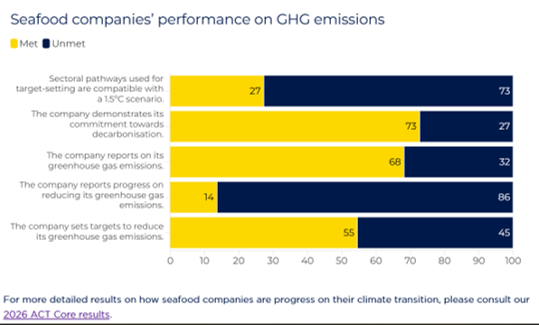
On climate, the insights reveal the seafood industry has made progress developing commitments for decarbonization and reporting their greenhouse gas emissions, but only three of the seafood companies in WBA’s benchmarking report on progress made towards reducing their GHG emissions.
Similarly, the nature benchmark was a mixed bag. Seafood companies have made steady progress in assessing their “nature-related risks, impacts, and dependencies”, but disclosure of progress and actions taken has been weak. Mowi showed more leadership by conducting a LEAP assessment, and both Mowi and Thai Union disclose how their nature and climate transition plans align or where tradeoffs exist reflecting an integrated approach of assessing impact that is seen as the future of assessment and reporting.
Another important learning from the insights is the foundational role traceability plays in supporting effective assessments and reporting. Cermaq, Thai Union, Nueva Pescanova, and companies like them with strong commitments and clear implementation plans for traceability tend to perform better on ecosystem-related indicators.
Despite this leadership in assessment, only 20 percent of companies in the seafood value chain report on the sustainability of their seafood products.
“Seafood is a sector completely dependent on nature and biodiversity. Having healthy and productive oceans, having clean oceans, having a stable climate, and reducing and removing incidents of forced labor and human rights violations are not just sustainability issues they are core business and operational issues,” Packer said. “Seafood companies should track, report, and drive improvement on these issues like their business depends on it – because it does.”
