

The Artic surf clam is a highly-coveted ingredient for sushi. In addition to its taste, the clam’s red tip is considered an auspicious color in Asian culture, worthy of a premium price.
For the last 30 years, Clearwater Seafoods Ltd. in Halifax has held all Arctic surf clam licenses issued by Canada’s government. The company has built several trawlers specifically for the fishery that are capable of quick-steaming and flash-freezing catches. In 2016, Clearwater fished 38,000 metric tons (MT) of Arctic surf clams, which generated CAD 91.9 million (USD 70.8 million, EUR 60.5 million) in sales.
In the fall of 2017, as part of a national reconciliation process with Canada’s First Nations, Ottawa announced a reallocation of 25 percent of the quota for an indigenous fishery to start in 2018. The plan was for First Nations in Atlantic Canada and Quebec to partner with an existing company to develop the surf clam fishery. Then-Minister of Fisheries and Oceans Dominique LeBlanc set a 2 November, 2017, deadline for expressions of interest to be filed with DFO.
In February 2018, LeBlanc announced the winner of the redistributed quote – a new company, Five Nations, representing First Nations from all five eastern Canadian provinces, which had partnered with Premium Seafoods of Isle Madame, Cape Breton. It was awarded a quota for 8,724 MT of clams, worth an estimated CAD 24 million (USD 18.5 million, EUR 15.8 million).
It soon emerged that one of Five Nations’ executives had a distant family relationship to the wife of Minister LeBlanc. That family connection triggered Canada’s ethics commissioner to review the award process and determine the minister had a conflict of interest.
While the four-month-long investigation took place, Prime Minister Justin Trudeau shuffled his cabinet. LeBlanc was reassigned and given responsibility for intergovernmental and Northern affairs and internal trade. Vancouver Member of Parliament Jonathan Wilkinson became minister of fisheries, oceans, and the Canadian coast guard. Not long after, Wilkinson canceled the quota award and announced a new award process, evaluated by an independent third party, would begin in 2019 for the 2020 fishing season.
In his most recent decision on Tuesday, 11 September, Wilkinson gave permission for Clearwater to continue fishing the entire surf clam quota for the remainder of 2018 and all of 2019. The DFO will launch an expression of interest process in spring of 2018 in order to identify a new indigenous-owned company to take over a yet-to-be-determined percentage of the Arctic clam fishery in time for the 2020 season.
“The decision to provide the 25 percent quota to Clearwater for 2018 and 2019 is welcome news to our 450 clam employees from over 52 communities in Nova Scotia and Newfoundland,” Christine Penny, Clearwater’s vice president of sustainability and public affairs, told SeafoodSource. “We indicated to the minister following his [10 August] announcement that Clearwater was ready and willing to harvest the 25 percent of the clam quota for 2018 and 2019.”
According Penny, the total allowable surf clam catch fluctuates and is based on annual DFO stock assessments. For 2018, Clearwater has permission to harvest 35,756 MT.
“This decision avoids any downtime for the fleet. Without access to the 25 percent, adjustments to our operations and workforce would have been required starting in the fall of this year,” Penny said. “Today’s decision keeps our people working in 2018 and 2019 and allows the economic benefits to remain in coastal communities where these year-round middle-class jobs are vital.”
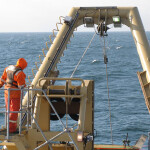
Photo courtesy of Bedford Institute of Oceanography
