






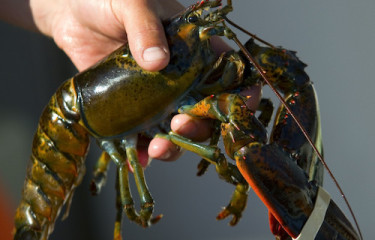
Conservation practices championed by Maine lobstermen are helping make the fishery resilient to climate change, according to a new study led by scientists at the Gulf of Maine Research Institute (GMRI) and colleagues at the University of Maine and NOAA.
For generations, Maine’s lobster catchers have returned large lobsters to the sea and have also marked egg-bearing females to give them further protection. This conservation culture distinguishes the Gulf of Maine fishery from southern New England, where fishermen have not historically taken the same steps to preserve large, reproductive lobsters, said the study,
Funded by the National Science Foundation and published in Proceedings of the National Academy of Sciences (PNAS), the investigation aimed to show how warming waters and contrasting conservation practices contributed to simultaneous record landings in the Gulf of Maine fishery and population collapse in southern New England.
Led by Dr Arnault Le Bris, the research team used computer models to simulate the ecosystem under varying conditions, allowing them to understand the relative impacts of warming waters, conservation efforts, and other variables. Their results showed that while temperature change was the primary contributor to population changes, conservation efforts made a key difference in population resiliency.
Over 30 years (1984-2014), ocean temperatures increased rapidly in both regions. Warming in both regions shifted optimal summer ocean temperatures northeast, causing the southern New England lobster population to decline and the Gulf of Maine population boom.
The researchers estimated that, during this 30-year period, the Gulf of Maine population increased by 515 percent, while the southern New England population declined by 78 percent. Challenges associated with warmer temperatures include decreased survival of larval lobsters, increased incidence of shell disease, and increased predation.
They also estimate that lobster population growth in the Gulf of Maine was more than double what it would have been without conservation measures. Model simulations found that without conservation measures to protect large lobsters and reproductive females the lobster abundance in the Gulf of Maine would have increased by 242 percent instead of 515 percent.
Temperature changes were disastrous for the southern New England fishery, which was already near the southern range of American lobster, said the study. Additionally, the region’s lack of protections on larger reproductive lobsters made the population less resilient to warmer waters. The model estimated that, even in the face of warming waters, more restrictive conservation methods would have limited the population decline from 78 percent to 57 percent over the 30-year period.
Looking ahead, the researchers said the Gulf of Maine lobster fishery will continue to be vulnerable to future temperature increases and their population projections suggest that lobster productivity will decrease as temperatures continue to warm, but continued conservation efforts can mitigate these impacts.
Their 30-year projection anticipates average populations similar to those in the early 2000s.
