

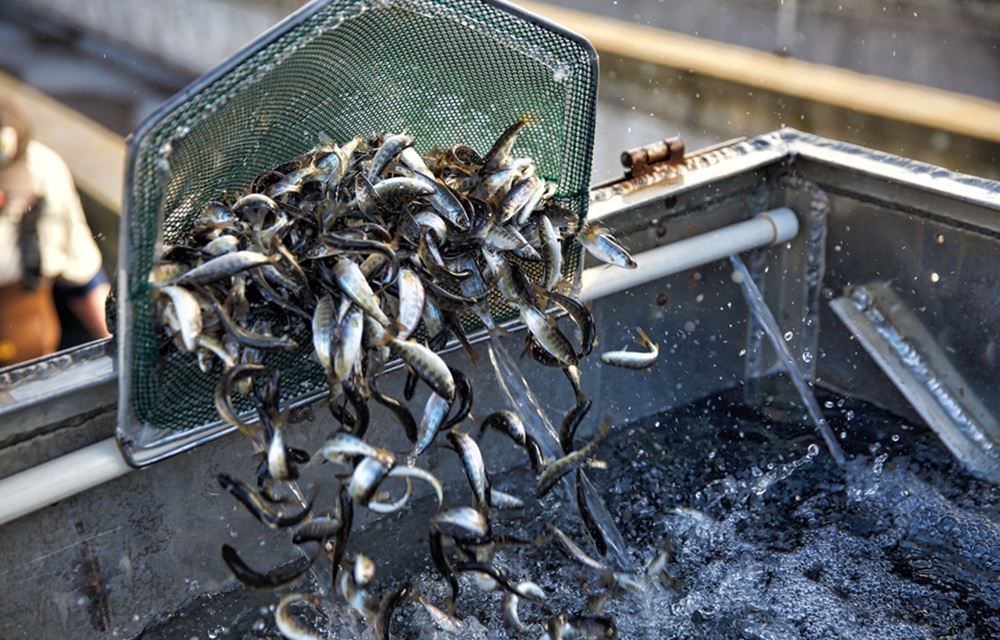
Two conservation groups are suing the federal government over Mitchell Act hatchery operations below the Bonneville Dam on the Columbia River, which they claim are contributing to the decline of wild salmon populations.
“If we want more wild fish returning to their home rivers, we need a broader, ongoing conversation about how hatchery production drives harvest in the ocean,” Wild Fish Conservancy (WFC) Executive Director Emma Helverson said in a release. “Flooding the ocean with hatchery salmon creates the illusion of abundance that increases harvest pressure on our most imperiled salmon populations – the fish we can least afford to lose. Meanwhile, under today’s ocean-harvest frameworks like the Pacific Salmon Treaty, more fish in the ocean simply results in more fish being harvested. We cannot recover these species without breaking this cycle.”
Wild Fish Conservancy first sued NOAA over the hatcheries in 2016, arguing that the government was using an outdated plan to justify operations. NOAA Fisheries responded by issuing a new biological opinion in 2017; however, WFC and The Conservation Angler (TCA) sued the government in April 2024 for not following through on the conditions and actions required under that 2017 plan. NOAA Fisheries responded again by issuing new biological opinions in 2024, leading the conservation groups to drop their lawsuit against the 2017 biological opinion and instead investigate the 2024 documentation.
In September, the groups announced their intention to sue over the 2024 biological opinion, which they argued was fundamentally flawed and included “scientifically indefensible conclusions.” On 21 November, the groups officially filed suit in the U.S. District Court of Oregon, arguing that NOAA Fisheries was violating the Endangered Species Act (ESA). The lawsuit also challenged a 2025 biological opinion used to justify the Select Area Fisheries Enhancement (SAFE) hatchery program in the lower Columbia River, which they claim is similarly flawed and connected to the 2024 Mitchell Act biological opinion.
According to WFC and TCA, the latest biological opinions understate the negative impacts of hatchery programs on wild fish populations, use incorrect abundance assessments, and do not account for how hatchery fish increase fishing pressure on wild salmon. The latest documents also push back timelines for improvements and actions by years, effectively erasing several years of missed deadlines, the groups claim.
“NOAA fast-tracked new plans that sweep aside documented violations in order to maintain hatchery funding and fish releases, instead of fulfilling their primary duty to protect endangered wild fish and orcas,” Helverson said. “Resetting and delaying the compliance timeline does nothing to address the underlying harm. NOAA is now delaying protections the agency previously said were required to be in place today to ensure the protection of these species into the future. Pushing deadlines out as far as 2034 is an unacceptable setback that would lock in another decade of avoidable harm.”
Just days before the two organizations filed suit, NOAA Fisheries acknowledged that its 2024 plan was flawed and would need to be updated and reissued.
In a response to the groups’ September notice of intent to file suit – which was apparently delayed due to the federal government shutdown – NOAA Fisheries disputed the conservationist claims while admitting that it would be updating the documentation to clarify its decisions.
“As far as the adequacy of the 2024 Opinion, we do not share your general views of alleged flaws,” West Coast Region Assistant Administrator Nancy Munn noted in a letter. “However, as mentioned above, we plan to re-issue the 2024 Opinion with added clarification, both in explaining the analysis and, barring a conclusion of jeopardy or adverse modification of critical habitat, in selecting the most appropriate incidental take measures or surrogates.”
The 19 November response did little to dissuade WFC and TCA, which filed suit a couple days later.
“It’s hard to imagine a clearer sign that NOAA is not doing its job,” TCA President and Lead Scientist John McMillan said in a release. “This latest plan downplays risk, glosses over missing science, and assumes wild steelhead and salmon can withstand more harm than they actually can. NOAA keeps rewriting the paperwork while the fish continue to disappear.”
