






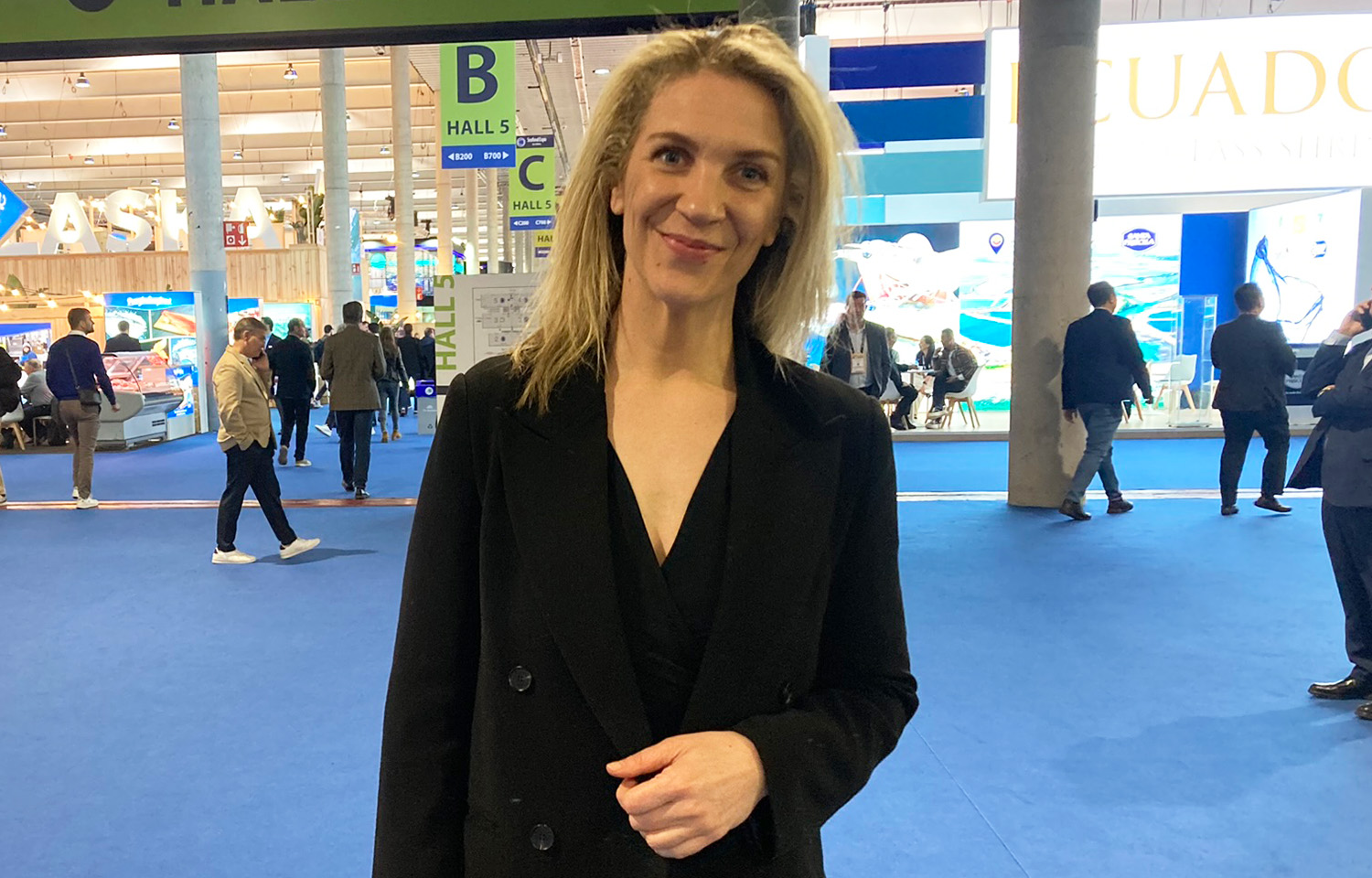
Siri Tømmerås is the commercial director of land-based operations at AKVA group.
SeafoodSource: What is your background, and how did you land at AKVA?
Tømmerås: I received my master’s from the Norwegian College of Fishery Science and have been in the land-based sector since 2015. After 10 years at Skretting, including five as product manager for land-based feed, I joined AKVA. While focusing on fish health and technical systems, I fell in love with the complexity of biofilters and microbiology. I now oversee both sales and technical services and lead a production advisory team. I also have what I call "my baby"– a team supporting customers with biofilter maturation, SOPs, and maintaining fish health after handover.
SeafoodSource: Do you feel like you need to have that level of expertise in order to do sales in such a specialized area of aquaculture?
Tømmerås: Yes. For me, it’s crucial to have the knowledge to properly discuss what the client actually needs. Recirculating aquaculture system (RAS) technology isn’t “plug-and-play” – we need to understand what we’re selling and how to manage it. The biggest bottleneck is competence. Although we have many experts in fish farming and welfare, RAS is still relatively new, and we need to build more expertise.
I get two or three emails a week from people wanting to build RAS in remote locations. When evaluating these projects, the first thing we look at is the team. The right expertise and capabilities are essential. For instance, at the Nordic Aqua Partners (NOAP) site in China, there are 11 to 12 ex-pat specialists who have been working on the project for years. The success comes from having people with deep knowledge of the facility, fish, and farm management.
In addition to having a competent team, the site needs to be suitable in terms of water quality and availability, power infrastructure, and effluent management. Land-based fish farming is also capital-intensive, requiring significant funding.
Our NOAP project is a great example of how collaboration and continuous support are key to success. We’re now focusing on a new model that goes beyond delivering the project. We provide personnel who stay on-site for six to 12 months to train local teams. This comprehensive training program begins long before handover, as there’s so much to learn – especially for those new to the industry. People need to quickly grasp RAS system management, fish feeding, and the developmental stages of fish. It’s about producing the best possible outcome for the fish and the farm.
SeafoodSource: Has the industry made progress in attracting more young professionals into focusing on land-based aquaculture as a career?
Tømmerås: That is now happening. I’m seeing more people showing interest in RAS and educating themselves about the knowledge needed to succeed, but the systems are also becoming more complex. They’re getting larger, and scaling isn’t always straightforward. We must optimize designs for energy efficiency, sediment elimination, and flow across various species and farm sizes.
Over the past three years, we’ve focused on standardizing how we deliver projects, making systems easier to understand. This also benefits technical and biological services, as familiarity improves support. The grow-out and smolt segments in RAS offer huge potential, especially with successful projects like NOAP and others. Reducing sea time for fish improves efficiency, cuts biological costs, and lowers production risks. For example, Grieg Seafood and partners have seen mortality rates drop significantly by growing smolt on land before transferring them to the sea. This approach not only boosts fish health but also optimizes license use.
SeafoodSource: How does AKVA fit into the larger aquaculture technology ecosystem? Does the company consider itself a specialist or a generalist?
Tømmerås: Since we have land-based, sea-based, and digital business units, I’d humbly say we’re the largest aquaculture technology provider globally. And, we strive to deliver total solutions for the farmers.
Our role in the industry depends on the business unit, but for land-based fish farming, we work to be a system integrator where we use our design and solution knowledge to build the best facilities for the fish and the farmer. This means that we include a lot of our solutions from other suppliers into the total [package]. We also wish to be a knowledge and teaching organization with our continuous R&D work, training, and support of customers.
SeafoodSource: Has the technology improved to the point where we're now in aquaculture 2.0?
Tømmerås: Yes, we use that term now. We've worked hard to establish a "science behind" our systems. In the feed industry, millions are spent on research annually, but seafood supply hasn't seen the same investment. That’s why we built an R&D department – to document and understand our systems better, with 150 already operational globally. This foundation helps us improve standardization, automation, data analysis, and control systems, incorporating AI and Industry 4.0 for smarter, data-driven operations.
SeafoodSource: Is AKVA doing all that, or are you looking at third-party suppliers for that technology?
Tømmerås: When it comes to sensors, we're buying them from a third party, but we are developing our own control systems. With the digital entity, we have in-house knowledge, so I'm happy about that. Even though I come from the biology and fish side, I understand that the future is quite digital. We have to take the lead, and that involves taking the first step with actually improving data collection so we know we are feeding the AI correct information.
The past year has seen an explosion of new suppliers entering the market with exciting and innovative tech solutions. We often meet with companies that bring fresh ideas and have developed impressive technologies that I know will be valuable to us moving forward. It’s great to see this, especially since when I first started in freshwater and post-smolt, there wasn’t much interest in those areas because the money wasn’t there. But now, with the growing focus on land-based farming, more people are developing solutions for this part of the industry.
SeafoodSource: What’s it like to work at the nexus between one industry that’s cutting-edge and another that’s as old as human history? Is there tension between those two groups or do they meet happily in the middle?
Tømmerås: There’s definitely a gap. Sometimes, I don’t even understand the tech people’s language; they're speaking English and Norwegian, but the terms are so technical! A big part of my role is bridging that gap, helping everyone communicate and understand one another. It’s about taking clever ideas and ensuring they’re implemented properly to add real value, whether that’s by reducing risk or increasing efficiency. Effective communication is key to making sure these advanced technologies truly benefit the industry.
SeafoodSource: How much further does the land-based sector have to go in terms of implementing technology?
Tømmerås: It’s quite varied. Many companies are now building the infrastructure needed to push production and efficiency forward. There’s a lot of work around sensors, which help us understand fish well-being by tracking things like gill activity and swimming patterns. As the costs of these large systems rise, companies are starting to see technology as a way to save money, ensuring energy is efficiently used for growth. It’s all about catching issues that may affect fish health as quickly as possible to maximize value.
SeafoodSource: How has the seafood industry as a whole dealt with the implementation of technology?
Tømmerås: Back in 2000, when new ideas like underwater cameras were introduced, people laughed at them, saying they were unnecessary. Now, they’re essential. There will always be resistance to new technology, but I have great respect for those who invest their time and money in innovation. It’s risky, as we’ve seen with land-based technology, which has had its share of challenges and losses. However, I believe we’ve turned a corner, and those visionaries are now seeing their ideas gain mainstream acceptance.
SeafoodSource: Most of the growth in the land-based sector is coming from big, established aquaculture firms building post-smolt facilities or grow-out centers. Why is that?
Tømmerås: There are a few reasons for this growth. First, there’s a lack of new aquaculture permits, and reducing time in the sea is critical for fish health. For a farmer in Norway producing 20,000 metric tons (MT) a year, increasing smolt size to 1,000 grams or more can boost production by 25 to 30 percent. The cost of building a post-smolt facility is more favorable than getting a new license. Plus, by shortening the time fish spend in the sea, you reduce mortality rates and the need for delicing, antibiotic treatments, or other interventions. This also lowers the risks of diseases and environmental threats like jellyfish attacks, making the entire process more efficient and cost-effective.
SeafoodSource: Is every big salmon-farming company building land-based post-smolt facilities now?
Tømmerås: I’d say everyone is moving in that direction, though not all the way to 1,000 grams yet. It’s not universal. In southern Norway, where the lice situation is more challenging, we’re seeing larger investments in post-smolt facilities. In northern Norway, you typically don’t see smolt over 120 grams, but even there, they’re starting to grow fish to 200 or 300 grams to make better use of their licenses.
SeafoodSource: What are some of the bigger companies that pioneered the land-based post-smolt movement?
Tømmerås: It's always tricky to name just a few because someone deserving might be left out, but I would say Mowi has been a significant player. We’ve been working with them since 2008, starting with the Nordheim project, where we’ve now built seven RAS facilities with a combined production of 5,600 MT of smolt up to 700 grams. Other key players include Vest Havbruk, Grieg Seafood, and Bremnes Seashore through the Tytlandsvik Aqua project.
SeafoodSource: What is the future of the land-based aquaculture movement?
Tømmerås: The future of land-based aquaculture depends on each region determining if it’s the right fit – there’s no one-size-fits-all approach. Some species, like salmon, benefit from RAS because they need clean water, which this technology can provide in areas previously unsuitable for farming, especially near markets. RAS won’t fully replace sea-based farming, but it can complement it, addressing disease issues and enhancing local production. While some predict 200,000 MT by 2030, I think we’ll see five to seven large RAS farms producing around 150,000 to 200,000 MT within the next five to 10 years, adding to global protein needs.
