






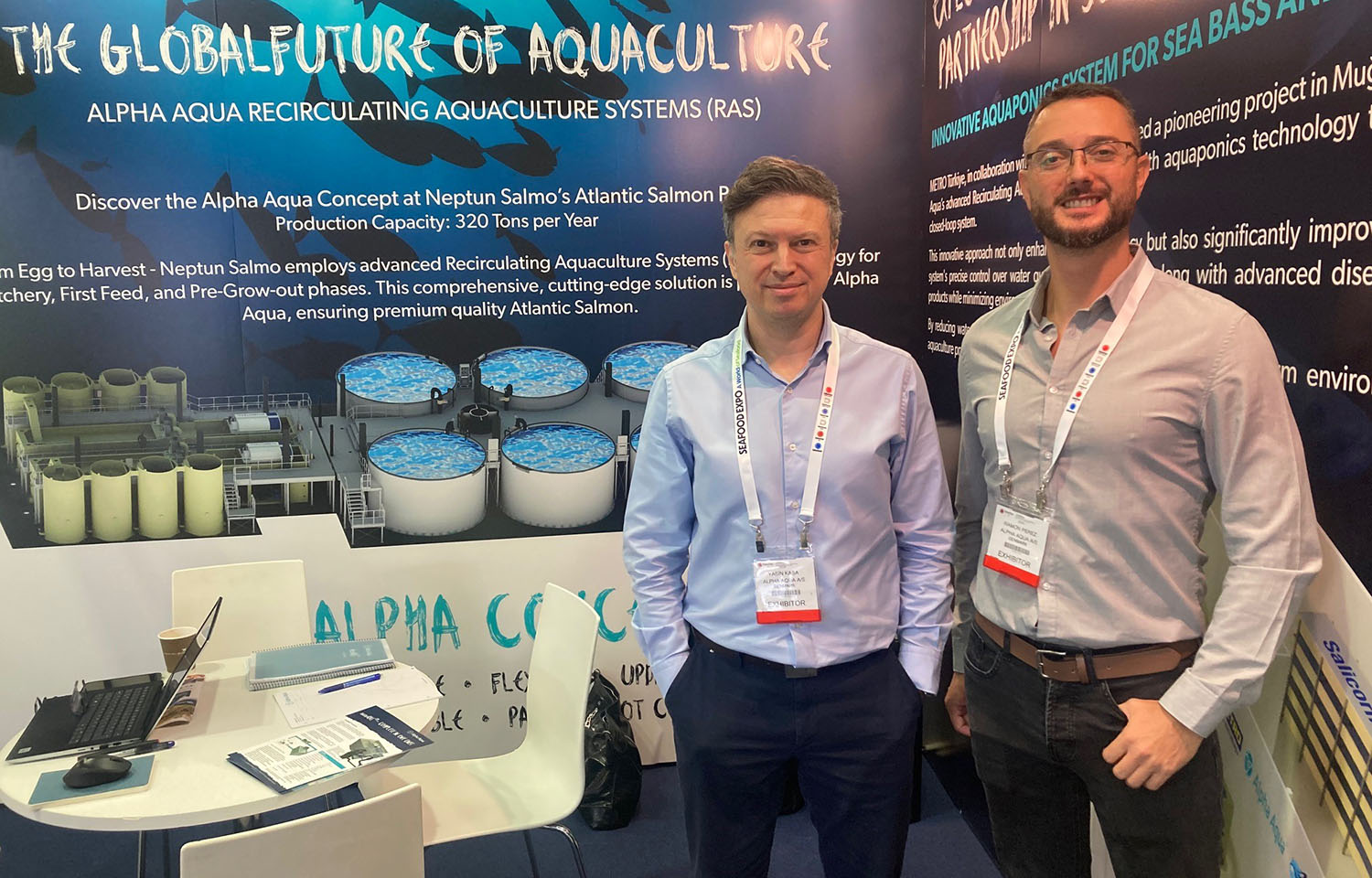
Ramón Pérez is the chief operating officer of Esbjerg, Denmark-based Alpha Aqua. The company recently won a contract from Metro Türkiye to supply it with a small-scale sea bass aquaponics recirculating aquaculture system (RAS) farm. Pérez spoke to SeafoodSource at the 2024 Seafood Expo Asia, which took place 4 to 6 September in Singapore.
SeafoodSource: So, you're from Spain, but your company is based in Denmark, and you're doing an RAS project in Turkey.
Pérez: I'm a veterinarian who specialized in fish. I got a master's of science degree from the University of Stirling and began working in agriculture. I’ve lived and worked in Ethiopia, Malaysia, and southern England, as well as Copenhagen. Through all this moving around, I’ve met some key people in aquaculture who have become very good friends, coworkers, and colleagues, some of whom were Danes.
When our previous jobs ended, we decided to create Alpha together in 2017. We had a lot of the knowledge on what to do and what not to do when it came to land-based aquaculture. We were all passionate about it; we really believe this is the future. But, when it came time to picking a focus, we looked at the question of what is the market going to request in five and 10 years from now? That's how we came with our focus on smaller systems.
SeafoodSource: Why did you decide on smaller systems?
Pérez: There are many aquaculture companies that have built big concrete constructions producing hundreds of thousands of tons of fish. We don't believe in that, and time has proven that we were right. The market has been evolving from fish farmers into investors, and what a fish farmer wanted was a tailor-made system for them based on their knowledge, their principles, and their understanding of the fish. But, an investor wants a proven concept and certified performance, if possible; they want a machine. That's actually what we created, and often, we came with three different units, the Nano 1, 2, and 3.
SeafoodSource: What are those?
Pérez: They are modular machines verified on performance and CE [Conformite Europeenne] marked, so it's tested and you know it's going to work as promised.
We knew we were the new kids on the block, so we needed to put ourselves in the position of having investors trust my Excel spreadsheet. This is proven by a third party from the European Union, and we're the only company with an ETV verification: That's an environmental technical verification based on performance of a unit. So, what we say the unit does, the unit does.
That means that when we are preparing a design for a farm, we can first reduce design hours because we have our baselines and our modules, depending on how much you want to produce. This is supposed to operate as close as possible to a factory. Everything is built over a flat surface of concrete so you have access to the whole system – even the tanks are above ground. Additionally, everything is modular, and everything is transport-friendly. If we go above 1,000 or, really, 1,500 tons, we prefer to have a complete separate system with biosecurity and risk mitigation to ensure full control of what's going on, and at that level, a harvest plan becomes super important. Everything is designed and run systemically.
SeafoodSource: Founding a startup focused on land-based aquaculture, which has had its fair share of challenges, is a big leap to make. Why do it? Why did you want to make this happen?
Pérez: It is precisely for the same reason I just said. There has been a switch in the overall market from fish farmers into investors. We're absolutely on board with that. That is actually why we created all these concepts because it's the way of securing the future. Everybody wants to eat protein, and we're not running around hunting chickens in the forest. The seas are at the absolute limit. For the first time, aquaculture production is bigger than fisheries extraction.
So, fish farms need to exist, but there's also a challenge of being environmental about it; that's why you will see that everything we do is land-based. We don't do anything in sea cages because we believe ours is a more sustainable way to it because we can control the overall environment. For example, we collect the feces from our farms – it has so much value. You can use it for biogas or fertilizer for aquaponics. Most companies are paying a premium for each percent of extra protein in their feed – why would you toss it?
I know it sounds like a circular economy model, but if you look to the future, this is where we're going. Investors are a key element in all of this. If you go to an investor and say, “No, I've never built this farm, but my Excel looks fantastic,” you can imagine what the investors would say, right? But if you can show them, it allays a lot of skepticism. It's not because you like me that we're going to get in business together. It's because this is a machine. This will do what we say it will do.
SeafoodSource: How much skepticism do you encounter, given the mixed record land-based farming has had over the past decade?
Pérez: There's huge skepticism. There are a lot of people who have become a bit reluctant to the idea, who are waiting a bit to see what happens. That’s why we have to do things differently. Building an RAS should not be trial and error. Clients should never be guinea pigs. Clients should get something that is proven to work.
At Alpha Aqua, we've done the trial and error. It’s a company policy that our data sheets are open; our competitors could see them if they want to. Aquaculture has, historically, been an industry that has been very secretive, but we want to be open. We are very keen on speaking about what we're doing because we trust the way we do it. Of course, we have 12 patents on our CO2 stripper that we won’t be giving away, but we are very open on our way of working because there are still a lot of people who want to believe in RAS and just need to be able to trust what they’re investing in is going to work as advertised.
SeafoodSource: How did your contract with Metro Türkiye come about?
Pérez: Metro got in contact with us through some of their consultants. They were scouting the market for quite some time, and they found us and thought what we were doing was interesting. They came for a visit. We have our own running farm in Denmark, and they instantly understood what we wanted to do and how we were approaching aquaculture; that's how we started.
In many industries, there are the very early adopters, the ones who are really brave, then you have the super-early adopters, and then you have these kind of visionaries. The latter defines this partnership with Metro.
Metro has a very proactive approach toward sustainability, supply chain control, and so on – very similar concepts to the ones we're promoting. Over the years, we have talked with many hospitality groups that have seen the potential of what we can do, but they were a bit reluctant. Now, we have a track record with over 70 NanoRAS systems in the world, and seeing this, Metro, which is at the forefront of pushing for this kind of innovation, has been a very good match for us.
SeafoodSource: Where are your other facilities that have been built?
Pérez: We have one in our own headquarters in Denmark. We actually acquired an old Nestlé frozen pizza and ice cream factory, emptied it out, and built an RAS where we're now producing steelhead at 2-kilogram harvest size. It’s our showcase – our way of showing potential customers you don't need to trust our word: Just come and see the system in action. But, in total, we've got close to 70 NanoRAS units working across the globe. We have delivered to companies like FishBase Group, Neptune Salmon, BioMar, Cargill, University of Bergen and Tromso, and Arctic University. Across all our systems, we are achieving very high survival rates versus traditional methods, keeping fish in the super-controlled RAS environment for their most critical days as juveniles, and then we move into the plants. So far, it's proving extremely successful.
SeafoodSource: Can your systems be used for more species than just salmon?
Pérez: Yes, and this is actually one of the things that we put a lot of effort into. We have one in Vietnam currently producing pangasius juveniles of an extreme high quality. Our systems are all made in plastic. Our sensor packages are made in plastic. We're corrosion-free. So, we can go into freshwater or saltwater. That also goes with part of our concept because the industry changes rapidly.
Everybody wanted to do salmon at 80 grams and then move them to the sea. Now, everybody wants to do salmon at 1 kilogram on land before going into the sea. So, flexibility is built into our system. We can tear our tanks apart and make bigger ones while still being able to use the water-treatment unit. If you have a building in concrete with big pits and whatnot, you get what you get. But, our system can be installed in any existing building and turned into a farm.
SeafoodSource: Are you building everything in Denmark and then sending it?
Pérez: Not necessarily. The economics of each project dictate that decision. If, let's say, we have a project in the U.S., we will compare the cost of making the piping and the tanks locally versus shipping them from Europe. It doesn't make sense that you're transporting something that you can find locally. The only thing we transport in every case is our water treatment units, which are assembled in Denmark. But, they are of a transport-friendly size, so we're avoiding special transport costs.
One of the strengths for us is that while the client is preparing the building where the farm is going to be, we can be preparing all the equipment; then, we do what we call a fabrication acceptance test. That means that we test it in-house. We do all the cabling, and all the wiring is pre-done. Even in the big units, we have everything pre-wired and tested, so when we go on-site, we're extremely quick.
For BioMar, we did the mechanical installation of 12 NanoRAS units with 12 tanks in six hours. At our farm, which has a capacity of roughly 200 tons of steelhead, we did the mechanical installation of the water treatment unit in two days. That is absolutely unique. Then again, the money is out there until I'm putting fish in the tanks, as investors want to know how much time will it be. This is a question we get a lot. If you look at traditional concrete structures, we're looking at maybe two years or so, but we're actually at 10 to 12 months between contract to fish in the water.
SeafoodSource: So, do you use the term plug-and-play? That seems to be getting more popular in RAS circles.
Pérez: I’m reluctant to use the term because it's not that simple. It's not like taking a mouse and connecting it to your laptop. But, we are getting very close to it. On one of our latest projects, we delivered the equipment with a set of instructions because the client wanted to do the mounting themselves. So, we left our piping uncut so they could cut it and prepare as they wanted and offered remote support if they needed it. They did it themselves, and it's up and running now.
For all our systems, the platform is the same, and the machine is the same. This is actually one of the bottlenecks, in my opinion, in aquaculture in general, is the know-how to run these systems. What we're doing is all of our clients can appoint their key staff to come to Denmark and be trained on our equipment. Then, when they go back to their farm, they have already been working hands-on.
SeafoodSource: How is Alpha Aqua incorporating technology into its systems?
Pérez: Overall, what we want is to be the most reliable supplier of RAS systems. That's why we are keeping ourselves on the spearhead of innovation. We're putting a lot of effort into new technologies. Aquaculture is a fairly traditional industry, but with technology advancing so quickly, why should we not be using it if we can make a profit off it by adapting it to do aquaculture better?
We can take advantage of our system’s ability to do big data acquisition to do aquaculture better. We can use AI to control and monitor farms. We're working with Siemens AGA in Germany to build out all our control systems. We're working with the best-in-market sensors. They're not the cheapest, but they're the best, and there's a lot of other available technologies that might not have been developed for aquaculture but can be adapted to it nicely.
We're developing with one of our partners a real-time monitoring process of ammonium and nitrate concentrations because up to now, the way of doing it is through colorimetric tests, or you can actually use the blue unit: this machine that brings water into it and analyzes it. Now, we're looking at real-time monitoring sensors that are economically feasible and giving us a level of data that can allow us to predict what's going to happen and how the biofilters are going to react. The system can also trigger alarms if conditions are set to deteriorate, like if your biofilter is being impaired. All of this is actually through data acquisition and data analysis. We will be idiots if we're not taking advantage of technology other industries developed if it can be successfully adapted.
We are in an era where RAS needs to not only show it can be reliable, but it needs to be at a point where it's industrialized. It needs to be at the level of professionalism that other industries have. This is no longer saying, “I saw a fish blinking to me, so it must grow quicker in red light.” We need to be science-based. Data is key and is the way we will evolve and spawn this industry so it can thrive wherever there's a source of water.
SeafoodSource: What's your goal with the company? Where do you want to be in five to 10 years?
Pérez: I'm guessing that what I say will be very different than some of the more economically oriented within the company. Of course, we're a company, and we need to make a profit. But if you're asking me, I think we're working toward being the most reliable solution provider for land-based, all the way through from design to post-sales and service, maintenance contracts, optimizations, consultancies, etc. Of course, we also do the whole execution – design, assembly, construction, commissioning, and training.
Overall, we want to be the most reliable andbest supplier, and if that means that we're not going to be involved in projects of 200,000 tons, so be it, because I think there's a lot more extremely attractive projects that are smaller but closer to the final consumer; to me, that’s the real beauty of RAS.
SeafoodSource: Do you think that there's space now for smaller projects to get off the ground in less traditional markets in more places in the world – areas that haven't been considered for RAS projects before?
Pérez: We're looking. I get excited about ideas like the concept of aqua-parks, where you could actually go and develop a market and a community. Some place where you train 25 farmers, each one with their own RAS. That way, you're limiting your risk and are investing on the community. You're developing local expertise while creating a local source of protein, and that is something that can be implemented anywhere. You could implement it outside of a metro supermarket, or you could do it in the middle of India in an empty building, producing both jobs and food. Our vision is that RAS should be able to be everywhere.
