






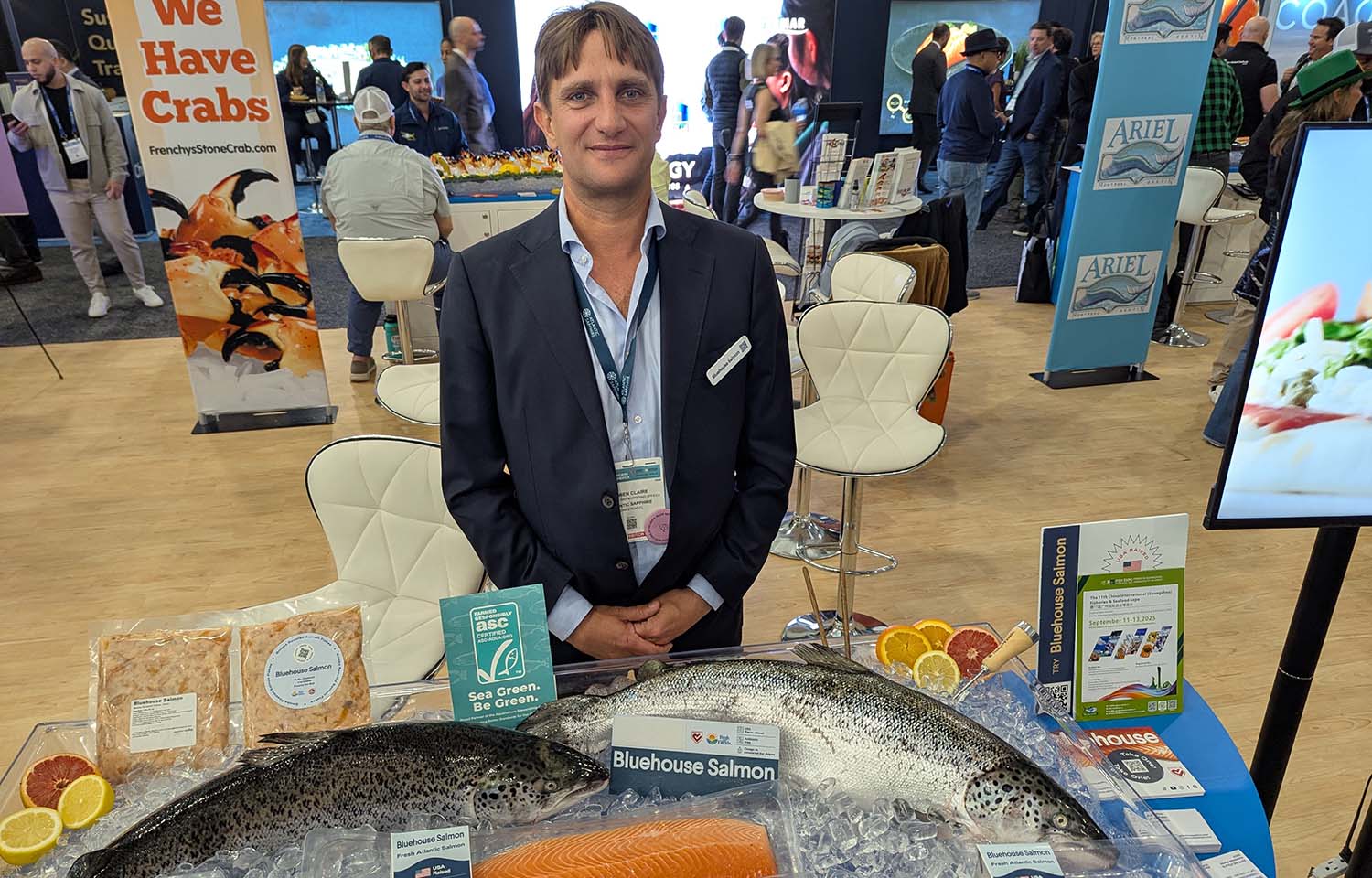
Atlantic Sapphire is working on growing large, healthy salmon at its Miami, Florida-based RAS as the company transitions from startup to salmon farmer.
After years of work and a few shortfalls, Atlantic Sapphire is transitioning from a startup with lofty goals for eventually farming salmon in a recirculating aquaculture system (RAS) in Miami, Florida, U.S.A. to a producer of salmon that’s being served to customers.
Atlantic Sapphire Chief Sales and Marketing Officer Damien Claire told SeafoodSource during Seafood Expo North America (SENA) – which ran from 16 to 18 March in Boston, Massachusetts, U.S.A. – that the company’s current trajectory can largely be tied to its change in leadership. Atlantic Sapphire picked former Cermaq Chile Managing Director Pedro Courard to serve as its CEO in May 2024, replacing founder Johan Andreassen who announced his departure in October 2023.
“Everything is related to that change,” Claire said.
He said the initial stages of the company required the vision and entrepreneurial drive Andreassen brought – and now that it is operating and no longer in startup mode, Courard’s leadership has helped it mature into a more stable operation.
“Pedro’s already put his fingerprints on how we do things, how processes are managed, and what his vision is for the future and the current-, middle-, and long-term of the company,” Claire said.
That current focus is the fundamental mission of Atlantic Sapphire: Producing salmon.
“Pedro wants to focus on making big, beautiful salmon,” Claire said. “Not on changing the planet, and not to talk about the 10-year growth plan, he wants to deliver amazing fish, today.”
Atlantic Sapphire has had a tumultuous journey to get to where it is now. It has faced setbacks during early production runs, mortality events, a massive fire at its Denmark facility, and temperature-related challenges that have resulted in the company undershooting its biomass targets.
Claire said a lot of that attention is thanks to the company being publicly traded.
“For good or for bad, we need to report to the stock market, and the news has access to those reports, and it’s endlessly celebrated and endlessly criticized,” Claire said.
The goal for now is to avoid those big headlines and focus solely on producing big salmon, and do so in an uneventful way.
“The focus is now on, ‘let’s produce fish.’ We’re selling a lot of fish right now, and I think more than a news article or a press release, the fish is going to talk for itself,” Claire said. “I’ve been with the company 11 years, so I’ve gone through all those ups and downs – and it’s really nice that we’re getting there.”
Part of its recent achievements came shortly before SENA, when the company achieved Aquaculture Stewardship Council (ASC) certification. Claire said ASC developed a new RAS module focusing on the key metrics for land-based farming.
Claire said ASC certification as it existed before the new RAS module didn’t quite fit for Atlantic Sapphire – which is why it waited until now to pursue it.
“Net pen guys are ASC, and ASC is asking them ‘how many escapes do you have? How much sea lice? How do you affect the seabed?' The answer to all of those questions for us was ‘not applicable,'” Claire said. “As soon as the ASC did a RAS module, then it made a lot more sense for us to work with them toward that certification, and that also really differentiates us from just being an ASC-certified farm.”
As it continues to produce salmon, the company has run into unexpected questions from customers who aren’t used to dealing with salmon as fresh as they can get from a nearby RAS.
“I won’t name names, but a few months ago, we sold to a big distributor that sells for sushi, and we sold them whole fish,” Claire said. “They shipped the fish on a Monday, and on Wednesday morning I got an angry phone call.”
Claire said the customer was upset that the fish was tough and firm – completely unlike the texture they were used to.
“I laughed and I said, ‘okay I know what’s going on. That’s something you’ve never had before, it’s too fresh. It’s still in rigor!” Claire said. “The truth is, that has become one of the main selling points – freshness.”
