




Land-based salmon-farming company Atlantic Sapphire is planning to become a private company and de-list from the Oslo Børs to secure additional financing that it says it will need over the next 12 months.
In a post to the Oslo Børs, the company said it has entered a restructuring agreement to address its long-term financing needs. That agreement will be between the company and its largest shareholders and will see those shareholders become the private owners of the company, Atlantic Sapphire CFO Gunnar Skinderhaug confirmed to SeafoodSource.
"The investor group of five of the largest shareholders intend for Atlantic Sapphire to be a private company, de-listing from the Oslo stock exchange,” Skinderhaug said. “The company is expected be a private company after the process has been completed and approved by general meeting and Oslo stock exchange"
That restructuring agreement, along with a USD 10 million (EUR 8.5 million) bridge loan the company secured in April, provide a “minimum” of USD 20 million (EUR 17.1 million) in new liquidity to Atlantic Sapphire from the investor group, the company said. It will also strengthen the balance sheet via a partial write-down of its outstanding convertible loans.
Atlantic Sapphire said former shareholders of the company will be invited to participate in a private placement for proceeds of up to USD 5.85 million (EUR 5.02 million).
The move is the latest effort by Atlantic Sapphire to stave off liquidity issues that were threatening to see it enter a technical default on some of its lending agreements if liquidity wasn’t secured. The company said that the bridge loan was needed was in light of the “acute need for liquidity to meet its ongoing obligations, sustain its operations, and avoid insolvency proceedings.”
During that process, the board determined that the company’s equity and shareholder value “were most likely lost” and that any further capital contributions to the company that met its needs, from anyone other than the core investor group, were unlikely.
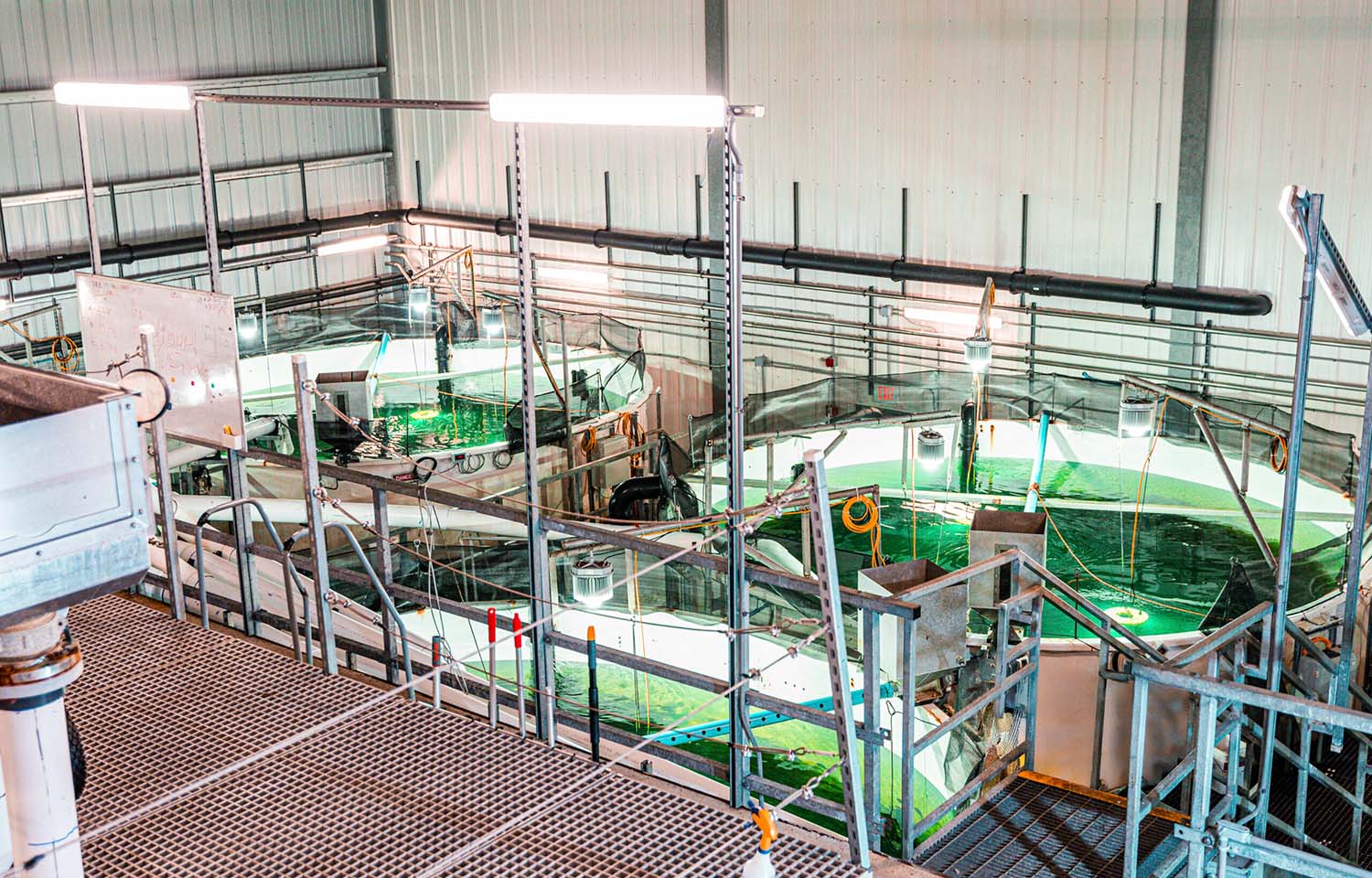
The move comes five years after Atlantic Sapphire went public on the Oslo Børs. At the time, construction on its land-based salmon farm in Miami, Florida, U.S.A., was underway, and farming in its Phase 1 operations had begun. At the time, the company said it was aiming to be one of the largest salmon farms in the world, with an anticipated yield of 220,000 metric tons (MT) by 2030.
Not long after it went public, it was forced to initiate an emergency harvest of 200,000 fish in July 2020 that resulted in revised revenue expectations and a big drop in its share price.
That mortality event was the first of multiple challenges the recirculating aquaculture system (RAS) company faced.
In March 2021, it suffered a mortality event that impacted the equivalent of 500 MT of head-on gutted salmon harvest related to a flaw in the design of the system. Later that same year, its functional RAS facility in Denmark was lost to a fire, which eventually resulted in a DKK 180 million (then USD 25.5 million, EUR 24.1 million) cash settlement.
During the same period, the company also said they were having issues securing oxygen for the first phase of its salmon farm, causing another drop in share price. In 2022, the company reduced its year-over-year losses and reported stable conditions at its U.S. operations but, just a year later, revealed it was undershooting biomass targets due to high temperature issues at its farm. The company installed new water chillers that solved its temperature issues, but those problems left it predicting lower-than-expected harvests.
In 2024, Atlantic Sapphire founders Johan Andreassen and Bjorn-Vegard Lovik sold off their shares in the company after Andreassen stepped down from the role of CEO in 2023. Pedro Courard, the former managing director of Cermaq Chile, took on the role in 2024, and in early 2025, Atlantic Sapphire Chief Sales and Marketing Officer Damien Claire told SeafoodSource the company’s focus was on growing salmon and maintaining stable operations.
Since Courard took the role of CEO, the company has seen higher harvests and improving pricing and revenue and predicted it could achieve positive EBITDA by the end of 2026. However, the financial position of the company has remained constrained even as its operational performance improves.
The company said becoming private was the only method to raise the funding it needs. It considered launching a rights issuance of USD 15 million (EUR 12.9 million) in shares to existing shareholders, but further analysis and dialogue determined that the rights issuance would “likely have created an unfair outcome for the participating minority shareholders."
The company said as part of a long-term financing solution, its investor group has created a new entity called Coral Holding that will effectively hold more than 90 percent of the shares of the company, which would give it the right to enact a compulsory acquisition of the remaining shares for a price as low as NOK 0.10 (USD 0.01, EUR 0.01) per share.
That price would have essentially meant any investors in the company would likely be subject to an acquisition at the same exact share price, meaning the investment would have had no return and a “significant loss” compared to the NOK 0.80 (USD 0.08, EUR 0.07) per share offered in the rights issuance.
The board emphasized that without the transaction to go private, the company’s employees would be in a “highly uncertain” situation, its creditors would have limited chance of recovery, and the company’s shareholders would have lost all value.
The company said further information, including proposals and the various steps the company will take in the restructuring, “will be provided in due course.”
