






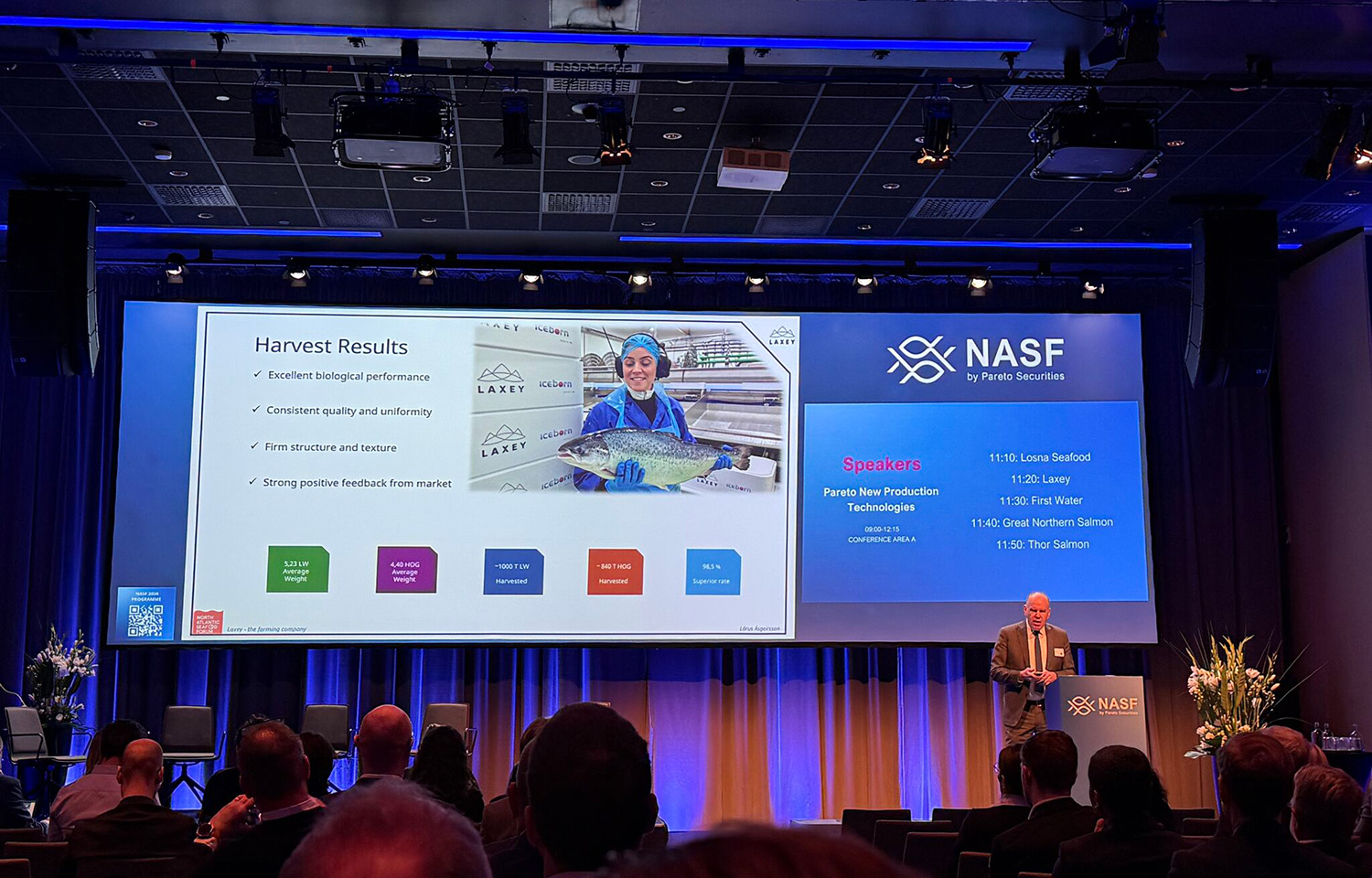
A handful of emerging aquaculture companies are betting on Iceland soon becoming a major hub for land-based salmon production, with executives at the 2026 North Atlantic Seafood Forum (NASF) outlining ambitious plans to scale output, which they say will be achieved by tapping into the country’s abundant water resources, renewable energy, and supportive communities.
Presenting at NASF in Bergen, Norway, leaders from Losna Seafood, Laxey, and Thor Salmon described projects at different stages of development but sharing a common vision: the large-scale production of Atlantic salmon on land.
Losna Seafood CEO Geir Nordahl-Pedersen said his company is building a large flow-through facility designed around simplicity and proven technology. When complete, the structure will measure roughly 550 meters long and 100 meters wide and will operate using deep seawater intake rather than recirculating aquaculture systems (RAS).
“Salmon have lived in seawater for thousands of years, so why change the water quality?” Nordahl-Pedersen said.
Built at sea-level, the facility will draw water from about 75 meters deep, where it is naturally free of sea lice and many pathogens. The company plans a low-energy system with no water treatment, no UV sterilization, and no recirculation, relying instead on continuous flow of clean seawater.
Losna holds a production license of 28,600 metric tons (MT) maximum allowed biomass (MAB) and estimates capital investment for its two-phase development at roughly NOK 2.3 billion (USD 238.1 million, EUR 205.9 billion).
Meanwhile, on the island of Heimaey, Laxey is already moving from its construction phase into commercial production. Chairman Larus Ásgeirsson said the company expects to reach 36,000 MT of annual production by 2032 through a modular development consisting of six production sections.
The project is now roughly halfway completed. Laxey has already begun harvesting fish from its first production cycle, reporting an average harvest weight of 5.2 kilograms and a superior grade rate of 98.5 percent.
“We have now become a salmon-farming company on a land-based platform,” Ásgeirsson said. “We are producing high-quality salmon with strong biological performance.”
Since November last year, the company has harvested about 1,000 MT and exported fish to more than 20 markets while continuing to expand its hatchery and grow-out infrastructure. Some of its smolts are being sold to other Icelandic producers.
Laxey expects to become “EBIT positive” later this year and has secured financing support from banks led by DNB for the next development stage, Ásgeirsson said.
The firm has also signed agreements with equipment manufacturers like BAADER, Marel, and AKVA, as well as a more recent deal with ScaleAQ to use its feed system in its flow-through salmon farm.
Another Icelandic entrant, 2022-founded Thor Salmon, is pursuing a long-term expansion plan that could eventually reach 40,000 MT of annual production. CEO Steinþór Pálsson told the conference the project benefits from a unique location on the country’s south coast, where freshwater and seawater are naturally filtered through volcanic lava formations.
This natural filtration system provides exceptionally clean water for aquaculture, while geothermal energy and renewable electricity help support the facility’s operations.
Thor Salmon began production at a smolt facility completed in 2024 with capacity for 4 million smolts per year. The company plans to scale up gradually, initially targeting around 5,000 MT of production before replicating grow-out modules to reach larger volumes over the next decade, with its first harvest expected in 2027.
Pálsson said the company intends to rely on proven aquaculture technology combined with automated monitoring systems controlling water flow, oxygen, temperature, and carbon dioxide levels.
Across the three projects, executives highlighted Iceland’s natural advantages for land-based aquaculture, including abundant clean water, renewable energy, and strong community support for the industry.
While the companies are pursuing different technical designs and timelines, each sees significant room for growth as global demand for farmed salmon continues to rise.
“We have a lot of land and a lot of water,” Pálsson said. “That gives us the opportunity to grow.”
The optimism comes as the government of Iceland is gathering public comments on the development of new aquaculture legislation. Environmental groups have expressed frustration at the bill making its way through Icelandic parliament, saying that the bill does not do nearly enough to ensure environmental responsibility, but the industry has conversely responded to the bill by saying its reporting requirements are excessive and its regulatory framework is too opaque.
However, the bill largely covers at-sea operations, rather than land-based facilities.
