


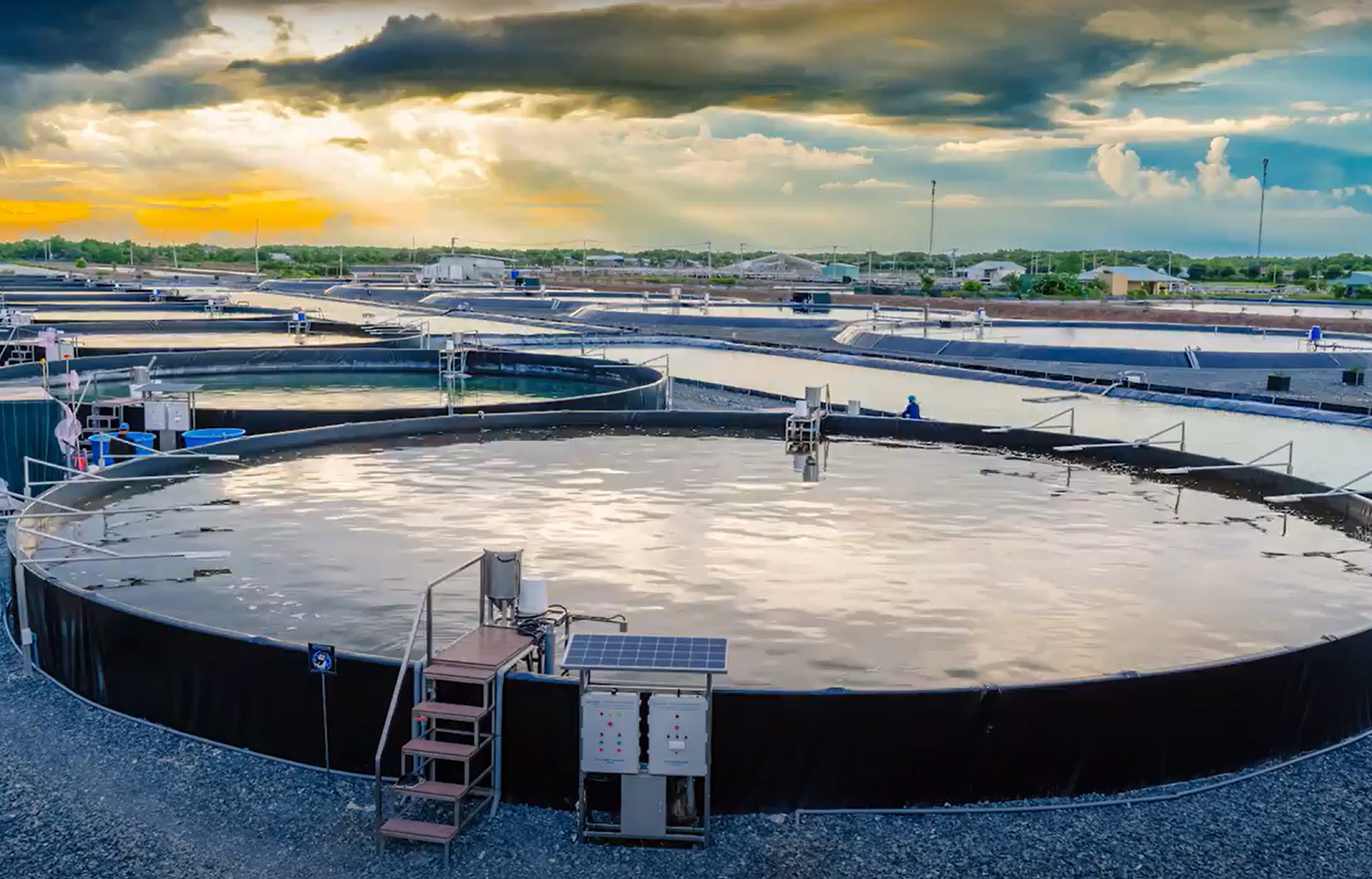
Vietnamese aquaculture and tech firms are actively deploying AI to modernize practices in the country’s shrimp industry, using data-driven tools to lower production costs and protect margins, especially amid rising electricity and feed prices.
Hai Nguyen, the co-founder and farm manager of shrimp company ESG, said at the 2026 VietShrimp Asia and Aquaculture Vietnam show that geopolitical issues have pushed equipment costs up by 25 percent and feed by 2,000 VND (USD 0.07, EUR 0.06) per kilogram.
With global shrimp supply expected to rise in 2026, profit margins are thinner than ever, according to Nguyen, who said an effective way to remain viable is to aggressively reduce production costs using AI to drive efficiency. He said that AI does not replace humans but acts as “a capable assistant” that executes orders with high precision.
To manage environmental risks, ESG uses six weather stations within a 15-kilometer radius and AI to cross-reference local data with satellite feeds. The system warns of heavy rain exceeding 30 millimeters roughly 30 to 60 minutes in advance. With this window, Nguyen’s team can stop feeding across hundreds of ponds to prevent waste and apply lime or minerals to shield shrimp from sudden thermal and salinity shocks, Nguyen said.
He further explained that feed accounts for over 50 percent of farming costs, yet management often relies on worker intuition. ESG has mitigated this issue with underwater cameras that capture feeding tray images every 30 minutes, allowing AI to check for leftovers and assess gut health. When shrimp enter a molting cycle and lose their appetite, the system immediately scales back automated feeders to reduce the feed conversion ratio and prevent pond pollution, avoiding the typical lag time of manual intervention.
Pham Bao Dang, project manager at tech firm RYNAN Smart Aquaculture, said that optimizing yield is critical as Vietnam’s shrimp-farming area is projected to shrink from 150,000 to 120,000 hectares in the near future. With smaller area available for farming, stocking densities have increased to as high as 200 shrimp per square meter, according to Dang, and traditional models of farming under that extreme of density rates lead to high greenhouse gas emissions.
To address this, RYNAN developed a technology called TOMGOXY that pushes dissolved oxygen levels to 20 to 30 parts per million, allowing farmers to at least double yields. The system uses AI to coordinate energy use based on real-time oxygen levels and electricity price windows, as peak rates can be three times higher than off-peak hours. This technology is already being deployed in Thailand, Indonesia, the Philippines, and Australia.
Vu Hong Thai, founder and CTO of shrimp farm design and infrastructure firm Aqua Mina, said that AI support begins even before the first shrimp pond is dug.
Drawing on experience from projects in Vietnam, Costa Rica, and Saudi Arabia, he argued that failing to use AI and Big Data in design is “a significant waste of resources.” For instance, design teams previously had to fly to sites for field surveys, but they can now use AI to analyze Google Maps coordinates to determine optimal terrain, drainage, and electrical connections.
Thai told SeafoodSource that he uses AI to process technical information and train it on internal data to confirm parameters or suggest design options. He found that using AI to present visual design changes was the most effective way to convince international clients to optimize their farm layouts.
Another innovative application of AI in the Vietnamese shrimp industry has been the creation of internal chatbots trained on specific standard operating procedures to streamline complex decision-making.
Nguyen of ESG said pond managers at his firm consult an AI chatbot to handle environmental spikes or technical failures, ensuring consistent performance without the need to constantly contact senior management. Similarly, Aqua Mina utilizes its own AI assistant to support its sales team and international clients, providing objective design advice and technical recommendations grounded in extensive industry data to reduce management overhead across global projects.
Ultimately, the successful adoption of AI in aquaculture depends on both the accuracy of the data collected and the ability of humans to act on it. Nguyen emphasized that while AI cannot replace humans, those who master these tools will hold a competitive advantage in an increasingly fierce international market.
