


Eric Enno Tamm is the co-founder and CEO of ThisFish, a Vancouver, Canada-based software and artificial intelligence company that services clients within the global seafood industry. Tamm started ThisFish as a small Canadian pilot project in 2010 and has grown the company to become a global business operating in Southeast Asia, the Americas, and across Europe. Prior to starting ThisFish, Tamm worked at multiple nonprofits, including the Coastal Community Network and Ecotrust Canada.
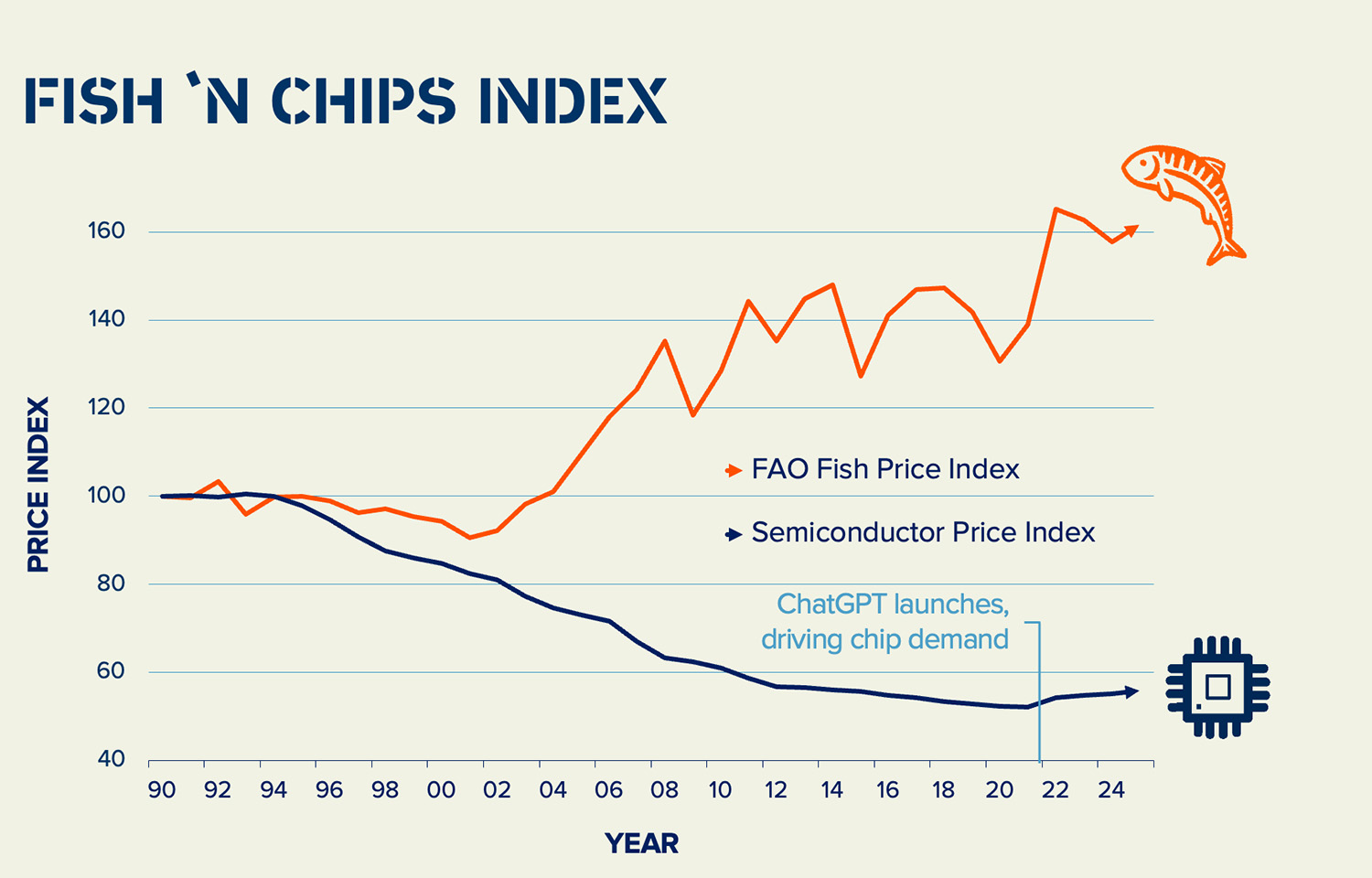
For the fourth year running, the price of computer chips has increased, while the price of fish is still lower than it was in 2022.
That’s a reversal of a 20-year trend – of fish getting pricier and chips getting cheaper – that I’ve been documenting in my annual Fish n’ Chips Index.
The cause? Blame ChatGPT.
OpenAI’s launch of ChatGPT in 2022 has driven explosive growth in data centers in the U.S. to train and run AI models such as ChatGPT, Gemini, Grok, Claude, and others. These data centers require phenomenal amounts of computing power, which has driven demand for chips. It may only get worse.
OpenAI alone has pledged USD 500 billion (EUR 428 billion) in new data center investments. The electricity requirements are so enormous that three companies are planning to build them in outer space where solar panels are three times more efficient.
So, how is all this AI going to impact us lowly earthlings in the seafood industry?
Beyond all the AI hype and headlines, here are five trends you should watch for in 2026 and beyond as AI sweeps into seafood.
1. Generative BI: Talk to your seafood data
Dashboards aren’t dead, but AI is going to change our relationship to data in 2026. AI such as ChatGPT are powered by large language models (LLMs) that are trained on trillions of megabytes of data from the Internet. They are referred to as “generative AI” – GenAI for short – because when you ask it a question, the AI can generate an answer in text, images, or video.
Now imagine an AI ingests 20 years of your seafood company’s data – sales, revenue, harvesting, processing, quality control, costing, and inventory – and you simply talk to your data by prompting it with questions to generate insights, charts, and tables. This marks a shift from traditional dashboard-based BI tools to GenBI, enhancing accessibility and speed in data-driven decision-making.
Two years ago, we at ThisFish piloted a GenBI tool, using Google’s Gemini, for a salmon processor. It performed poorly because the AI struggled to understand seafood jargon and the non-standardized, unstructured data.
Fast forward to today and the AI models have become much more powerful. Expect to have some dynamic dialogues with databases in the coming year.
2. AI agents: Vibe coding for cod
Since 2021 – the year before ChatGPT – the price of computer chips has gone up 7 percent, according to the U.S. Semiconductor Price Index. While chip costs may continue to rise, software development costs are heading in the opposite direction thanks to GenAI.
Software is built on coding languages such as Python, Java, and SQL, which are more structured and logical than our messy human languages. GenAI has proved remarkably adept at automating coding using AI agents. Anthropic, which developed Claude, a leading coding agent, surveyed 132 of its own engineers who estimated improved productivity of 50 percent. At ThisFish, we just completed an AI agent that reduced a six-hour engineering task to just 30 minutes. Many tools now allow even non-programmers to “vibe” code-simple software apps.
In my Fish ‘n Chips Index, I used the U.S. Semiconductor Price Index as a proxy for declining technology costs. But, that’s no longer the case. Hardware costs will likely continue to rise, but software is getting cheaper to develop. We could see more niche software being built for seafood, which is a highly fragmented market that often requires inexpensive, small-scale solutions.
3. Computer vision: Paradigm shift for quality inspection
Ask any quality control supervisor in a processing plant to show you photos of their children or pets on their smartphone, and they will struggle to do so as they scroll through thousands upon thousands of images of fish, product, and packaging defects. Snapping random pics is how quality is documented in the seafood industry. Yet, this method is highly manual, depends on sampling, and is prone to human bias and error.
For this reason, I believe that AI-enabled smart cameras represent a paradigm shift for quality control: from manual to automated, from random sampling to continuous inspection, from inconsistent and biased to consistently controlled. Imagine taking a photo of every fish, fillet, or can and inspecting it for color, defects, and other attributes. You can even affordably store every photo in the cloud, retrieving them for audits or to defend against customer claims.
Computer vision technology is advancing significantly as engineers explore the advantages of LLMs over traditional neural networks. Tech startups such as OnDeck AI, which started in fisheries electronic monitoring, are now using AI models that can analyze video without training data, a claim that might have sounded absurd only a few years ago.
AI can exponentially improve quality inspection while significantly reducing costs. The obvious ROI will help speed adoption in seafood processing over the next few years.
4. AI and automation: Machine learning for machines
The use of AI by automated equipment manufacturers is surprisingly limited. The Baader 1860 and Marel’s QC Scanner, for instance, relaunched in 2024, both use AI for salmon fillet inspection. These companies, plus Marelec, use AI for dynamic portion cutting. Laitram Machinery uses laser and vision technology to sort shrimp. Some of these companies also use machine data for predictive maintenance. Still, given our industry’s diversity – there are 2,107 items on the FDA Seafood List – these examples aren’t exhaustive.
There is so much more that AI can do for tuna, squid, scallops, pelagics, lobster, crab, whiting, and more. Combined with computer vision and machine learning, automated equipment could provide a no-brainer ROI for seafood companies.
ThisFish, for example, has been conducting AI research in multiple tuna canneries with early results showing that feeding production and QC data into an AI model could save USD 500,000 to USD 1 million (EUR 428,000 to EUR 855,000) in raw material costs alone by optimizing a single production process.
The biggest challenge to AI adoption in seafood is both the quantity and quality of data to train AI models. Since automated equipment typically collects large quantities of clean data, I believe we’ll see many more integrated systems combining AI and automation over the next few years.
5. Augmented reality: A look back to the future
Google Glass first came out in 2013. It flopped – limited apps, ugly design, pricey, and just plain creepy.
In 2026, Google is bringing Glass back to reality or, should I say, back to augmented reality. It’s spurred by the wildly popular Ray-Ban Meta AI glasses first launched in 2021. Two cameras, a speaker, microphone, and an integrated display enable these multi-modal devices to integrate different types of data such as text, images, audio, and video. Last year, sales tripled. Google is now playing catch-up.
While these are currently consumer products, enterprise versions could be used for hands-free industrial activities. Imagine a cold storage worker driving a forklift with AI glasses which could scan barcodes, read labels, and detect objects while the driver verbally logs data on inventory movements. AI glasses could enable QC supervisors to easily document defects or production-line workers to count and inspect fillets for productivity bonuses.
Augmented reality might be a leap for the seafood industry, but GenAI’s impact will be inescapable for most industries, seafood included, in 2026.
