





Predictions about the future of artificial intelligence range from fears it will lead to human extinction, to hopes it will be a transformative technology that positively changes lives forever.
Tony Chen, the co-founder and CEO of aquaculture data analytics firm Manolin said he believes the truth lies somewhere in the middle.
Chen said he isn't sure where exactly in the middle that truth lies, but he does know one thing for certain: Many industries, especially seafood, could be doing more to leverage this technology.
Chen, a Massachusetts Institute of Technology (MIT) graduate with a degree in computer science, started Manolin in 2018 with his roommate John Costantino after working with oyster farmers in the Chesapeake Bay in the U.S. state of Virginia. Early on in the company's start Chen and Costantino realized what a little bit of predictive modeling could do for seafood.
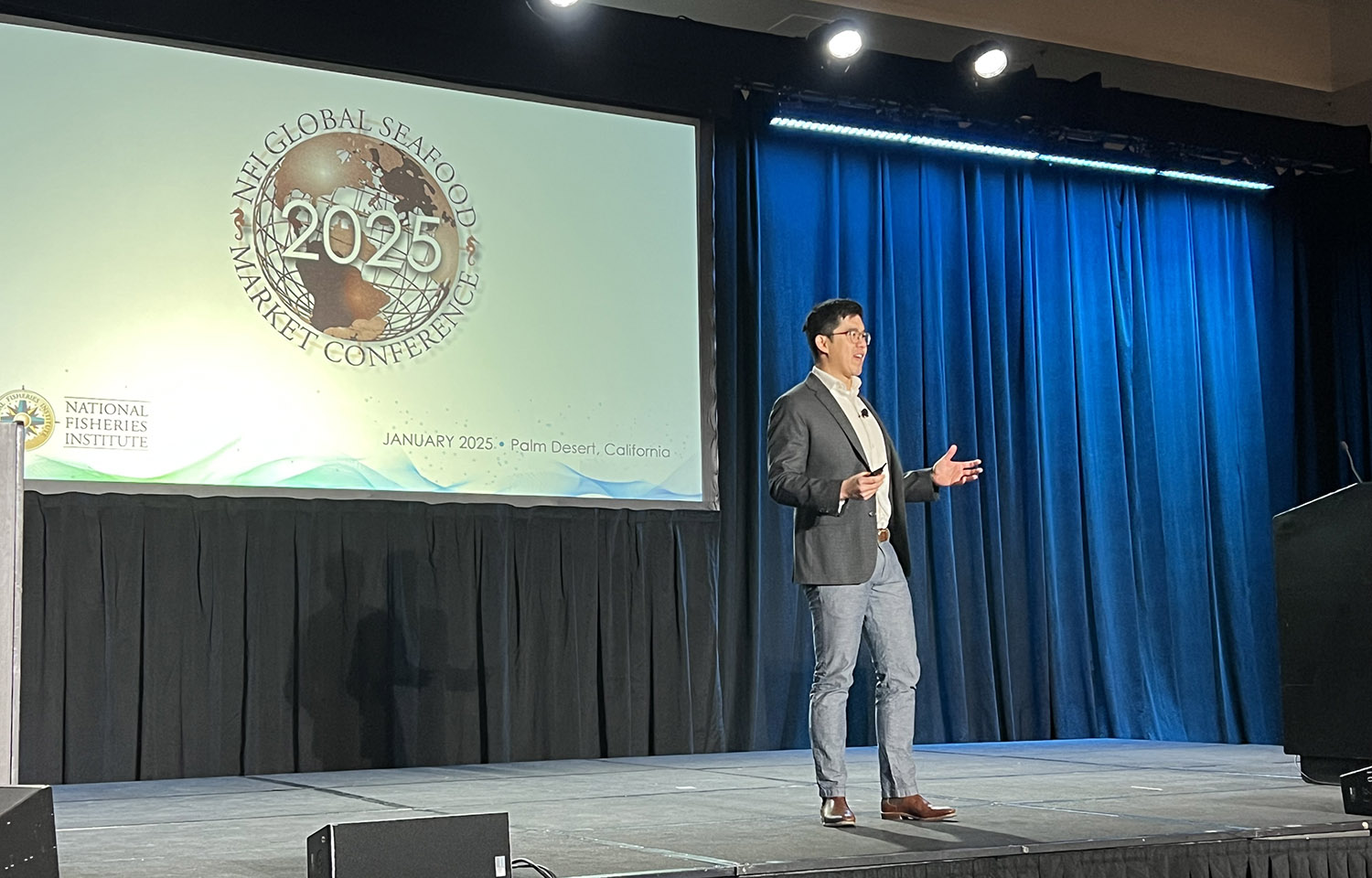
“We saw what the power of data could do for the industry,” Chen said during the 2025 Global Seafood Market Conference in Palm Desert, California, U.S.A., on 23 January.
Chen and Costantino soon moved on to working with organizations across the seafood sector, including the Aquaculture Stewardship Council’s (ASC) work in Norway, where Manolin helped to “significantly simplify the process of managing key data sets for ASC reporting and instantly reduce hours of work into seconds.”
They also began partnering with salmon-farming firms directly in Norway, such as Kvarøy, to accomplish such tasks as automating sustainability reporting, migrating data into new systems, and accelerating aquaculture feed research.
“At Kvarøy, we recognize the significance of sharing farm data through Manolin’s research platform,” Kvarøy Chairman of the Board Alf-Goran Knutsen said. “It allows us to contribute to a broader understanding of aquaculture, supporting evidence-based decision-making and fostering continuous improvement in our operations and the industry as a whole.”
That evidence-based decision-making is where Chen said AI can have the greatest impact in seafood.
Chen said AI can help develop models that show how aquaculture companies can selectively breed fish with superior genetics, with the potential of significantly shortening the time it takes fish to grow to their full marketable size.
“We’re still very new in this idea of domesticating fish,” Chen said. “There are fish that are growing faster and healthier than what you see in the general population. The problem is trying to find them and trying to isolate the right genes and production methods to get there more consistently. This is where companies can use AI to make smarter decisions and achieve their goals a lot faster.”
Another way Chen said AI can help is through the modeling of feed formulas. By referencing AI models, firms can determine the right mix of ingredients that results more consistently in raising fish that have less variation in melanin and blood spots, as well as produce greater nutritional benefits to consumers.
“[Manolin] ended up publishing one of the largest studies ever conducted in a commercial salmon farm setting on this topic, and we’re using this data to develop models and help farmers make smarter decisions on what to use in their feed,” he said.
Elsewhere, companies can use AI to provide consumers with personalized marketing experiences and to better advance and automate processing capabilities, according to Chen.
"To use AI effectively, I think companies need to be very clear about the problem they're trying to solve through the technology,” he said. “Seafood is far ahead of other food industries when it comes to AI in that there's more data available compared to other sectors.”
Though the possible uses of AI are wide-ranging and exciting for the seafood industry, Chen emphasized that the technology is still evolving and, therefore, will not solve all of the industry’s problems.
But, if the industry remains pragmatic and targeted in its use of AI, Chen said chances at successful implementation are high.
"Though it's scary for some, I think the seafood industry can find the right balance in using AI effectively,” he said.
