


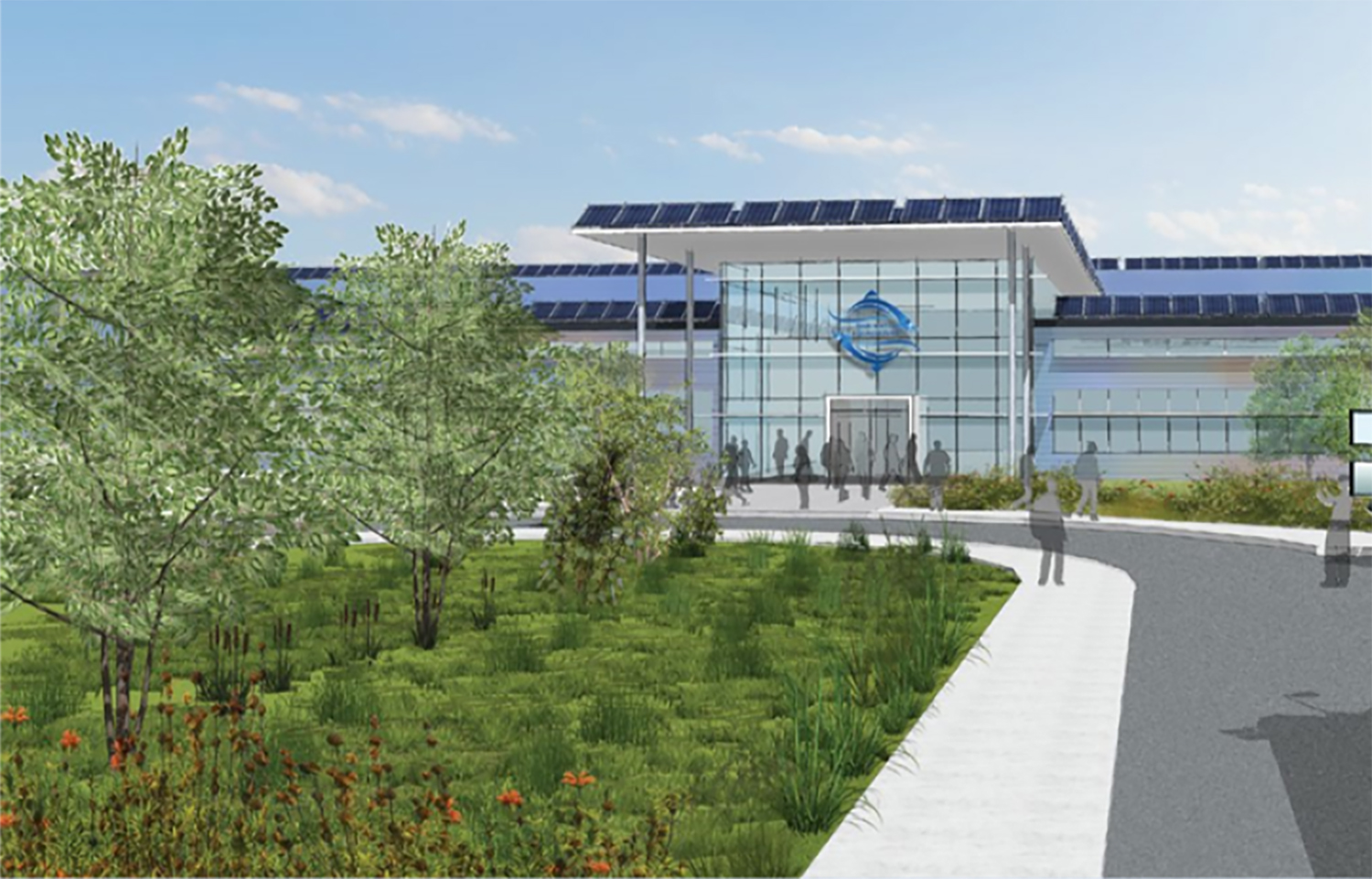
Blue Water Farms, an aquaculture startup in the U.S. state of Minnesota aiming to develop the first large-scale commercial walleye farm in the U.S., is partnering with SIFT Group to adopt its recirculating aquaculture system (RAS) technology.
SIFT, a Norway-based aquaculture technology company, recently developed and successfully piloted a land-based RAS that features raceways with constant flow to mimic a natural river. SIFT said the system comes at reduced capital and operational expenses when compared to a standard RAS system.
The new partnership with Blue Water Farms marks SIFT’s entry into the U.S. aquaculture industry.
“European companies have been [raising fish] for decades,” Blue Water Farms CEO Clarence Bischoff said. “It’s time we bring the latest technology here to Minnesota to accomplish our goals. There’s a huge market in the U.S., and we can meet it. But, I really think we need to rely on European companies initially.”
The SIFT Group will receive a 30 percent ownership share of Blue Water Farms Aquafood, a subsidiary of Blue Water, in exchange for SIFT’s technology and expertise.
Blue Water Farms, on the other hand, aims to take advantage of the unique design of the SIFT RAS system, which is built so that the raceways can be vertically stacked up to eight levels, like “Lego bricks,” according to Bischoff, so that multiple species can be raised throughout the system in separate closed loops.
The company is currently in the process of raising an estimated USD 20 million (EUR 19.4 million) to launch its aquaculture operation, and plans to grow walleye – and potentially steelhead trout – using the SIFT system, aiming for 1,000 metric tons of annual production.
However, that’s just a drop in the bucket of local market demand, Bischoff said.
In the Midwest region of the U.S., walleye is a valued fish, but the majority of supply comes from wild-caught commercial fisheries in Canada. The U.S., conversely, has largely prohibited commercial walleye fishing to protect the multi-billion-dollar recreational industry that the fish supports.
Therefore, Blue Water Farms sees a huge opportunity in providing sustainable, locally produced walleye to an underserved market.
“Consumers are becoming more aware of the health issues in our country and are really tuning into sustainability,” Bischoff said. “The benefits of seafood in terms of health are huge. What’s better than walleye protein raised in a RAS system, where you don’t have to worry about pollutants like mercury?”
Preliminary results from a study conducted by Minnesota Sea Grant, a water science research organization run by the University of Minnesota system, found that some people are willing to pay up to 25 percent more for locally grown fish.
“The supply of locally grown fish in Minnesota is so low, and the demand is definitely out there,” said Don Schreiner, a fish specialist at Minnesota Sea Grant.
Though the demand is there, there are unique challenges to farming walleye that Blue Water will have to overcome.
One such issue is that the fish, which takes around 14 months to reach market size, does not easily spawn out of season.
“Right now, the only access to walleye eggs we really have is through wild-caught adults that spawn, and they only spawn once a year,” said Edward Aneshansley, author of the recent Minnesota State Aquaculture plan and the president of Massachusetts-based EdA-Aquatic Design Services. “That means you only have access to eggs pretty much once a year.”
Aneshansley explained that only having fish coming in once a year is an inefficient way to operate a system.
“What you really want to do is have a steady biomass within that system,” he said. “That requires constant input of fish at least three or four times a year and outputs almost on a weekly basis, which would match up with what the market wants.”
Leading walleye researchers at the University of Wisconsin-Stevens Point (UWSP), the Northern Aquaculture Demonstration Facility (NADF), and Purdue University have found two other solutions to the lack of year-round egg availability.
The first solution is to induce walleye to spawn out of season by altering water temperature and light. In 2024, NADF researchers had mixed results inducing out-of-season spawning. While the researchers saw success in spawning for walleye earlier in the season – in February as opposed to the natural spawning time of April – it came with “tradeoffs of smaller egg size and lower larval survival.” No viable eggs were produced in the late-season treatment.
The good news for Blue Water Farms is that the study suggests an intensively reared walleye broodstock, rather than relying on fish from the wild, as the study did, could produce better results, especially over several years of a breeding program.
“A genetic breeding program is essential, and our team is working closely with the NADF on planning this program,” Bischoff said.
The other solution is known as cold banking, which is a process that involves “exposing fingerling walleye to cold water temperatures to slow growth rates before bringing batches of cold-banked walleye into warmer water temperatures at different times,” according to UWSP.
Researchers at USWP and Purdue University have just begun a two-year study into the physiological and economic evaluation of cold banking walleye.
Another challenge for Blue Water Farms Feed is to address walleye's sensitivity to lower-cost feeds like soy-based fish feed.
“We’ve come up with an insect-based feed that is high in omega-3s and entirely made with locally produced, sustainable products,” Bischoff said. “I really feel the vulnerability in aquaculture is the cost and supply of feed, so we are addressing that.”
Once the funding is secured, hopefully by this summer, according to Bischoff, it's off to the races for Blue Water Farms. Besides the SIFT collaboration, the startup has already formed a partnership with Minnesota based grocery distributor Shanghai Wholesale, which has identified a major market for walleye and is willing to sell Blue Water walleye even if it takes a loss initially.
The company is also in the process of finding a location for its main campus, which will contain its main aquaculture system, feed operation, and potentially an aquaponics operation.
“In terms of the technology, production, marketing, and sales, everything is in place,” Bischoff said.
