



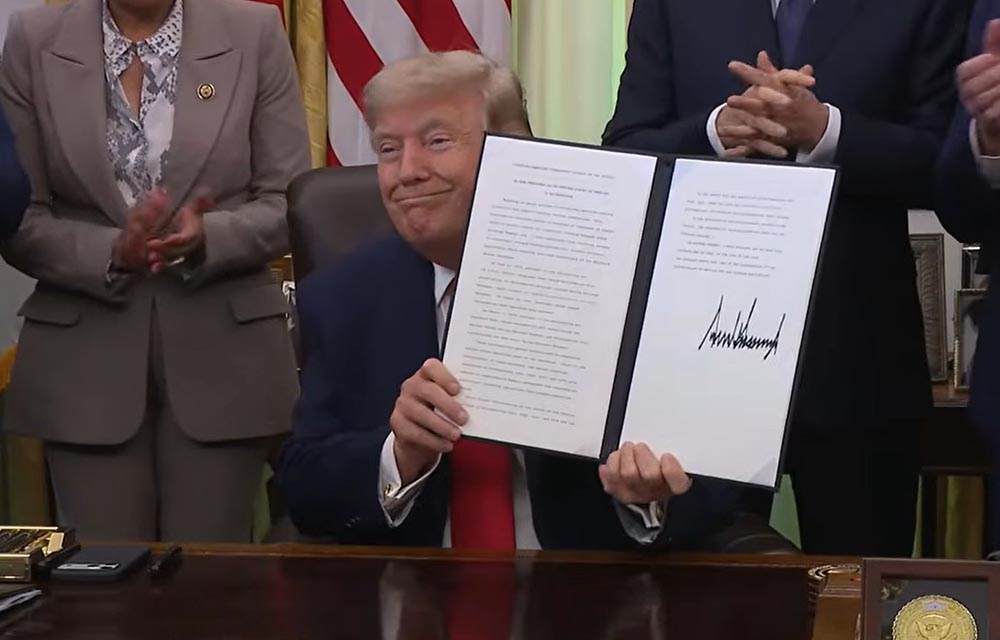
U.S. President Donald Trump issued a proclamation opening roughly 500,000 square miles of Pacific marine national monuments to commercial fishing, continuing his push to roll back protections unilaterally enacted by his predecessors.
“President Trump is once again delivering for American fishermen by opening prized Pacific fishing grounds with this Executive Proclamation,” U.S. Commerce Secretary Howard Lutnick said in a release. “By restoring commercial fishing in the remote Pacific, we are creating new economic opportunity for coastal communities and restoring U.S. seafood competitiveness.”
The 11 June executive order “Restoring American Commercial Fishing in the Pacific” expands commercial fishing access to the Islands Unit of the Mariana Trench Marine National Monument; the Mau Zone, Ho‘omalu Zone, and areas seaward of 50 nautical miles within the Papahānaumokuākea Marine National Monument; and between 12 and 50 nautical miles around the Rose Atoll in the Rose Atoll Marine National Monument.
“Restoring commercial fishing access to these vital areas reflects the continued commitment of this administration to American fisheries, which are built on the foundation of rigorous science, robust monitoring, strong enforcement, and the daily commitment of our dedicated fishermen,” NOAA Administrator Neil Jacobs said in a release. “This historic action will lead to more U.S.-caught fish on American tables.”
In his second term in office, Trump has pushed to restore fishing access within multiple national marine monuments. In April 2025, Trump issued a proclamation, titled “Unleashing American Commercial Fishing in the Pacific,” to open the Pacific Remote Islands Marine National Monument (PRIMNM) to commercial fishing, and in February 2026, he issued another proclamation reauthorizing commercial fishing within the Northeast Canyons and Seamounts Marine National Monument.
“In my First Term, I reversed the prohibitions placed on Commercial Fishing, but Joe Biden, or whoever was using the AUTOPEN, foolishly reinstated them,” Trump wrote on his social media site Truth Social following the second proclamation. “Since Day One, I have taken historic action to END these disastrous policies and today, I signed a Presidential Proclamation to UNLEASH Commercial Fishing in the Atlantic Ocean, advancing the America First Fishing Policy!”
The moves have been welcomed by commercial fishing groups who claim that the United States’ system for regulating fisheries can manage harvests sustainably and protect marine resources. The Western Pacific Fishery Management Council (WPFMC) has long complained about the impact of marine national monuments on the commercial fishing sector and has worked to enable commercial fishing in some protected areas. In March, the council recommended restoring commercial fishing access within 12 to 50 nautical miles at Rose Atoll and 0 to 50 nautical miles in the Marianas Trench Islands Unit. Following Trump’s latest proclamation, the council again declared its intention to expand fishing access.
“We are pleased that under the authority of the Magnusons-Stevens Act, the management of fishing in monument waters is returning to the fishery councils,” WPFMC Executive Director Kitty Simonds said in a release. “The Council is committed to continue working together with our fishing communities in American Samoa, Hawai‘i, and the Northern Mariana Islands to discuss and develop fishery management plans in these areas.”
Conservation groups were quick to denounce Trump’s executive order, which reversed years of conservation actions.
“The Trump administration is greenlighting harmful commercial fishing on some of the planet’s most pristine, biodiverse ocean ecosystems,” Sheila Sarhangi, executive director for the Pacific Islands Heritage and Papahānaumokuākea Coalitions, said in a release. “These areas have remained off-limits to commercial extraction for more than a decade because of bipartisan conservation action, community advocacy, and scientific research that show they are irreplaceable and need the highest levels of protection.”
Environmental NGO Earthjustice – which along with other NGOs successfully sued to block the initial reopening of commercial fishing in PRIMNM last year – questioned whether the reopenings would actually benefit the commercial fishing fleet and declared its intent to sue.
“Commercial fishing in our protected marine monuments would not only be disastrous for the environment but also does nothing for the fishing industry,” said David Henkin, deputy managing attorney with Earthjustice’s Mid-Pacific Office. “Without fishing in the monuments, U.S.-based fisheries hit their catch limits for tuna every year. Science-backed management for the benefit of current and future generations requires protected marine areas. Safe havens allow marine life to maintain healthy populations and prevent corporate greed from stripping the ocean of life. We’ll see the administration in Court.”
Earlier in June, U.S. Representative Aumua Amata Coleman Radewagen (R-American Samoa) introduced a bill that would bar presidents from using the Antiquities Act to ban commercial fishing within a marine national monument, ensuring that fishing activities are managed under the Magnuson-Stevens Act.
“The MSA, along with the Endangered Species Act, Marine Mammal Protection Act, and other applicable authorities, provides enforceable, adaptive, and science-based mechanisms sufficient to ensure the proper care and management of monument objects,” Petty said. “Moving forward, NOAA will continue to rely on the regional fishery management councils as critical advisors to ensure that fishing regulations are developed with local expertise and stakeholder input. By cutting red tape and prioritizing the MSA, we ensure our marine monuments support both a healthy environment and a thriving ocean economy.”
