






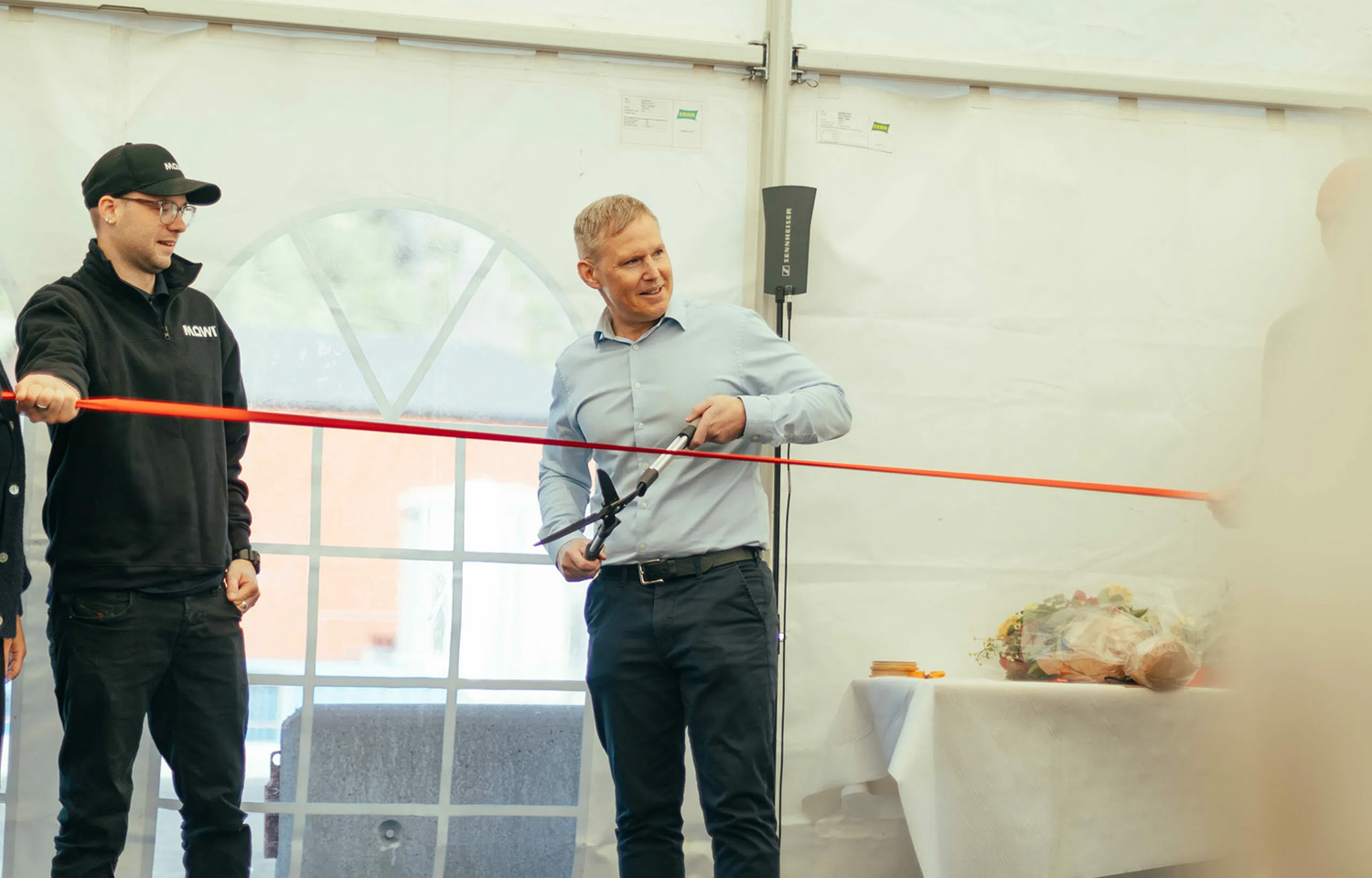
Bergen, Norway-based Mowi has opened a new post-smolt facility at its freshwater site in Haukå.
Mowi CEO Ivan Vindheim opened the facility, calling it “a large and strategically very important investment for Mowi. With this facility, we will be able to produce healthy and sustainable food in an even better and more efficient way.” The new facility represents a NOK 600 million (USD 58.7 million, EUR 52 million) investment and took several years of construction work, he said.
Mowi said continued investment in post-smolt facilities is central to its current strategy. Its new facility at Haukå is the third coompany has recently built on the Norwegian coast, and it still has four more are planned. When they are complete, the company’s total investment in the facilities will be NOK 2.2 billion (USD 215 million, EUR 191 million).
“Post-smolts are a key part of the work to improve survival, welfare and productivity in the company. By keeping the fish on land until they are larger, we get a more robust smolt that needs significantly less time at sea," Mowi Norway CEO Øyvind Oaland Oakland said. “Our calculations show that we can almost halve both mortality and the number of delousing by using post-smolt."
The new facility will produce 6.4 million post-smolts per year with an average weight of 700 grams; it will employ 11 to 25 people, including two apprentices.
Director of Mowi Region West Asgeir Hasund said that the new site is a symbol of growth for the company.
"With this facility, we are taking an important step forward – for the company, for the employees and for our entire district. This major investment creates new jobs, strengthens local value creation and contributes to a vibrant district," Hasund said.
Vindheim took the site’s opening as an opportunity to comment on new aquaculture regulations currently under consideration in Norway.
The proposed law is meant to address environmental and welfare issues that have come with the rapid development of the aquaculture sector into Norway’s second-largest export industry.
It proposes adjusting how maximum permitted biomass is managed at the company level, linking that number to the prevalence of sea lice on a given salmon farm.
Norwegian Minister of Fisheries and Oceans Marianne Siversten Næss explained that the thinking behind this proposal was that it would “become more profitable to operate with a low environmental impact” if the presence of sea lice created a direct cost for farmers.
At the Haukå site opening, Vindheim said the government’s proposal needed reconsideration.
“These days, politicians are sitting in the Storting and will consider the government’s proposal for new regulation of the aquaculture industry. This proposal will significantly reduce industry production, employment, and value creation, especially in Western Norway," Vindheim said. "I both believe and hope that the politicians understand that we as a nation cannot kick our feet under Norway’s most important regional industry and ask the government to develop new and better-studied proposals for future regulations.”
