






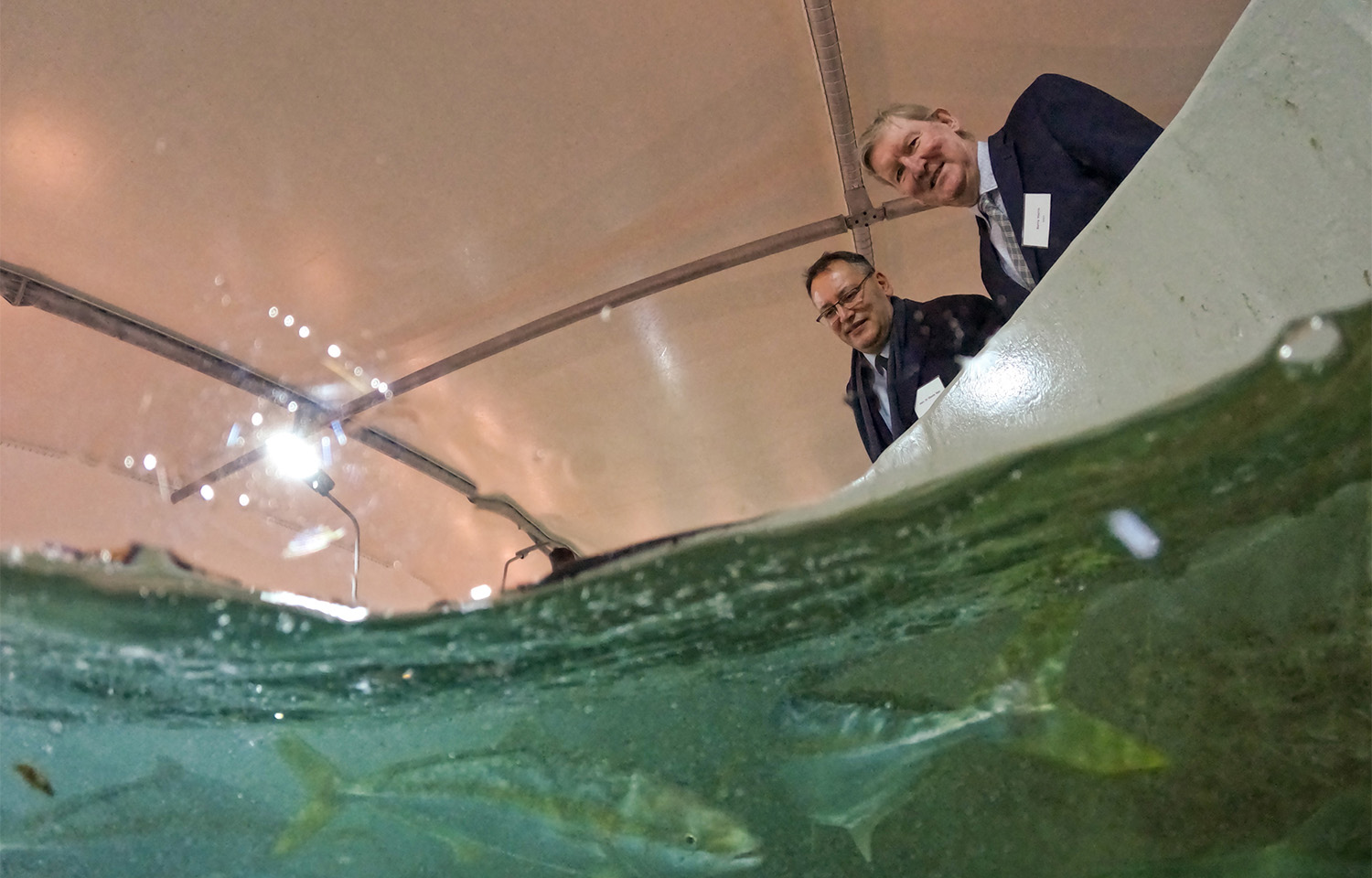
New Zealand’s National Institute of Water and Atmospheric Research (NIWA) has opened a land-based kingfish farm, calling it the first of its kind in the country.
The new kingfish farm is located in Ruakaka Northland and can produce up to 600 metric tons (MT) of kingfish each year, according to NIWA. The farm uses a land-based recirculating aquaculture system (RAS) to produce the fish and is the product of a joint venture between NIWA and the Northland Regional Council.
NIWA is a Crown Research Institute established in 1992, which, like other Crown Research Institutes, operates as a Crown-owned company that can operate independently to do scientific research on topics relevant to New Zealand. Ownership in the company is held between two ministers appointed by the New Zealand government, and management of the company is undertaken by a Crown-appointed board of directors.
NIWA Chief Executive John Morgan said the new farm was designed with introducing kingfish into the New Zealand market in mind.
“We saw a clear gap in the market for an on-land farm that produces commercial quantities of high-quality fish,” Morgan said in a release. “This new facility uses a recirculating aquaculture system, which offers superior environmental and economic performance, and full control over all aspects of production.”
Morgan said NIWA chose kingfish for its growth characteristics and its status as a premium species.
“Kingfish are known for their rapid growth and efficient conversion of feed to flesh. Our fish grow from a 1mm egg to a 3-kilogram, market-sized fish in less than 12 months,” Morgan said. “Our extensive research and experimentation has identified the conditions that maximize the health and welfare of the fish.”
The new farm will also help the economic development of the region it was built in. Ruakaka, located on New Zealand’s northern island, could become a hub for similar developments.
“Beyond the jobs created and revenue generated for our community, this venture has helped to put Northland on the map in terms of forward-thinking, environmentally friendly farming,” Northland Regional Council Chairman Geoff Crawford said. “It sets a great precedent, and we hope that the success of this venture will spark investment in larger RAS operations and unlock the economic growth potential of other marine species.”
Morgan said the new farm will also help New Zealand’s aquaculture industry reach its goal of NZD 3 billion (USD 1.8 billion, EUR 1.7 billion) in annual sales by 2035.
New Zealand set an aquaculture strategy in 2019 that set the NZD 3 billion goal, focusing on increasing the development of sustainable open ocean and land-based aquaculture operations. Part of its goal is to reduce the impacts of climate change by shifting to sustainable food production methods that reduce carbon emissions and take pressure off of natural ecosystems.
Land-based aquaculture operations were also a key part of New Zealand’s strategy – whether it be through fully commercial farms or land-based operations supporting marine aquaculture.
Morgan said the new farm is already establishing itself as a viable industry in the region.
“Chefs and local restaurant suppliers sing the praises of the quality of our kingfish, and we have had significant interest from the food sector and commercial partners,” he said.
