



The Newfoundland Aquaculture Industry Association (NAIA) and Cooke Inc. CEO Glenn Cooke are pushing back against a proposal for a new marine protected area (MPA) they both say will negatively impact the aquaculture and fisheries industries in the Canadian province.
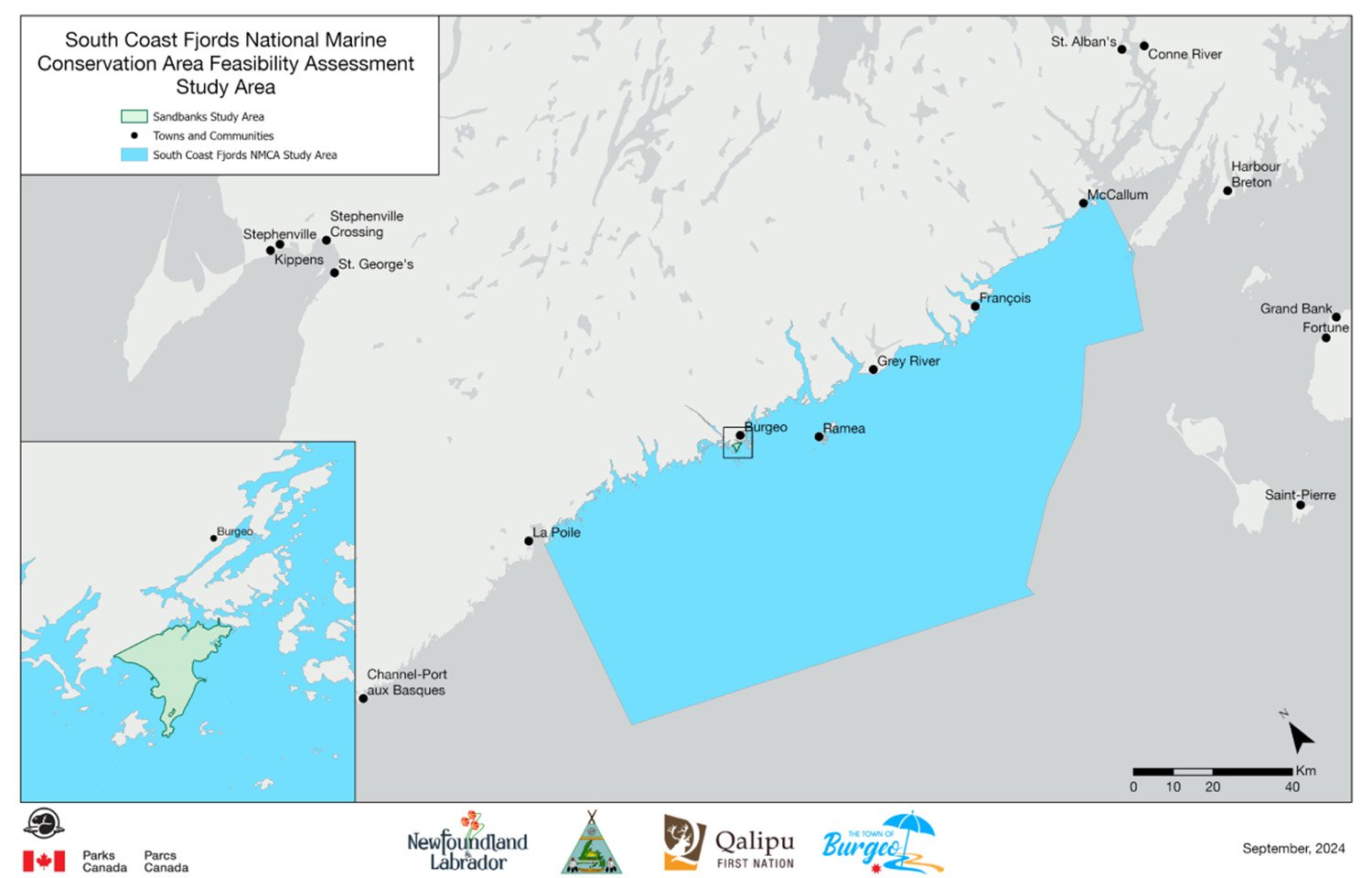
Canada’s federal government has proposed a new National Marine Conservation Area (NMCA) for the South Coast Fjords area, located on the southwest coast of the island of Newfoundland. The study for the new NMCA covers 9,112 square kilometers, and the feasibility of the project is currently being assessed by the government.
According to Parks Canada, the Canadian government, the government of Newfoundland and Labrador, the Miawpukek First Nation, the Qalipu First Nation, and the town of Burgeo signed a memorandum of understanding in June 2023 to begin assessing the feasibility of the new conservation area.
“This ecologically rich marine environment is a productive marine ecosystem and biodiversity hotspot,” Parks Canada said in a summary of its efforts. “It is amongst the most productive marine environments in Atlantic Canada and is home to the largest tides in Newfoundland.”
Conservation groups like the Atlantic Salmon Federation and The Pew Charitable Trusts have supported establishing the South Coast Fjords MPA as a means of protecting the environment and wildlife species that utilize the area, including 20 species of whales that migrate through the region, Atlantic cod, redfish, and leatherback sea turtles.
As the government continues to investigate the feasibility of the new conservation area, NAIA, Cooke, and some provincial officials have come out to oppose it on the grounds it would negatively impact multiple seafood industries in the region with dubious benefits for wildlife.
“Charting the best course for our marine environment should not come at the expense of the seafood industry and the livelihoods it supports; it doesn’t have to,” NAIA said in a release.
NAIA claimed that the proposal is being pushed through by “activists embedded within Park Canada” who haven’t established how the NMCA will impact fishing, aquaculture, and recreational activity in the area and will develop the site first and determine what’s allowed in it later – to the detriment of the seafood industry.
“The fact is that the NMCA in Gwaii Haanas, British Columbia, has restricted fishing in nearly half of the ocean area and completely restricted all commercial aquaculture,” NAIA said.
NAIA claimed that the proposal is also being pushed by outside lobbies like the Atlantic Salmon Federation (ASF) and the Ecology Action Centre – who won’t be affected by the economic impacts of bans to fishing and aquaculture.
“The Atlantic Salmon Federation is far from Atlantic Canadian – its major donors are wealthy Americans living in big U.S. cities,” NAIA said. “ASF hosts lavish New York City events and invests millions in political lobbying and sensational campaigns claiming the need for funds for wild salmon conservation projects.”
NAIA pointed out that according to Charity Intelligence Canda, ASF has received donations from individuals like Yvon Chouinard – the founder of Patagonia clothing. Patagonia has pushed petitions to ban salmon farming in Iceland, and Chouinard executive produced a feature-length documentary called “Artifishal” criticizing the salmon farming industry. He is also, according to NAIA, an investor in Nova Scotia land-based salmon farming company Sustainable Blue – which was placed into receivership after an equipment failure and the loss of salmon caused the company to fall short of paying its debts.
“The American chapter of ASF is sliding U.S. funds across the border to influence Ottawa politicians and negatively impact Newfoundland and Atlantic Canadian jobs and communities where ocean salmon farming has existed for decades,” NAIA said.
The association also said ASF’s financial statement indicates it spend just CAD 258,000 (USD 199,158, EUR 189,675) on wild salmon watersheds in all of Canada.
ASF refused to provide details when asked last week for a list and expense amount of their 2023 research and conservation programs in each Atlantic Canadian province, according to NAIA.
“The reality is that they are fundraising off the backs of hard-working Atlanic Canadians in the seafood industry while spending very little on actual wild salmon conservation projects in Newfoundland and Atlantic Canada," NAIA said.
On top of what NAIA called “devious” activities by NGOs like ASF, Cooke said the new NMCA would also represent a sharp increase in authority for Canada’s federal government. Currently, the waters that would be covered under the new protected area are governed by provincial regulations, not federal ones. Ceding the waters to federal authorities, he said, would give Canada’s Department of Fisheries and Oceans, Transport Canada, Parks Canada, and Environment and Climate Change Canada more power over the area and override any provincial decisions.
“This initiative, spearheaded by Environment and Climate Change Canada (ECCC), Parks Canada, and the Department of Fisheries & Oceans, represents an alarming overreach of federal jurisdiction into waters currently under the jurisdiction of the province and will have severe consequences for local rural coastal communities and economy,” Cooke wrote in a letter to Newfoundland Premier Andrew Furey.
Cooke argued the NMCA would be an ineffective way to protect species amid changes to the climate and would hamper sustainable fisheries and aquaculture management.
“As a seafood company with local and global fishing and aquaculture interests, it is clear that shifts in the distribution of fish stocks and changing marine conditions, including severe weather events, mean that the most responsible way to have a sustainable seafood industry is to provide harvesters and aquaculture producers with flexibility to conduct their work in multiple areas with conservation objectives and regulatory oversight guiding operations,” Cooke said.
