



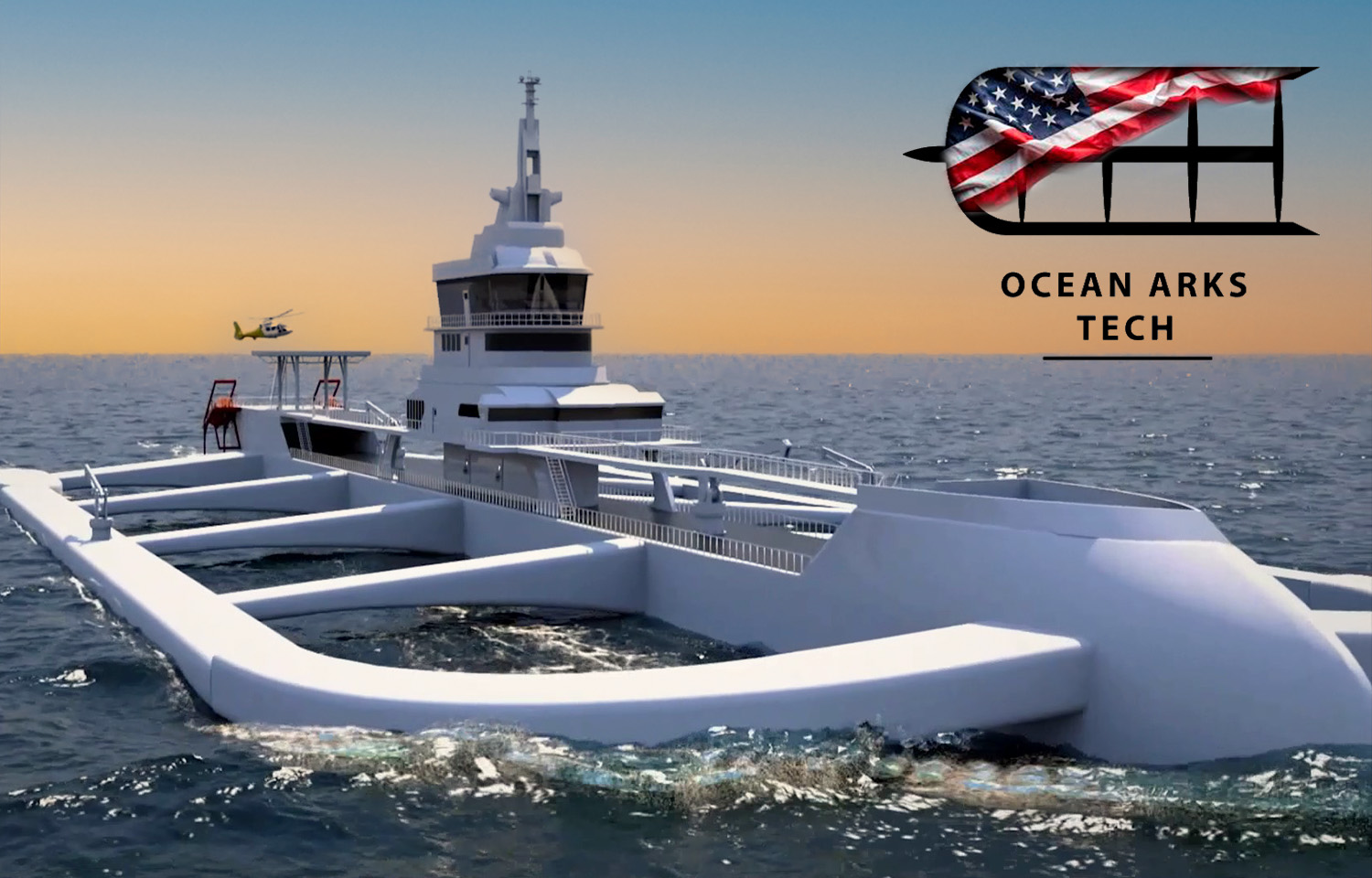
The United States Patent and Trademark Office (USPTO) has granted a patent to Chilean firm Ocean Arks Tech for its project to design a “superyacht” to develop aquaculture operations in the deep sea.
The company said it gained the patent on 31 December 2024 when the USPTO awarded it an invention patent following “six years of rigorous patent proceedings in the United States.”
Ocean Arks Tech said that the award marks it as “[one of] the few companies worldwide with patented technology of this scale for aquaculture and, potentially, as the first in Patagonia's history to achieve such recognition.”
“Our next steps are to build a prototype and globalize the technology,” Ocean Arks Tech Founder and Director Rodrigo Sanchez told SeafoodSource.
Ocean Ark Tech’s prototype is in part a response to criticisms of traditional aquaculture methods, including that waste from fish-farming operations harms the seabed and that fish can be kept under poor conditions.
The firm proposes transferring aquaculture farms to huge oceanic aquaculture vessels that can remain far offshore – avoiding any impact to one area – while addressing industry challenges such as sustainability and scalability.
The patent award is for a mobile farm constituting a central structure similar to a ship’s hull, which can be either self-propelled, towed, or pushed.
According to the patent abstract, the structure will also have the ability to alter its draught and the ability to change its containment volume to allow for individual or collective hoisting of the section fish are raised in.
Ocean Arks Tech’s concept vessel measures 550 feet by 197 feet, boasts a heliport, and is specifically designed to operate offshore in waves up to 7 meters in height, allowing for repositioning to optimize farming conditions.
The vessel can operate fully autonomously for up to 25 days, with harvesting of up to 3,900 metric tons conducted by a wellboat across eight mesh cages of 115-foot width, or four cages of 210-foot width, with each cage measuring 115 feet long and 66 feet deep.
“Think of it as an oil rig,” Sanchez previously told SeafoodSource. “We are going to have the ship far from the coast, and the crew, together with supplies such as fish feed, are transported to the vessel via boats; the transport of juveniles would be loaded onto the vessel by wellboat; and the harvest is brought back to shore via wellboats.”
According to Sanchez, the ship also has low-carbon emissions as its engines are to be used solely to position the vessel in the best place for the fish in terms of water quality, temperature, and oxygen.
The possibility of bringing production closer to the place of consumption will also significantly cut down on emissions when compared to existing modes of product transportation, he noted at the time.
While the new system constitutes a major facility, Sanchez said it is fairly cost-efficient compared to existing land-based or traditional aquaculture – especially when considering expensive licenses and permitting needed for stationary structures.
The facility will aims to keep fish in the best water conditions possible for the species it is raising, helping to guarantee their well-being, health, and survival – which Sanchez said will hopefully reduce the need for antibiotics.
Sanchez said the patent approval process “was a long and complex journey.”
“Our process started even earlier, but we faced significant obstacles along the way,” Sanchez said. “Initially, we encountered challenges with deadlines during the international phase and, later, had to completely reformulate the application with the support of new advisors just to have a chance. The larger the invention, the more preexisting patents you encounter, especially in the United States, the country with the most patent filings in the world.”
The company said that it now holds valuable intellectual property that positions it to enter into the U.S. – giving it direct access to one of the world’s most significant seafood markets and, potentially, the most promising aquaculture market in the Americas.
“This achievement not only solidifies the company’s leadership in innovative aquaculture solutions but also paves the way for transformative opportunities in sustainable seafood production worldwide,” Sanchez said.
