



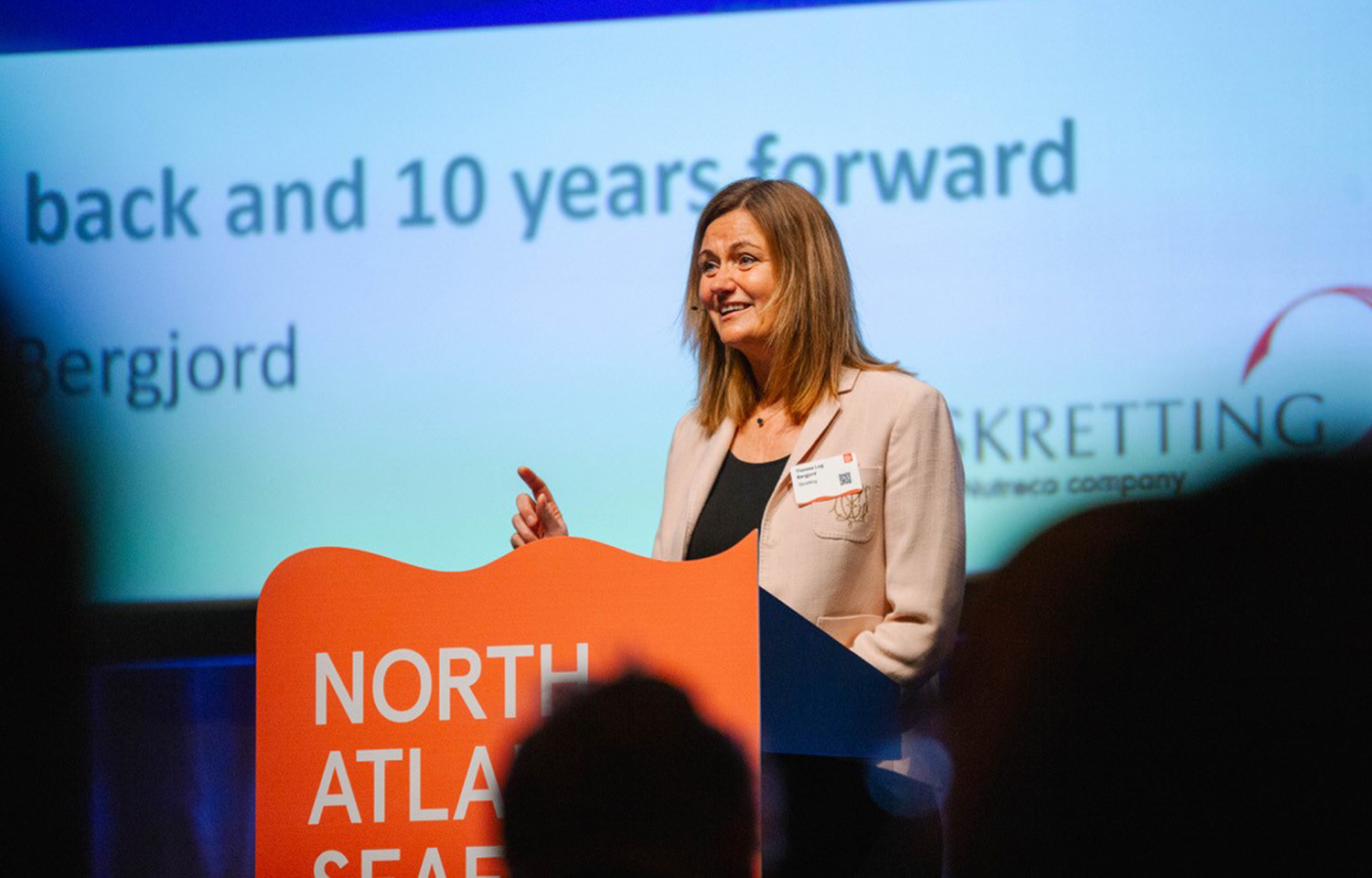
Norwegian salmon feed prices have exploded over the past decade, and if the problem has any chance of abating, self-imposed restrictions around marine ingredient replacements need to be removed, according to Skretting CEO Therese Log Bergjord.
Speaking at the North Atlantic Seafood Forum (NASF) 2024 in Bergen, Norway, Bergjord urged the entire supply chain to work together to “break the curve” and take action to both control unchecked price increases and reduce the industry’s dependency on traditional fishmeal.
Norway’s feed costs have risen 80 percent over the past decade, which is partly attributable to currency factors, Bergjord said, such as the weakening of the Norwegian kroner. What makes that a difficult pill to swallow – especially for Bergjord, as salmon farming comprises around 35 percent of her business – is the fact that there are limitations placed on alternative ingredients, such as hesitation related to justifying their use in supply chains.
“Our, to a large degree, self-imposed restrictions have not helped us increase raw material flexibility and keep costs down. Fishmeal is still used today in Norway,” she said. “We, as an industry, have a great opportunity. Salmon is a high-value product. There’s money in the value chain, and I would say it’s our duty to manage the increasing pressure on nature. We must accept and apply the best technology and science that’s available and not drag our feet into the future. Let’s make educated decisions and tell our story well.”
Meanwhile, the world’s second-largest salmon-producing nation – Chile, where Skretting also operates – has done a much better job ensuring feed costs don’t overwhelm producers, Bergjord highlighted.
Feed costs have increased by only 20 percent in the South American country over the same time frame, and these manageable price increases have occurred in tandem with raw material flexibility, as animal and vegetable protein have seamlessly replaced fishmeal on a large scale, according to the Skretting head.
At the same time, the carbon footprint of Chilean feed production has decreased 15 percent, Bergjord said.
Bergjord is particularly discouraged that [genetically modified] soy, land animal proteins, palm oils, and more potential alternatives are not being used at large in the Norwegian industry.
“These are low-hanging fruits to reduce feed costs without impacting performance. They are safe; their efficiency has been proven with good results,” she said.
In tandem with cost increases, the industry now experiences more health problems than it did a decade ago, according to Bergjord, with the key KPI for most companies at the time being growth rather than sustainability.
As such, Skretting’s main research and development focus was on reducing its dependency on ingredients that it believed would be limited in the future – a task that has only gotten harder, she said.
“Back in 2013, the industry was partly independent of marine ingredients. We have reduced the amount of fishmeal that we use by about 50 percent, and fish oil has been partially replaced by vegetable oils, mainly rapeseed oil. I remember reading about vegetarian fish – it was among the main media stories back then,” she said.
While it’s difficult to forecast what the industry will be talking about in another 10 years’ time, it’s clear it will need more flexibility and resilience, she told the attendees at NASF.
