




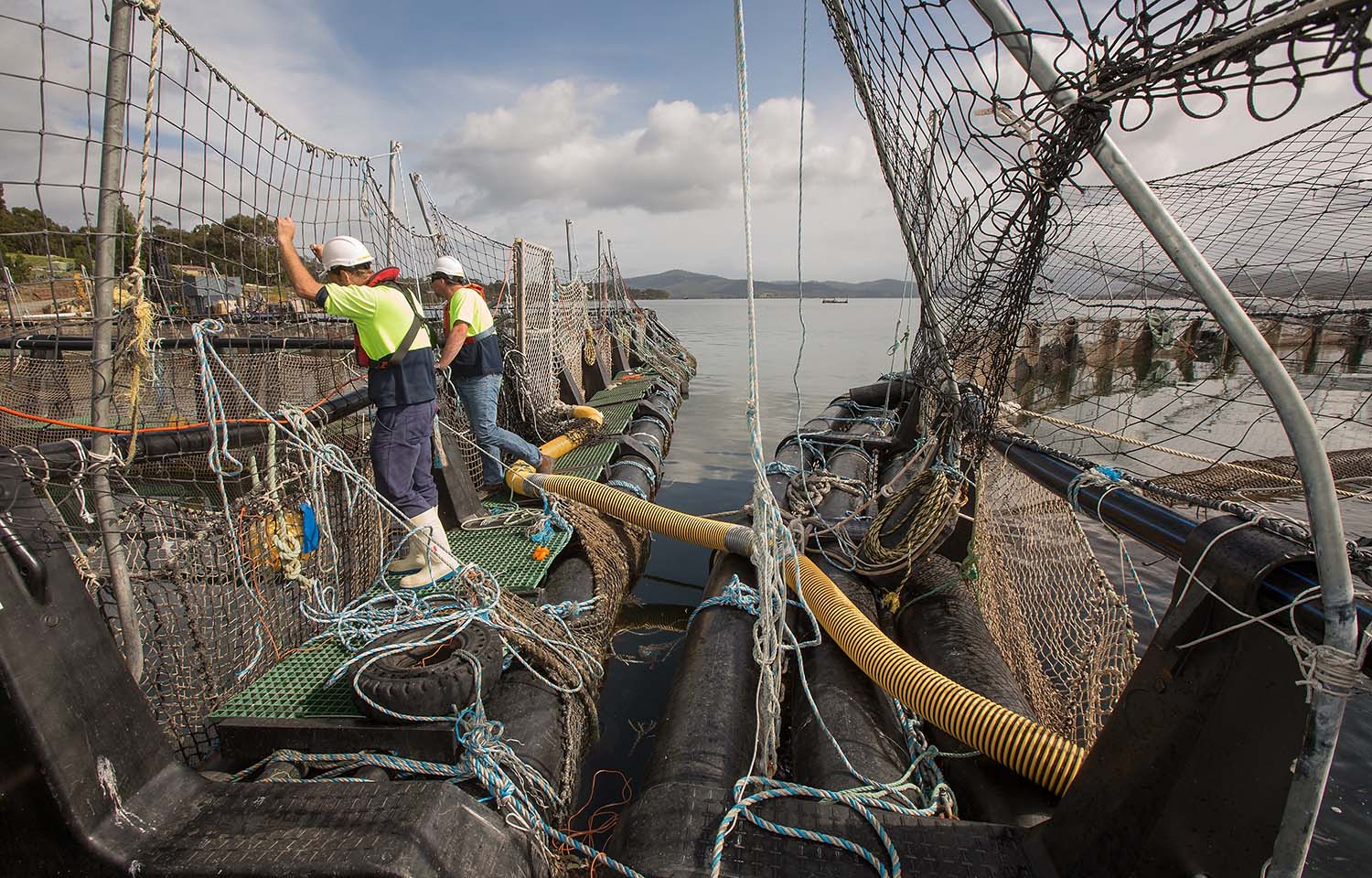
The government of Tasmania is launching an independent review of salmon farming in the Australian state, garnering mixed reactions from NGOs and sharp condemnation from the industry.
Tasmania Premier Jeremy Rockliff announced the independent review alongside a pause on all salmon farming expansion. The order comes after the Tasmanian salmon industry faced unprecedented mortalities due to RLO, or Rickettsia-like organisms.
Rockliff announced the pause on 17 August and said the review was intended to ensure the industry is operating transparently and responsibly, ABC Australia reported.
The announcement has been met with mixed reactions from environmental NGOs opposed to salmon farming in the state, as well as strong condemnation from the salmon industry, which said the decision walks back promises Rockliff made just last month.
Salmon Tasmania, a group representing the state’s salmon-farming industry, issued a release claiming Rockliff’s pause and review goes back on his own written commitments to the industry – and that the implications could affect more industries than salmon farming.
“The Premier’s announcement today will send a loud caution to any company in any sector that invests or is looking to invest in Tasmania,” Salmon Tasmania CEO John Whittington said in a release. “The Premier has let down the salmon aquaculture industry – strangling growth, guaranteeing a whole host of new red tape, and significantly undermining confidence and investment.”
Salmon Tasmania cited a letter that Rockliff sent directly to the organization on 2 July, in which he said that “there is no stronger supporter” for the industry than Tasmania’s liberal party – of which Rockliff is a member.
“This industry benefits so many Tasmanians and has become such an integral part of our brand, economy, and community,” Rockliff wrote at the time. “We want to see your industry continue to sustainably grow, innovate, and remain a key economic driver for Tasmania.”
Rockliff’s decision to pause any expansion and engage in an independent review runs directly counter to that letter, Whittington said.
“Many salmon workers trusted the Liberals with their valuable vote, only to be completely betrayed just six weeks later,” he said. “The Premier’s word has proven worthless.”
The Australian Workers’ Union (AWU) also pushed back against the pause, saying it jeopardizes the livelihoods of thousands of Tasmanians.
"The Premier has gone back on his word and commitments to every salmon worker who trusted the Liberals with their valuable vote,” AWU Tasmania Secretary Ian Wakefield said in a release. “He literally signed a letter on July 2 promising not to trade the salmon industry 'in any way, shape, or form' to retain government. Six weeks later, he's done exactly that. His word is worthless.”
While the salmon industry pushes back against the review, environmental NGOs have had more mixed reactions. Environment Tasmania welcomed the announcement, calling it a welcome step to ensure the industry is aligned with the standards of other Australian states.
“A holistic approach which centers around ecosystem health has been very much needed, and this takes us with enormous strides in the right direction,” Environment Tasmania Senior Marine Campaigner Rebecca Howarth said in a release. “We thank the premier for listening to the community who have been calling for a Marine Plan and marine law reform for Tasmania, and we look forward to working together to ensure Tasmania’s marine ecosystems get the priority and protection they need.”
Not every environmental NGO was in favor of the review, however.
Neighbors of Fish Farming (NOFF), an NGO that has accused the Tasmanian salmon industry of greenwashing its products and has been a driving force behind shareholder actions against Woolworths over selling Tasmanian salmon, said the review is a “farce.”
“We know what needs to be done; we do not need yet another inquiry,” NOFF President Lisa Litjens said.
Litjens claimed similar reviews in the past resulted in no changes and that the review does not contain enough specifics to create any meaningful changes to the salmon farming industry.
“It is time for clear and concise action, not more empty promises delivering nothing but well-wrapped delays on real and permanent action," NOFF Campaigner Jess Coughlan said.
