


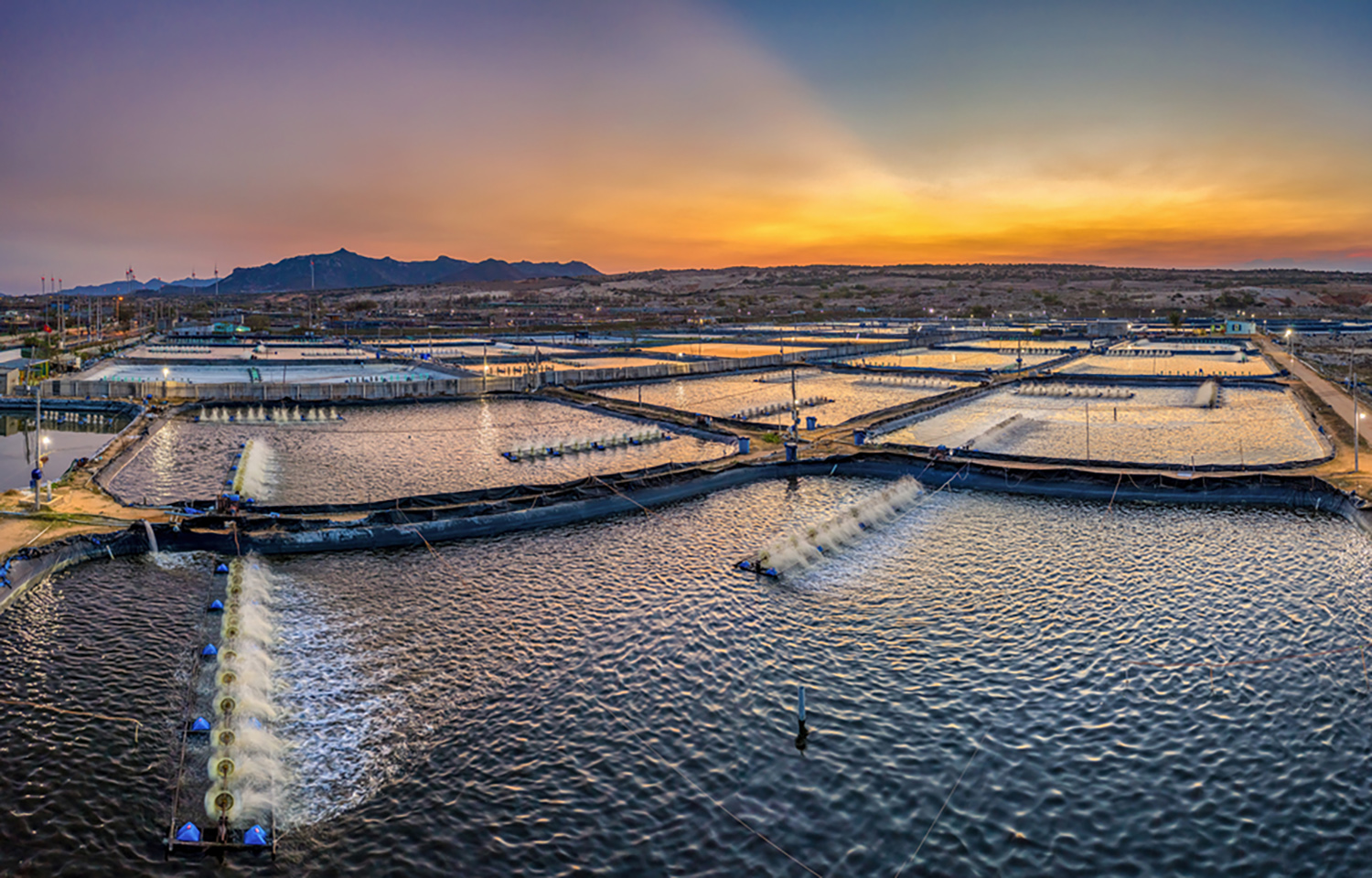
The Vietnam Association of Seafood Exporters and Producers (VASEP) is seeking support from the Vietnamese government to expand high-tech shrimp farming in the Southeast Asian nation.
High-tech shrimp farming models are not new to Vietnam, with companies such as Taiwan’s Grobest, Thailand’s CPF, and Norway’s Skretting having introduced proprietary systems into Vietnam in recent years.
Vietnamese shrimp firm Minh Phu Seafood has also developed its own farming model, dubbed MPBio, which draws on expertise gathered from over 50 shrimp-farming technologies worldwide.
Minh Phu CEO Le Van Quang told SeafoodSource that Minh Phu has implemented the MPBio model across a combined farming area of 900 hectares and is exploring additional sustainable methods to further cut production costs. However, scaling up these advanced farming models requires substantial land resources, and the company believes government support is essential to enable large-scale adoption.
VASEP General Secretary Nguyen Hoai Nam has echoed Quang’s view, saying that with stronger government backing, the shrimp industry across the nation, not just leading firms, could harness advanced technology to exceed its current annual revenue of around USD 4 billion (EUR 3.4 billion).
In response to VASEP’s call, Vietnam Deputy Minister of Agriculture Nguyen Hoang Hiep said his ministry is spearheading a series of reform proposals aimed at overhauling land management and utilization in the country’s agricultural sector. As part of the effort, the ministry is considering the conversion of around 500,000 hectares of low-efficiency rice land to other productive uses, including aquaculture, to unlock new growth opportunities.
“We welcome news that the National Assembly plans to amend the Land Law and the Planning Law; this presents a key opportunity to unlock land for high-tech shrimp farming, generate employment, and boost foreign currency earnings,” Nam said at the Vietnam Economic Growth Forum on 10 July.
To ensure these changes can actually come to fruition, VASEP is also calling for improved financing.
The trade group estimates that with an investment of around VND 2 billion (USD 76,570, EUR 65,490) per hectare, farms can generate up to VND 3 billion (USD 114,850, EUR 98,230) in annual revenue per hectare under normal conditions. If scaled to 100,000 hectares, for example, the sector could make a substantial contribution to Vietnam’s gross domestic product growth. To unlock this potential, VASEP is asking for preferential annual interest rates of 2 percent for the first three years and 5 percent over the nationwide project’s lifecycle, alongside regulatory reforms to ease restrictions on land use.
In addition to promoting high-tech farming, VASEP is urging the nation’s government to offer support in expanding export markets, especially amid ongoing trade disruptions.
The U.S. Department of Commerce (DOC) recently released preliminary findings and decisions that determined duties on certain Vietnamese shrimp firms. The DOC determined that sales conducted by Soc Trang Seafood Joint Stock Company (Stapimex) of certain frozen warmwater shrimp in the U.S. were finalized at below the “normal value” of sales in Vietnam. As a result, Stapimex will be hit with a 35.29 percent dumping margin, as will 22 other companies shipping to the U.S. market.
Nam said that VASEP is concerned about the unusually high tax rate, suggesting it may be due to calculation errors.
A bigger problem, though, according to Nam, is that the U.S. is not accepting any more submissions from Vietnam, meaning that even complete and transparent data won’t be considered.
“They’re not accepting our submissions,” Nam said. “Even though our data is clear and complete, they won’t review it. That means we’ll get a poor score.”
He said VASEP has sent two letters on this issue to the Vietnamese government, asking for urgent support.
“We really hope the government can step in and officially ask the U.S. to reconsider,” he said.
In the first five months of 2025, Vietnam exported shrimp worth USD 1.7 billion (EUR 1.5 billion) to markets around the globe, marking an increase of 32 percent year over year.
The top destinations for Vietnamese shrimp in the period included China, as well as Hong Kong, which bought USD 494 million (EUR 422.4 million), soaring 90 percent year over year; countries under the Comprehensive and Progressive Agreement for Trans-Pacific Partnership (CPTPP), which bought USD 472 million (EUR 403.6 million) worth of Vietnamese shrimp, marking an increase of 37 percent year over year; the U.S., which bought USD 294 million (EUR 251.4 million), representing a surge of nearly 29 percent year over year; the E.U., which bought USD 202 million (EUR 172.7 million), marking a spike of 22 percent year over year; and South Korea, which bought USD 140 million (EUR 120 million), an increase of 13 percent year over year, VASEP said in June.
