






Norway-based aquaculture technology firm AKVA group held its latest Capital Markets Day on 12 June, at which the company confirmed it has set a revenue target of NOK 5 billion (USD 501.1 million, EUR 432.2 million) for 2027 alongside an EBIT margin of 9 percent.
Of its three business segments, the firm expects most growth to come from its Land Based division, in which the target is to more than double revenue from the NOK 600 million (USD 60.1 million, EUR 51.9 million) earned in 2024 to NOK 1.4 billion (USD 140.3 million, EUR 121 million) in 2027. The target for the Digital segment is to grow revenue from NOK 137 million (USD 13.7 million, EUR 11.8 million) to around NOK 250 million (USD 25.1 million, EUR 21.6 million), and the target for its Sea Based business is to grow its revenues from NOK 2.8 billion (USD 280.6 million, EUR 242 million) to NOK 3.4 billion (USD 340.8 million, EUR 293.9 million) in 2027.
“We were reasonably pleased with last year’s performance, but now we need to look for growth because we have invested a lot and have capacity for more activity than we saw last year. That's why the 2027 target revenue is NOK 5 billion, which happened to be the same 12 percent growth [seen in] 2024, and we think that's realistic,” AKVA CEO Knut Nesse said during the firm’s Capital Markets Day. “We have relatively good visibility through our order backlog, in particular on Land Based, which we expect most of the growth to come from. We have good visibility on the activity level all the way to 2027, but of course, we need to land a few more contracts; we think that can happen. We also expect continuous focus on deep farming and our digital applications. In combination, that's going to give us the NOK 5 billion.”
Even longer term, AKVA has ambitions to reach NOK 7 billion (USD 701.5 million, EUR 605 million) in revenue by 2030 and an EBIT margin of more than 10 percent as it aims to capitalize on the salmon-farming industry’s increasing need for new innovation and technology.
The 2030 revenue goal, if achieved, would be double last year’s NOK 3.5 billion (USD 350.1 million, EUR 302.5 million).
Though AKVA has set ambitious growth targets, Nesse noted that “industry barriers” and other factors are limiting growth in the global salmon-farming industry and, therefore, need to be taken into consideration when making projections.
“It has to do with fish health. We have seen more mortality. We have seen more diseases. Those, next to regulat[ory] systems, which are today blocking the big growth, both in Norway and Chile, have been [impacting] our social license. The agreement between the industry and the society at large has not been favorable either, and some of that criticism is, of course, absolutely valid,” he said. “However, being in this industry for 30 years, I still believe the consumption of salmon represents a megatrend on the back of the rising middle class in the world and on the back of the sushi/sashimi trend. It’s easy to cook and easy to prepare … that will continue the growth.”
AKVA’s goals are still possible, Nesse said, if the salmon-farming industry is able to double its production by 2040.
“That's 5 percent annual growth, and that's what most analysts believe is the consensus of how much growth consumers can absorb. We believe that could happen, but it needs to be on the back of new technology to overcome the industry barriers. That takes investments,” he said.
In Norway in particular, the salmon industry is awaiting a new whitepaper, Nesse said, and while it will take some time before this is “hammered out” into new aquaculture regulations, the hope is that it will result in a new regulatory framework that includes predictable policies concerning the environment, regulatory efficiency, and trust-based collaboration.
“We think if that is the outcome, we will be back in a better situation,” he said.
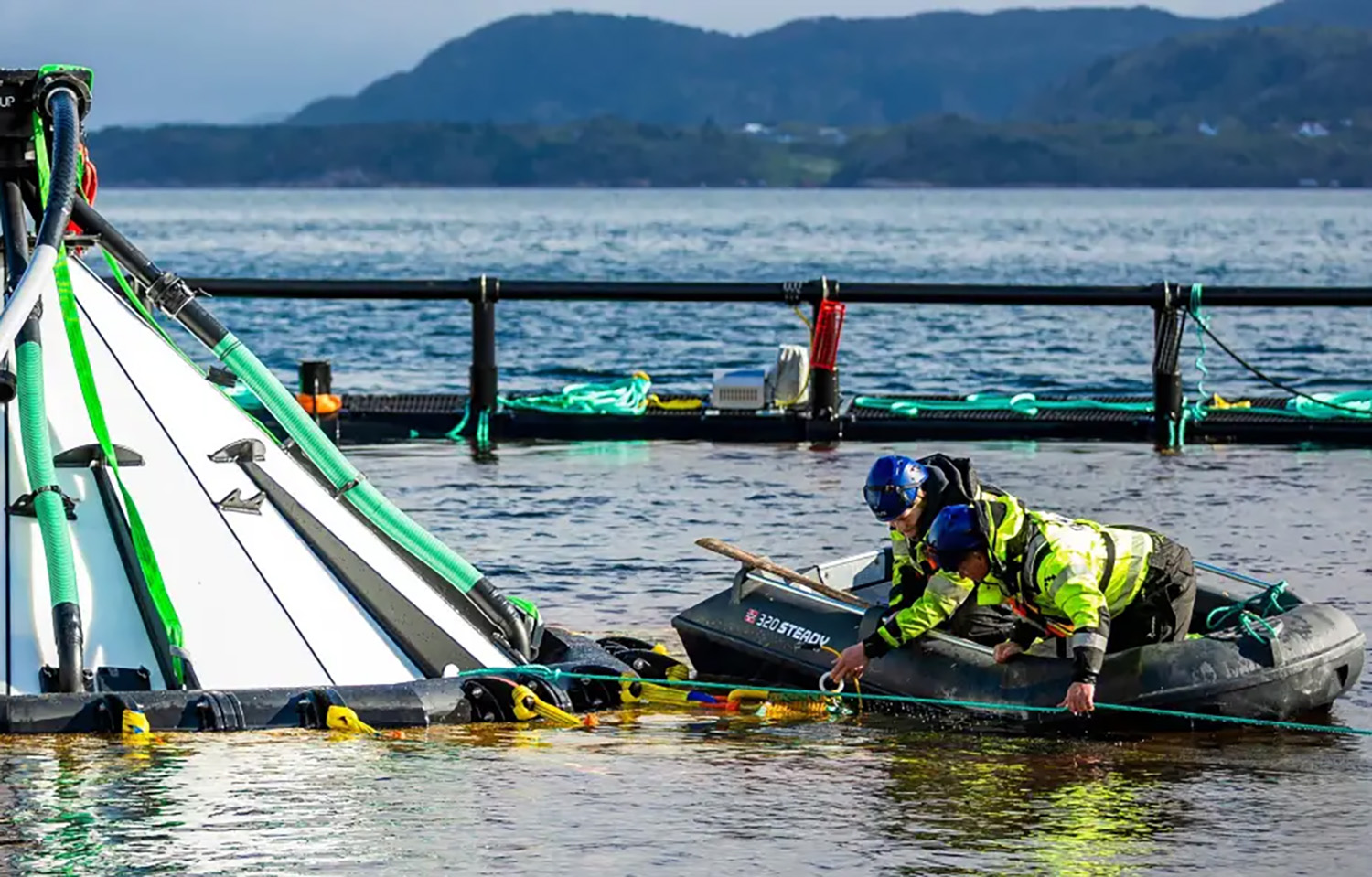
Besides better regulatory frameworks, Nesse also said that over the next 15 years, innovations like deep farming have the potential to add around 15 percent capacity, or 500,000 metric tons (MT) of production, from existing licenses, mainly by reducing lice and lowering mortality. Other innovations like post-smolt could add 30 percent to 35 percent, or 1 million MT, to current production volumes by improving biomass yield and also reducing mortality. Additionally, land-based grow-out technology is beginning to gain traction and has the long-term potential to deliver upward of 500,000 MT, he said.
“We believe that technology can be used for improved fish health, and this is our most important ESG contribution,” Nesse said. “If you can significantly reduce mortality by applying new technologies, you are part of the solution. We think the industry will come back to growth again.”
